
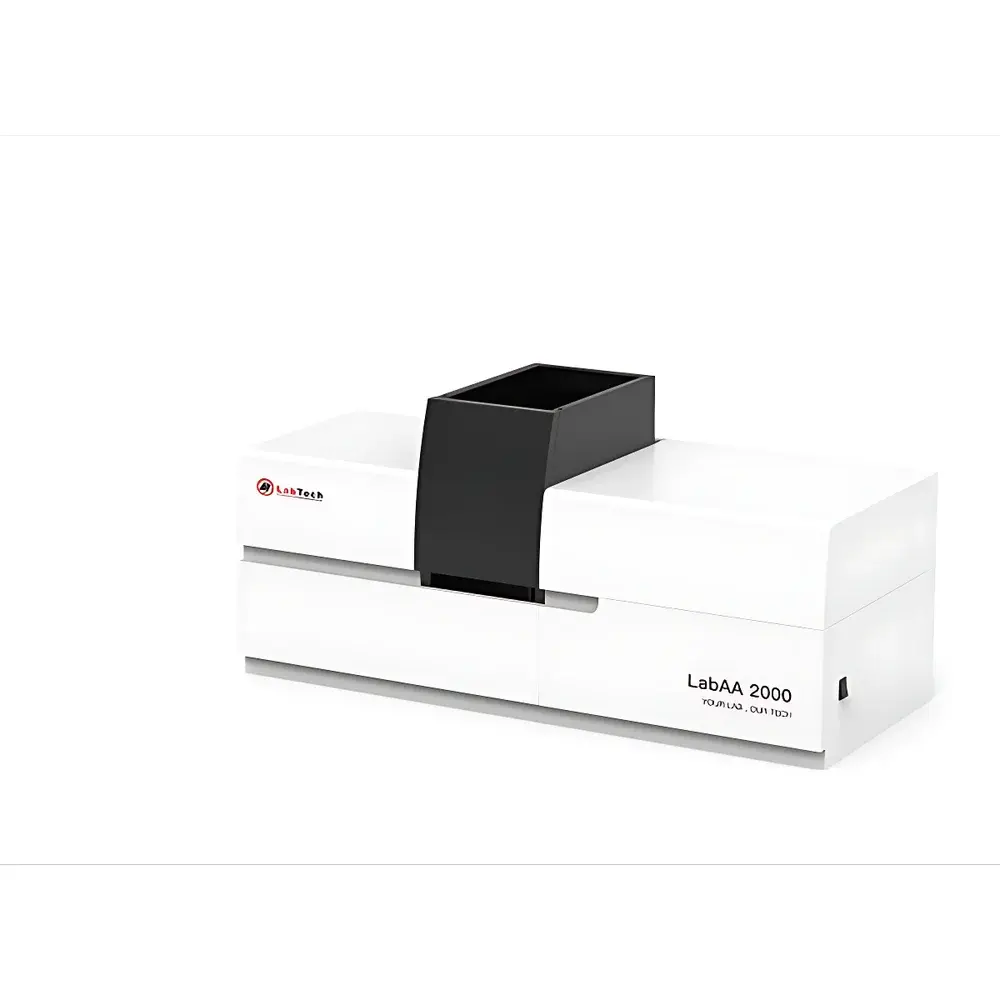
LabTech LabAA 2000 Flame and Graphite Furnace Atomic Absorption Spectrometer
| Brand | LabTech |
|---|---|
| Origin | Beijing, China |
| Manufacturer Type | Direct Manufacturer |
| Instrument Type | Flame and Graphite Furnace AAS |
| Model | LabAA 2000 |
| Monochromator | Plane Grating |
| Optical System | Single-Beam |
| Detector | Solid-State Detector |
| Background Correction | D₂ Lamp + Self-Absorption Method |
| Resolution | Mn Doublet (279.5–279.8 nm), Valley-to-Peak Ratio ≤30% at 279.5 nm |
| Sensitivity | Flame Mode — Cu Characteristic Concentration ≤0.035 mg/L |
| Precision (RSD) | Flame Cu (2 ppm) ≤1.0% |
| Detection Limits | Flame — sub-ppb to ppm range |
| Baseline Stability | ≤±0.003 Abs over 30 min at Cu 324.8 nm |
Overview
The LabTech LabAA 2000 is a dual-mode atomic absorption spectrometer engineered for high-precision elemental quantification in diverse sample matrices. It integrates flame atomization and electrothermal graphite furnace atomization within a single platform, enabling seamless transition between rapid routine analysis and ultra-trace detection. The instrument operates on the fundamental principle of atomic absorption spectroscopy: ground-state free atoms in the gaseous phase absorb light at element-specific wavelengths emitted by hollow cathode lamps. Absorbance is measured according to the Beer–Lambert law, providing quantitative results traceable to primary standards. Designed for laboratories requiring regulatory compliance and method flexibility, the LabAA 2000 supports both EPA, ISO, and ASTM standard methods—including ISO 11885, ASTM D1688, and EPA Method 7000B—for metals analysis in environmental, clinical, food, and industrial samples.
Key Features
- Dual-atomization architecture with fully automated switching between flame and graphite furnace modes—no manual reconfiguration required.
- Modular 8-lamp turret with independent lamp positioning control; user-selectable working/pre-heating lamps ensure optimal spectral output stability and extended lamp lifetime.
- Full-reflection optical path with achromatic design across 190–900 nm, minimizing chromatic aberration and maximizing signal-to-noise ratio.
- Automated wavelength scanning and peak search algorithms accelerate method setup and reduce operator dependency.
- Integrated background correction using both deuterium arc lamp and self-absorption techniques—enabling accurate compensation for structured and non-structured background interference in complex matrices such as soil digests or biological fluids.
- Titanium alloy burner head ensures uniform flame geometry, rapid thermal equilibration, and corrosion resistance against aggressive acid mixtures (e.g., HNO₃/HF).
- Graphite furnace with constant-power temperature control delivers precise, reproducible ramping profiles and uniform radial/axial heating—critical for minimizing analyte loss and matrix effects.
- Comprehensive safety architecture: real-time acetylene pressure monitoring, flame-out detection, coolant flow verification, and automatic gas shutoff upon anomaly detection.
Sample Compatibility & Compliance
The LabAA 2000 accommodates liquid samples (aqueous, organic, and acid-digested), suspended particulates (after filtration or centrifugation), and solid micro-samples via direct solid sampling accessories (optional). Its dual-atomization capability extends dynamic linear range from ng/mL (flame) to pg/mL (graphite furnace), supporting applications from drinking water compliance (EPA 200.7, ISO 17294-2) to occupational hygiene monitoring (NIOSH 7300). The system complies with GLP and GMP requirements through hardware-enforced audit trails, electronic signature support, and full adherence to FDA 21 CFR Part 11 data integrity specifications—including role-based access control, immutable log files, and time-stamped event recording.
Software & Data Management
The proprietary LabAA Control Suite provides intuitive workflow-driven operation—from method creation and calibration curve generation to QC flagging and report export. All analytical sequences are stored with metadata (operator ID, timestamp, instrument parameters, lamp history), ensuring full traceability. Data export formats include CSV, PDF, and XML for LIMS integration. Audit trail logs record every parameter change, result modification, or user login, satisfying regulatory review requirements. Software validation documentation (IQ/OQ/PQ protocols) is available upon request for laboratory accreditation purposes.
Applications
- Environmental testing: quantification of Pb, Cd, Cr, As, Ni, Zn, Cu in wastewater, leachates, and soil extracts per ISO 11885 and EPA SW-846 Methods.
- Clinical and toxicology labs: measurement of essential (Fe, Zn, Cu) and toxic (Pb, Cd, Al) elements in whole blood, serum, and urine.
- Food safety: determination of mineral nutrients and heavy metal contaminants in infant formula, cereals, seafood, and dietary supplements (AOAC 984.27, ISO 11171).
- Pharmaceutical quality control: elemental impurity screening in APIs and excipients per ICH Q3D guidelines.
- Geological and metallurgical analysis: multi-element assays in ore concentrates, slags, and alloys following ASTM E1019 and ISO 11885.
FAQ
Does the LabAA 2000 support hydride generation or cold vapor techniques?
No—the LabAA 2000 is configured exclusively for flame and graphite furnace atomization. Hydride generation and cold vapor modules are not integrated but may be supported via third-party peripherals under validated conditions.
Is the graphite furnace autosampler included as standard equipment?
The LabAA 2000 supports optional integration with a programmable autosampler (model AS-2000); it is not supplied as standard but is factory-certified for compatibility and performance validation.
Can the software generate reports compliant with ISO/IEC 17025 requirements?
Yes—report templates include uncertainty estimation fields, calibration verification records, and instrument performance logs aligned with ISO/IEC 17025 Clause 7.7 and ILAC-G8:2021 guidance.
What maintenance intervals are recommended for the D₂ lamp and graphite tubes?
D₂ lamps typically require replacement after 500–800 hours of use; graphite tubes vary by matrix but average 200–500 firings under optimized temperature programs—both monitored via built-in usage counters and logged in the audit trail.
Is remote diagnostics or firmware update capability available?
Yes—the system supports secure remote connection via TLS-encrypted VNC for technical support, and firmware updates are delivered as digitally signed packages with version rollback functionality.



