
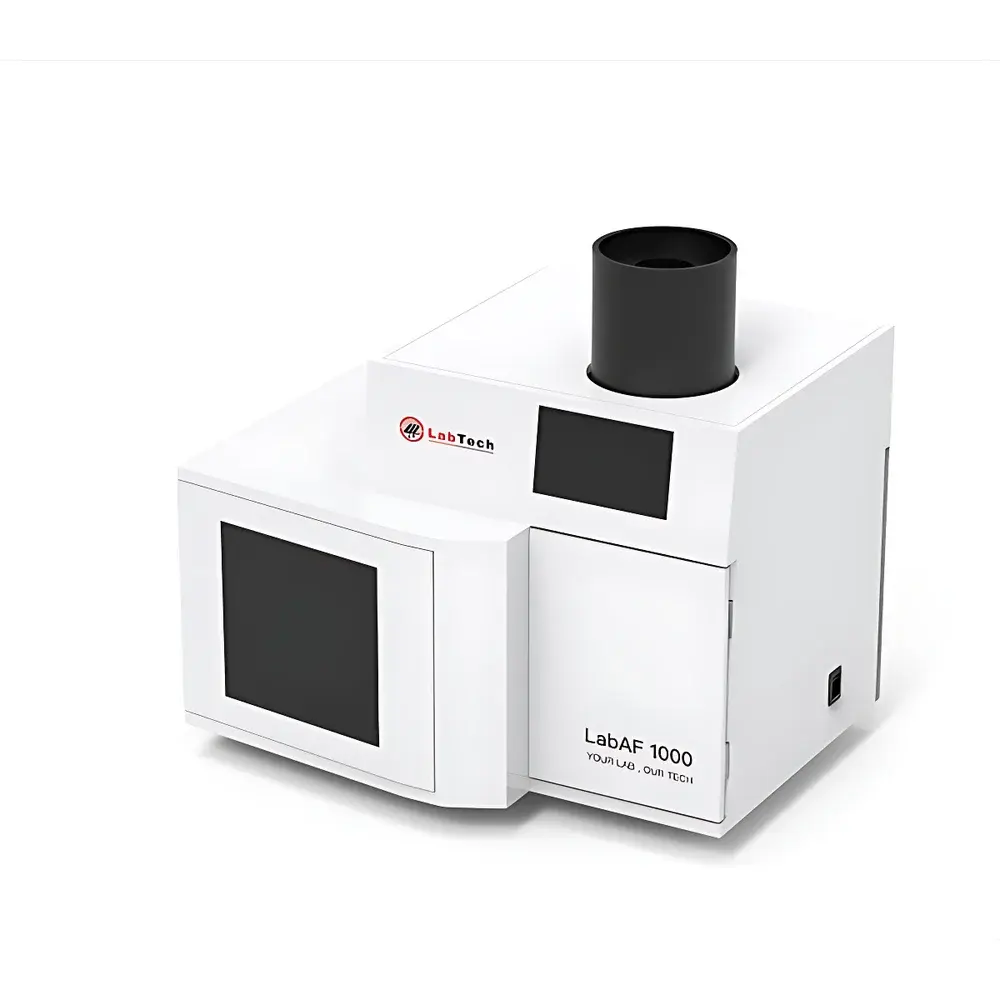
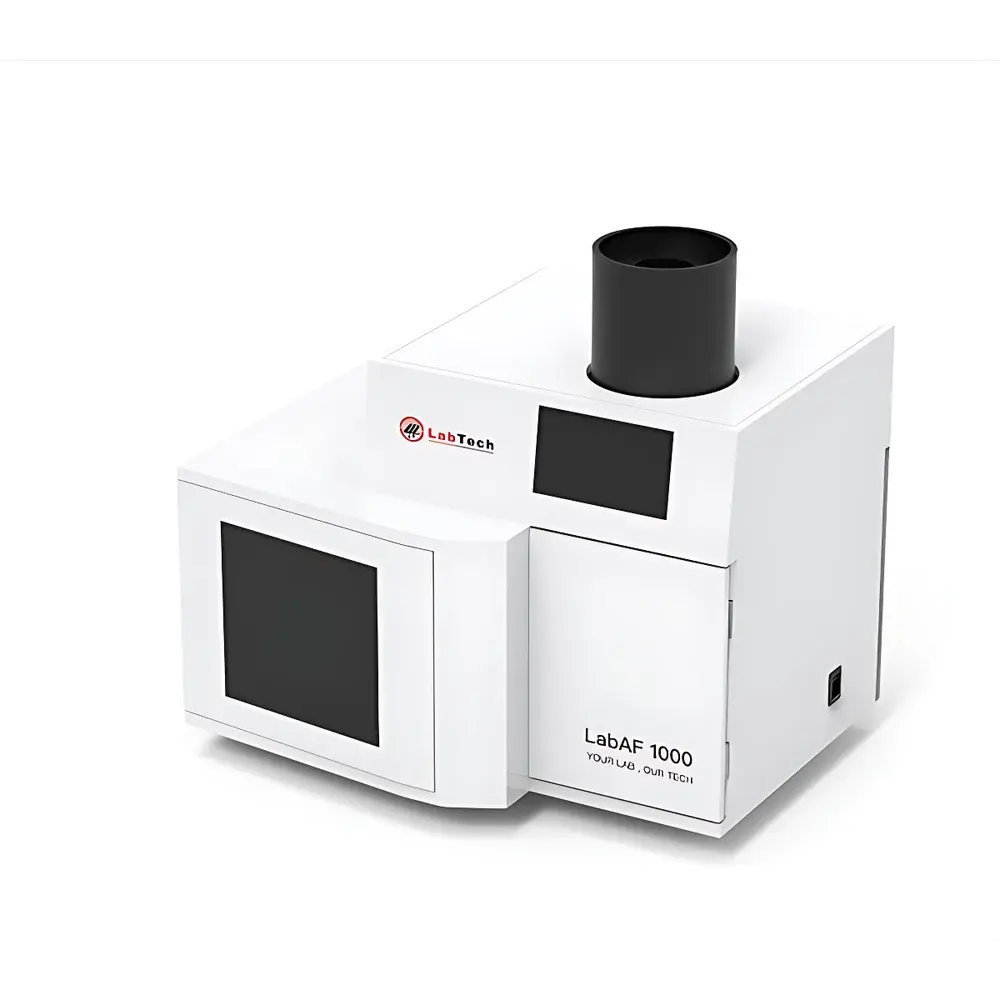
LabTech LabAF 1000 Atomic Fluorescence Spectrometer
| Brand | LabTech |
|---|---|
| Origin | Beijing, China |
| Manufacturer Type | Original Equipment Manufacturer (OEM) |
| Instrument Type | Multi-channel Atomic Fluorescence Spectrometer |
| Sample Introduction | Dual Sequential Injection Pumps |
| Waste Liquid Disposal | Peristaltic Pump Extraction |
| Hydride Generation Mode | Vapor Generation / Hydride Generation |
| Gas Flow Control | Rotameter |
| Detectable Elements | As, Sb, Bi, Hg, Se, Te, Sn, Ge, Pb, Zn |
| Relative Standard Deviation (RSD) | ≤0.7% |
| Linear Dynamic Range | ≥3 orders of magnitude |
| Detection Limits | As, Se, Bi, Pb, Sb, Te, Sn, Zn < 0.01 µg/L |
| Photomultiplier Tube (PMT) Wavelength Range | 160–320 nm |
Overview
The LabTech LabAF 1000 Atomic Fluorescence Spectrometer is a dedicated analytical instrument engineered for ultra-trace quantification of hydride-forming and cold-vapor elements in environmental, food, pharmaceutical, geological, and clinical matrices. It operates on the principle of atomic fluorescence spectroscopy (AFS), where analyte atoms—generated in situ via hydride vapor generation (HVG) or cold vapor atomic fluorescence (CV-AFS)—are excited by a high-intensity, element-specific hollow cathode lamp (HCL). The resulting fluorescence emission at characteristic wavelengths is collected at right angles to the excitation beam and measured using a solar-blind photomultiplier tube (PMT), ensuring minimal background interference and exceptional signal-to-noise ratio. Unlike ICP-MS or AAS, AFS delivers superior sensitivity for specific elements without requiring high-power plasma sources or complex vacuum systems, making the LabAF 1000 particularly suitable for routine regulatory monitoring where detection limits in the sub-ppt range are mandated.
Key Features
- Triple-channel simultaneous detection architecture with optical isolation between channels, eliminating cross-talk and enabling concurrent quantification of As, Sb, and Hg—or any other compatible triad—without spectral overlap or signal suppression.
- Dual-mode hydride generation system supporting both sequential injection (SI) and continuous flow (CF) operation, allowing method flexibility for complex or particulate-laden samples while maintaining reproducibility and minimizing reagent consumption.
- Shielded short-focal-length optical path design minimizes photon loss and scattering, enhancing fluorescence collection efficiency and long-term signal stability.
- Double-layer quartz atomizer with integrated shielding reduces liquid-phase interferences and memory effects, improves atomization efficiency, and extends service life under high-throughput operation.
- High-output pulsed/constant-current driven hollow cathode lamps with automatic lamp identification and usage-time logging—ensuring traceable lamp performance history and consistent excitation intensity across analyses.
- Solar-blind PMT detector (160–320 nm) optimized for resonance line detection of key hydride-forming elements, delivering low dark current and high quantum efficiency within the UV-VIS region critical for As, Se, Hg, and Sb measurements.
Sample Compatibility & Compliance
The LabAF 1000 accommodates aqueous digests, filtered environmental waters, acid-extracted soil leachates, biological tissue homogenates, and food extracts prepared per EPA Method 1631E, ISO 17892-12, GB/T 22105.1–2008, and USP /. Its hydride generation interface supports sample introduction volumes from 0.1–5 mL with programmable reaction coil residence times, enabling robust handling of high-salinity or organic-rich matrices when paired with optional online matrix separation modules. The system meets GLP and GMP requirements through hardware-enforced audit trails, role-based user permissions, electronic signature support, and full compliance with FDA 21 CFR Part 11 for data integrity, change control, and electronic record retention.
Software & Data Management
The instrument is controlled via LabAF Control Suite—a validated Windows-based application compliant with 21 CFR Part 11 Annex 11 guidelines. The software provides method editor with multi-step sequence programming, real-time signal visualization, automatic calibration curve fitting (linear/log-linear), QC check integration (blanks, spikes, duplicates), and customizable reporting templates aligned with ISO/IEC 17025 documentation standards. All raw spectra, peak integrations, instrument parameter logs, and user activity records are stored in an encrypted SQL database with immutable timestamps, supporting retrospective review and regulatory inspection readiness.
Applications
- Regulatory monitoring of inorganic arsenic and methylmercury in rice, seafood, and infant formula per EU Commission Regulation (EU) No 2023/915 and FDA Elemental Analysis Manual (EAM) Chapter 4.10.
- Groundwater and wastewater analysis for As, Sb, and Se under EPA Unregulated Contaminant Monitoring Rule (UCMR 5) and China’s GB 5749–2022 drinking water standard.
- Speciation analysis of As(III)/As(V), MMA, DMA, and inorganic Hg in environmental and clinical samples when coupled with HPLC-AFS interfaces.
- Quality control of catalysts, semiconductor precursors, and pharmaceutical excipients where trace metal impurities must be verified below ICH Q3D thresholds.
- Geochemical surveying of ore-grade samples and sediment cores for exploration geochemistry workflows requiring rapid, field-deployable elemental screening.
FAQ
What hydride-forming elements can the LabAF 1000 quantify with certified detection limits?
The instrument achieves validated detection limits of <0.01 µg/L for As, Sb, Bi, Pb, Se, Te, Sn, and Zn, and <0.001 µg/L for Hg and Cd—verified against NIST SRM 1640a and CRM SLRS-6 reference materials.
Is the LabAF 1000 compatible with HPLC for elemental speciation?
Yes—its modular gas–liquid separator and low-dead-volume nebulizer interface allow seamless coupling with standard HPLC systems for As, Se, and Hg species separation and time-resolved AFS detection.
Does the software support automated method validation protocols?
Yes—the LabAF Control Suite includes built-in tools for linearity assessment (r² ≥0.999), precision evaluation (RSD ≤0.7% over n=10 replicates), LOD/LOQ calculation per ICH Q2(R2), and recovery testing with matrix-matched standards.
How is gas flow accuracy maintained during long-term operation?
Gas flow is regulated via calibrated rotameters with ±2% full-scale accuracy; optional mass flow controllers (MFCs) are available as an upgrade for enhanced reproducibility in regulated laboratories.
Can the LabAF 1000 be integrated into a laboratory information management system (LIMS)?
Yes—it supports ASTM E1384-compliant ASCII and XML data export formats, ODBC connectivity, and HL7 messaging for bidirectional LIMS synchronization and automated report distribution.






