
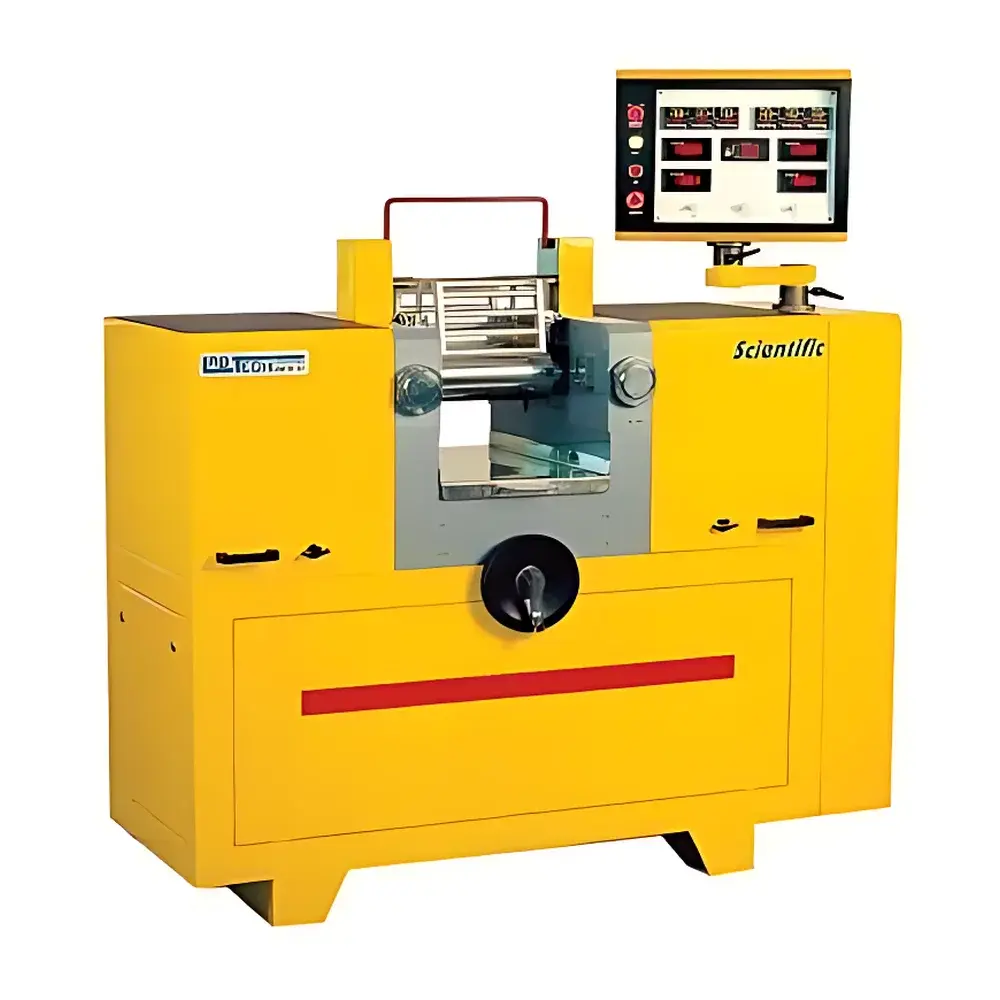
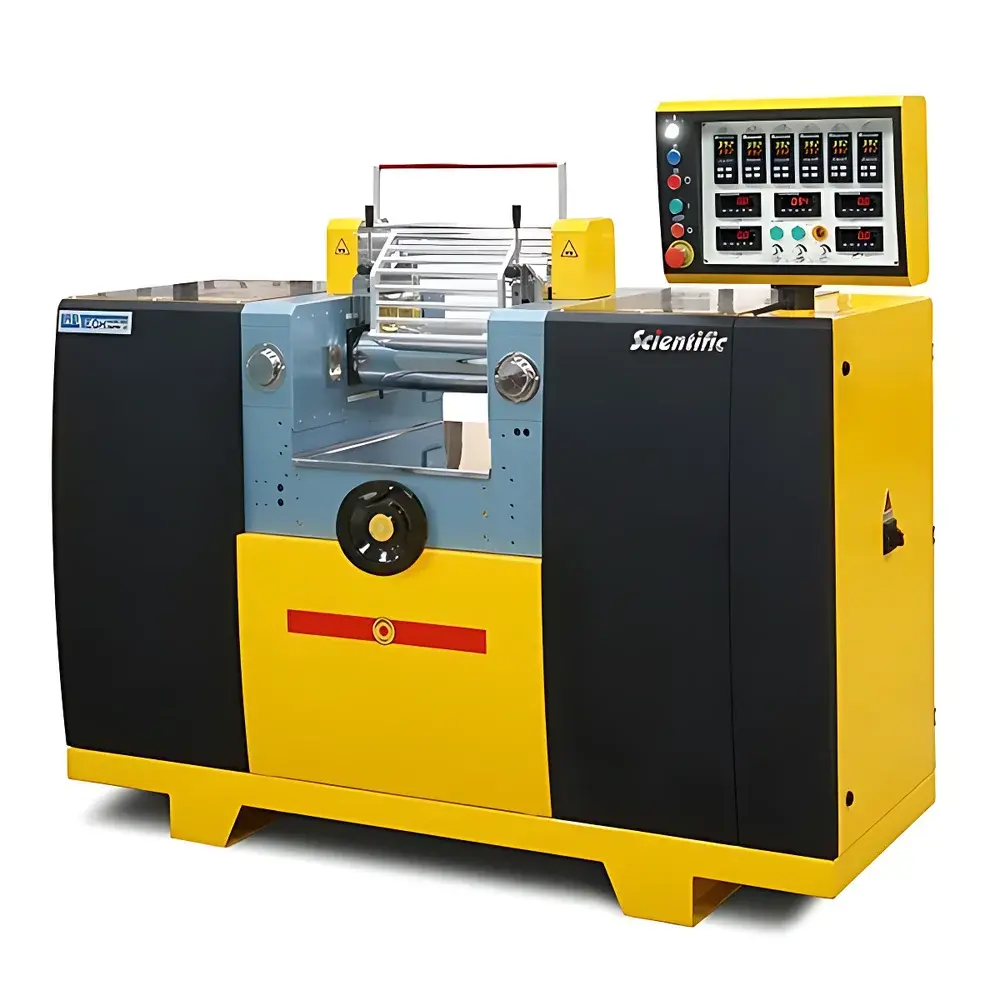
Labtech LRM-S-150 Open Two-Roll Mill for Polymer Processing
| Brand | Labtech Engineering |
|---|---|
| Roll Diameter | 150 mm |
| Configuration | Horizontal Open Two-Roll Mill |
| Drive Type | Variable-Frequency AC Motor with Precision Speed Control |
| Roll Surface | Chrome-Plated Steel |
| Roll Gap Adjustment | Manual Micrometer with Digital Readout |
| Safety Compliance | CE Marked, EN ISO 13857 & EN 61800-5-1 Compliant |
| Construction | Heavy-Duty Cast Iron Frame with Reinforced Bearing Housings |
| Temperature Control Option | Optional Water-Cooled or Electrically Heated Rolls (±1 °C Stability) |
| Power Supply | 380–415 V, 3-Phase, 50/60 Hz |
| Dimensions (L×W×H) | 1850 × 920 × 1280 mm |
| Weight | Approx. 1,450 kg |
Overview
The Labtech LRM-S-150 Open Two-Roll Mill is an engineered solution for laboratory-scale polymer compounding, rubber mastication, sheeting, and masterbatch dispersion. Designed in accordance with fundamental principles of shear-dominated rheological processing, the mill operates on the classical two-roll geometry where differential roll rotation generates controlled shear strain rates within viscoelastic materials. Its robust mechanical architecture ensures consistent torque transmission and minimal roll deflection—critical parameters for reproducible material homogenization, especially when processing high-viscosity thermoplastics, elastomers, or filled compounds. Unlike simplified benchtop mills, the LRM-S-150 integrates precision-machined chrome-plated rolls with a rigid cast iron frame to maintain dimensional stability under prolonged thermal and mechanical load—enabling correlation with pilot- and production-scale twin-screw extrusion data.
Key Features
- Heavy-duty cast iron frame with reinforced bearing housings and preloaded tapered roller bearings—minimizing axial play and roll misalignment over extended operation cycles.
- 150 mm diameter chrome-plated steel rolls with surface hardness ≥62 HRC and Ra ≤0.4 µm finish—ensuring wear resistance, thermal uniformity, and compatibility with abrasive fillers (e.g., carbon black, silica, CaCO₃).
- Variable-frequency AC drive system delivering smooth, stepless speed control from 3 to 25 rpm (adjustable ratio 1:1.2 to 1:1.5)—supporting both low-shear warm-up and high-shear dispersion protocols.
- Manual micrometer-based roll gap adjustment with digital linear encoder readout (resolution: 0.01 mm)—enabling repeatable gap setting across multiple batches for comparative process development studies.
- Integrated safety interlocks compliant with EN ISO 13857 (safe distances for moving parts) and EN 61800-5-1 (drive system functional safety)—including light curtain integration capability, emergency stop circuitry, and roll nip guard engagement verification.
- Optional temperature-controlled roll configurations: water-cooled (ambient to 80 °C) or electrically heated (ambient to 120 °C), each featuring PID-regulated zones with ±1 °C stability—essential for studying thermal degradation kinetics or melt viscosity transitions.
Sample Compatibility & Compliance
The LRM-S-150 accommodates a broad spectrum of polymeric systems including natural and synthetic rubbers (NR, SBR, EPDM, NBR), thermoplastics (PP, PE, PVC, PC, ABS), thermoplastic elastomers (TPEs), and highly filled composites (up to 80 wt% filler loading). It supports ASTM D3182 (Standard Practice for Rubber—Materials, Equipment, and Procedures for Mixing Using Two-Roll Mills), ISO 289-1 (Rubber—Determination of Raw Rubber Consistency), and GB/T 16584 (Chinese national standard for rubber Mooney viscosity preparation). The mill’s structural design and operational envelope meet requirements for GLP-compliant material preparation in R&D labs serving pharmaceutical excipient development (e.g., polymer-based sustained-release matrices) and automotive compound qualification per OEM specifications (e.g., Ford WSS-M99P1111-A, GMW15635).
Software & Data Management
While the base LRM-S-150 operates via hardware-integrated controls, Labtech provides optional LabTech Control Suite v3.2—a Windows-based interface supporting real-time logging of roll speed, gap position, motor current, and optional temperature sensor inputs. All logged parameters are time-stamped and exportable to CSV or Excel format. Audit trail functionality complies with FDA 21 CFR Part 11 requirements when deployed with user authentication, electronic signatures, and immutable record retention settings. Process recipes—including speed profiles, gap sequences, and dwell times—can be saved, version-controlled, and recalled to ensure inter-laboratory method transfer consistency.
Applications
- Rubber compound mastication and sheeting prior to vulcanization testing (ASTM D3184, ISO 34-1)
- Masterbatch dilution and pigment dispersion evaluation in colorant development
- Thermoplastic blend morphology assessment via controlled shear history application
- Preparation of standardized test specimens for tensile, tear, and hardness analysis (ISO 527, ISO 37, ISO 48)
- Accelerated aging studies involving heat-shearing synergism in stabilizer package screening
- Qualification of reprocessed/recycled polymer streams for mechanical property recovery potential
FAQ
What is the maximum recommended batch size for the LRM-S-150?
For optimal dispersion and temperature control, the recommended batch weight ranges from 300 g to 1.2 kg—dependent on material density and melt viscosity. Exceeding 1.2 kg may compromise roll coverage uniformity and increase edge buildup risk.
Can the LRM-S-150 be integrated into an automated lab workflow?
Yes—via optional RS-485 Modbus RTU or Ethernet/IP communication modules, enabling synchronization with upstream gravimetric feeders and downstream pelletizers in fully traceable compounding sequences.
Is calibration documentation provided with shipment?
Each unit ships with a factory-verified mechanical calibration certificate covering roll parallelism (≤0.02 mm deviation over 150 mm length), gap linearity (±0.015 mm full scale), and speed accuracy (±0.5% of setpoint at 15 rpm).
Does Labtech offer application support for method development?
Yes—Labtech’s Application Engineering Team provides protocol optimization services, including shear rate mapping, residence time distribution modeling, and comparative benchmarking against industry-standard reference mills (e.g., Brabender Plasti-Corder, Haake MiniLab).





