
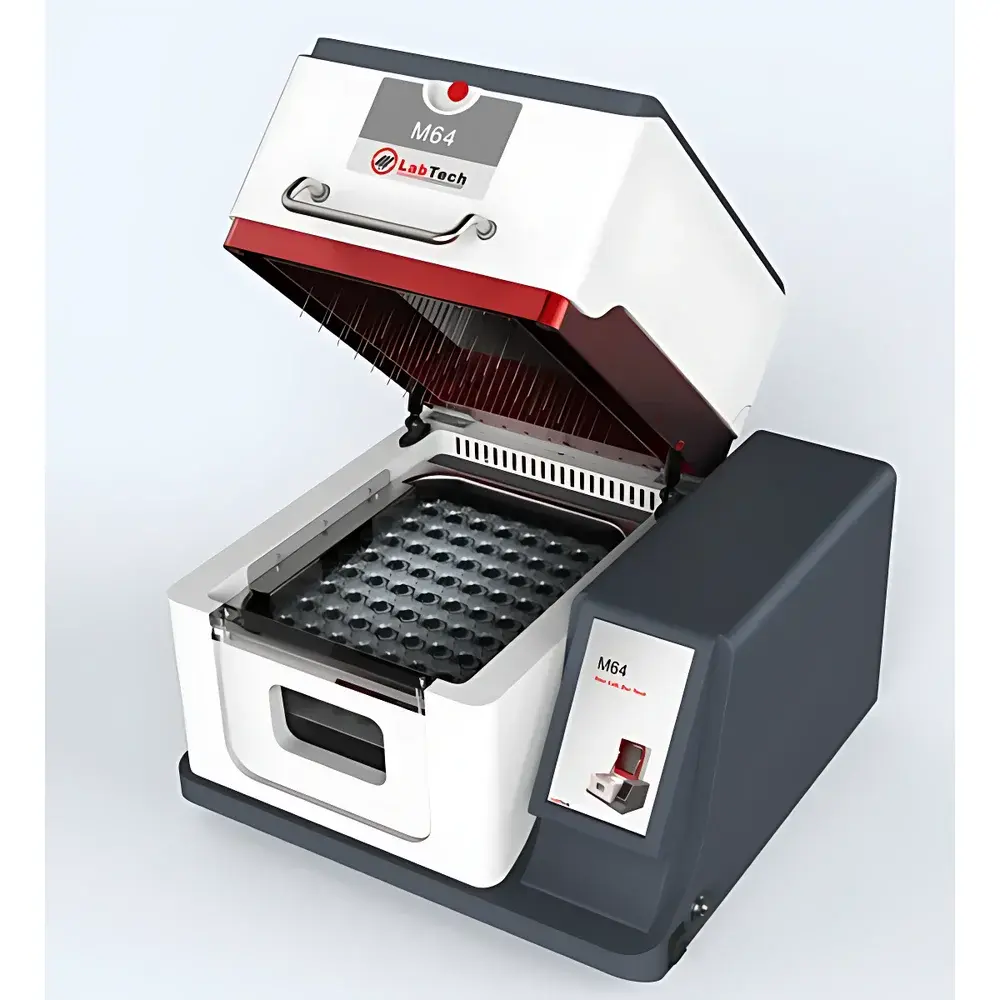
LabTech M64 Fully Automated High-Throughput Parallel Concentrator
| Brand | LabTech |
|---|---|
| Model | M64 |
| Type | Automated Quantitative Nitrogen Evaporation Concentrator |
| Max Channels | 64 |
| Heating Method | Precision Water Bath |
| Gas Delivery | Motorized Vertical-Tracking Nitrogen Needles with Closed-Loop Pressure Control |
| User Interface | 10.1" Full-Color Touchscreen with Real-Time Method Editing |
| Safety | Auto-Lid Interlock with Instant Pause/Resume |
| Visual Monitoring | Front-Access Illuminated Viewing Window |
| Compliance | Designed for GLP/GMP-Lab Environments |
| Software | Onboard OS with Audit Trail & Method Archiving Capability |
Overview
The LabTech M64 Fully Automated High-Throughput Parallel Concentrator is an engineered solution for quantitative solvent removal in analytical laboratories requiring reproducible, unattended sample preparation across large batch sizes. It operates on the principle of controlled nitrogen gas sweep combined with precise water bath heating — a widely accepted technique for gentle yet efficient evaporation of volatile solvents (e.g., hexane, acetone, ethyl acetate, methanol) from biological, environmental, pharmaceutical, and food samples. Unlike manual or semi-automated systems, the M64 integrates real-time liquid-level tracking, dynamic gas flow regulation, and programmable thermal profiles to maintain consistent evaporation kinetics across all 64 parallel channels. Its architecture eliminates operator-dependent variability in endpoint determination, making it suitable for regulated workflows where traceability, repeatability, and method integrity are essential.
Key Features
- 64-Channel Parallel Processing: Simultaneous concentration of up to 64 samples in standard 15–50 mL tubes or vials, significantly reducing batch turnaround time compared to single- or low-channel systems.
- Motorized Vertical-Tracking Nitrogen Needles: Each needle automatically descends as solvent volume decreases, maintaining optimal distance above the liquid surface — minimizing nitrogen consumption by up to 40% while ensuring uniform gas dispersion and preventing splashing or cross-contamination.
- Closed-Loop Pressure Regulation: Independent pressure control per channel group ensures stable nitrogen flow regardless of active channel count; no manual recalibration required when switching between partial and full-load configurations.
- Precision Water Bath System: Uniform temperature distribution across the entire heating block with rapid thermal response; compatible with temperature-sensitive analytes requiring strict thermal management (e.g., pesticides, hormones, vitamins).
- Intelligent Safety Architecture: Lid-mounted microswitch triggers immediate suspension of gas flow and heating upon opening; system resumes automatically after closure, preserving method continuity without user intervention.
- Front-Illuminated Observation Window: Enables real-time visual verification of sample volume reduction without interrupting operation — eliminating need for lid lifting and minimizing exposure to ambient contaminants or temperature fluctuations.
Sample Compatibility & Compliance
The M64 accommodates common laboratory consumables including borosilicate glass test tubes (15–50 mL), screw-cap vials, and centrifuge tubes with standardized diameters. It supports both aqueous and organic solvent matrices, provided volatility and boiling point fall within standard nitrogen-assisted evaporation parameters (typically ≤80 °C bath temperature). The instrument is designed to meet foundational requirements for Good Laboratory Practice (GLP) and Good Manufacturing Practice (GMP) environments: onboard method archiving, timestamped run logs, user-access-level permissions, and non-editable audit trails compliant with FDA 21 CFR Part 11 principles. While not certified to ISO/IEC 17025 out-of-the-box, its operational consistency enables validation per internal SOPs aligned with ASTM D5291, USP , and EPA Method 505/525 series protocols.
Software & Data Management
The embedded operating system features a responsive 10.1-inch capacitive touchscreen interface with intuitive icon-driven navigation. Users can create, store, and recall multi-step concentration methods—including ramp-and-hold temperature profiles, staged nitrogen flow rates, and endpoint volume estimation logic. All method changes during active runs are logged with timestamps and operator IDs. Raw data (start/end times, actual bath temperature, average nitrogen pressure per group, lid-open events) are exportable via USB or Ethernet in CSV format. Optional integration with LIMS platforms is supported through standard TCP/IP communication protocols and configurable API endpoints.
Applications
- High-throughput pesticide residue analysis in food safety testing labs (AOAC 2007.01, QuEChERS workflow)
- Pharmaceutical impurity profiling requiring parallel clean-up of extraction eluates prior to LC-MS/MS injection
- Environmental monitoring of PAHs, PCBs, and organochlorine compounds in soil/water extracts (EPA 8270, 8082)
- Forensic toxicology sample prep involving blood, urine, or hair extracts
- Academic research labs performing metabolomics or lipidomics requiring reproducible solvent removal across hundreds of samples per week
FAQ
What types of sample containers are compatible with the M64?
Standard 15 mL, 30 mL, and 50 mL conical-bottom glass tubes with outer diameters of 16–30 mm; compatibility with custom tube racks is achievable via optional accessories.
Does the M64 support method validation documentation?
Yes — the system generates immutable run logs, method change history, and user authentication records, enabling full traceability required for IQ/OQ/PQ documentation.
Can the M64 be integrated into automated lab workflows?
It supports external trigger signals (TTL-compatible) for start/stop synchronization with robotic liquid handlers or autosamplers, and offers Ethernet-based remote command execution.
Is calibration certification available?
LabTech provides optional NIST-traceable temperature calibration reports and flow verification services upon request; field service technicians perform annual performance qualification per client SOP.
What maintenance is required for long-term reliability?
Routine cleaning of the water bath and nitrogen manifold; quarterly inspection of O-rings and needle alignment; annual verification of pressure sensor linearity and thermal uniformity across the bath block.



