
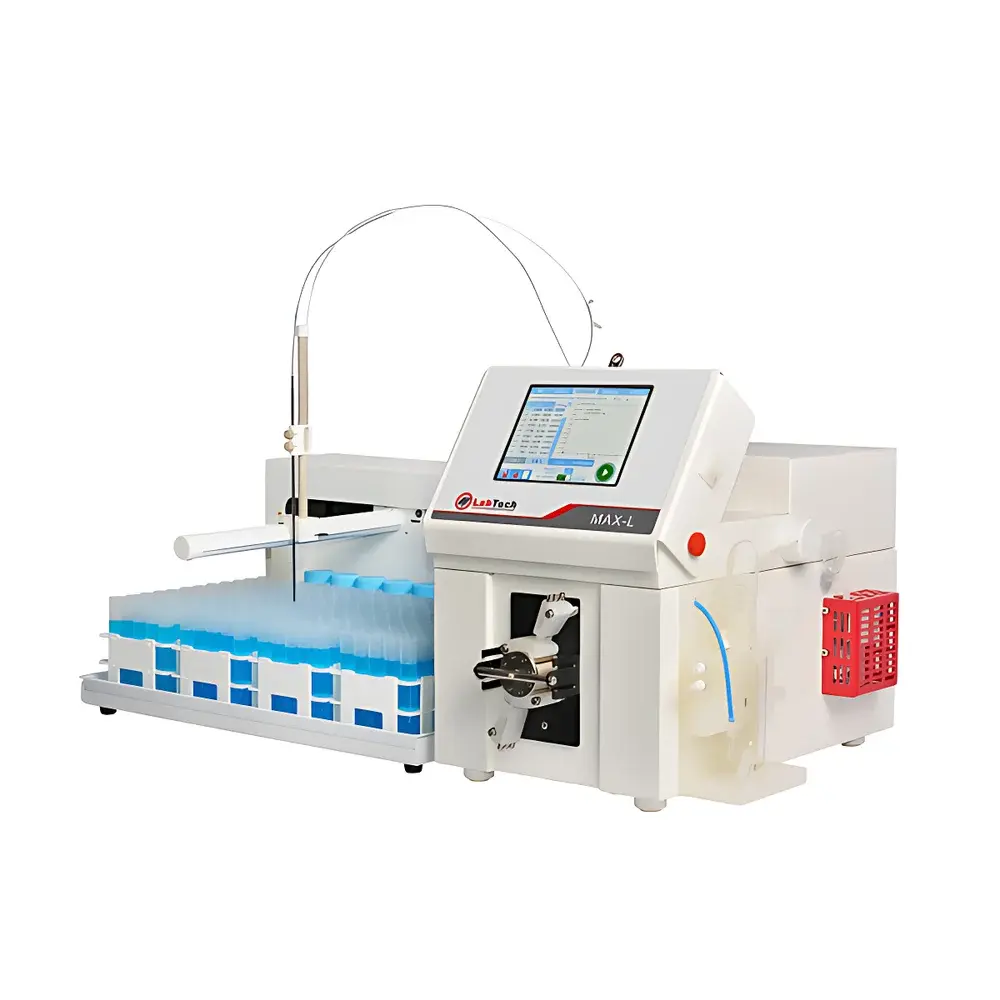
LabTech MAX-L Cold Vapor Atomic Absorption Mercury Analyzer
| Brand | LabTech |
|---|---|
| Origin | Imported |
| Manufacturer | LabTech |
| Model | MAX-L |
| Principle | Cold Vapor Atomic Absorption (CVAAS) |
| Detection Limit | 0.1 ppt |
| Repeatability | <1.5% RSD |
| Linearity Error | ±0.2% |
Overview
The LabTech MAX-L Cold Vapor Atomic Absorption Mercury Analyzer is a dedicated, laboratory-grade instrument engineered for ultra-trace mercury quantification in aqueous and digested environmental, biological, and industrial samples. It operates on the well-established cold vapor atomic absorption spectroscopy (CVAAS) principle: mercury ions in solution are chemically reduced—typically using stannous chloride (SnCl₂)—to elemental mercury vapor, which is then swept by inert carrier gas into a thermostatically controlled quartz absorption cell. Here, mercury atoms absorb light at the characteristic 253.7 nm wavelength emitted by a low-pressure mercury hollow cathode lamp. The degree of absorbance is directly proportional to mercury concentration, enabling highly selective and sensitive detection down to 0.1 ppt (ng/L) with sub-2% relative standard deviation across replicate analyses.
Key Features
- Dual-stage chemical mixing system: Integrates a precision pre-mixer and a helical flow-through mixer to ensure stoichiometric and kinetically complete reduction of Hg²⁺ to Hg⁰—maximizing vapor generation efficiency and minimizing incomplete reduction bias.
- Foam-free gas–liquid separation: Employs a high-surface-area fritted column separator that enables rapid, quantitative volatilization of mercury vapor while retaining liquid phase and eliminating foam formation—critical for stable baseline and long-term operational reliability.
- Gold amalgamation preconcentration: Utilizes thermally stable gold-coated traps to selectively capture mercury vapor from complex matrices; non-mercury species are vented, significantly reducing spectral and chemical interferences.
- High-temperature thermal desorption: Achieves rapid, complete release of trapped mercury at 950°C, ensuring quantitative recovery even from strongly bound or matrix-adsorbed species—enhancing accuracy and lowering effective detection limits.
- Dual thermostatted absorption cells: Maintains both sample and reference cells at precisely controlled temperatures up to 120°C, minimizing condensation artifacts and water vapor interference—eliminating the need for external desiccants or Nafion dryers.
- Intelligent memory-effect mitigation: Incorporates an automated high-flow carrier gas flush sequence post-analysis, coupled with elevated cell temperature, to remove residual mercury deposits—ensuring negligible carryover between high- and low-concentration samples.
- Synchronized six-port valve architecture: Enables simultaneous sample introduction and tubing cleaning during each analytical cycle, reducing cycle time and improving throughput without compromising integrity of calibration or blank performance.
Sample Compatibility & Compliance
The MAX-L supports direct analysis of filtered water samples (e.g., drinking water, wastewater, seawater) and acid-digested solid matrices including soils, sediments, tissues, and sludge. It is fully compatible with standardized methodologies including EPA Method 1631E (Mercury in Water by Oxidation, Purge and Trap, and Cold Vapor Atomic Fluorescence Spectrometry), ASTM D3223-22 (Standard Test Method for Mercury in Water), ISO 12846:2012 (Water quality — Determination of mercury — Method using atomic absorption spectrometry with cold vapour technique), and China’s HJ 597-2011 and HJ 910-2017. Its design supports GLP-compliant operation with full audit trail capability when integrated with compliant LIMS or data acquisition software.
Software & Data Management
The MAX-L is operated via LabTech’s MercuryControl Suite—a Windows-based application supporting method setup, real-time signal monitoring, peak integration, calibration curve generation (linear and quadratic), QC flagging (e.g., drift, blank exceedance), and automatic report generation. All raw absorbance data, instrument parameters, and user actions are timestamped and logged with digital signatures. The software complies with FDA 21 CFR Part 11 requirements when configured with electronic signature modules and network-based access controls—enabling secure, auditable data handling for regulated laboratories.
Applications
- Regulatory compliance testing for mercury in drinking water, surface water, and effluent discharge per national and international standards.
- Environmental monitoring of mercury contamination in sediment cores, biota, and atmospheric deposition samples.
- Pharmaceutical and cosmetic product testing for mercury impurities under ICH Q3D and USP <232>/<233> guidelines.
- Food safety laboratories performing mercury screening in fish, rice, and dietary supplements.
- Research applications requiring ultra-low-level mercury speciation support (when paired with optional hyphenated front-end separation).
FAQ
What sample types can be analyzed directly without digestion?
Filtered aqueous samples—including tap water, groundwater, and treated wastewater—can be introduced directly. Samples with suspended solids or organic content require acid digestion (e.g., EPA 3050B/3052) prior to analysis.
Is the instrument compliant with EPA Method 1631E?
Yes—the MAX-L meets all instrumental performance criteria specified in EPA Method 1631E for mercury determination in water, including detection limit verification, spike recovery, and reagent blank requirements.
How is memory effect controlled during high-to-low concentration transitions?
The intelligent flush system activates automatically after each analysis, combining high-purity argon purge, elevated absorption cell temperature (up to 120°C), and gold trap regeneration at 950°C to eliminate residual mercury carryover.
Does the system require external drying agents or desiccant tubes?
No—its dual thermostatted absorption cell design actively prevents water vapor condensation, rendering consumable drying tubes unnecessary and reducing operational cost and maintenance frequency.
Can the MAX-L be integrated into an existing LIMS environment?
Yes—via configurable ASCII or CSV export protocols and optional OPC UA or ODBC connectivity, enabling seamless data transfer to enterprise LIMS platforms under validated configurations.



