
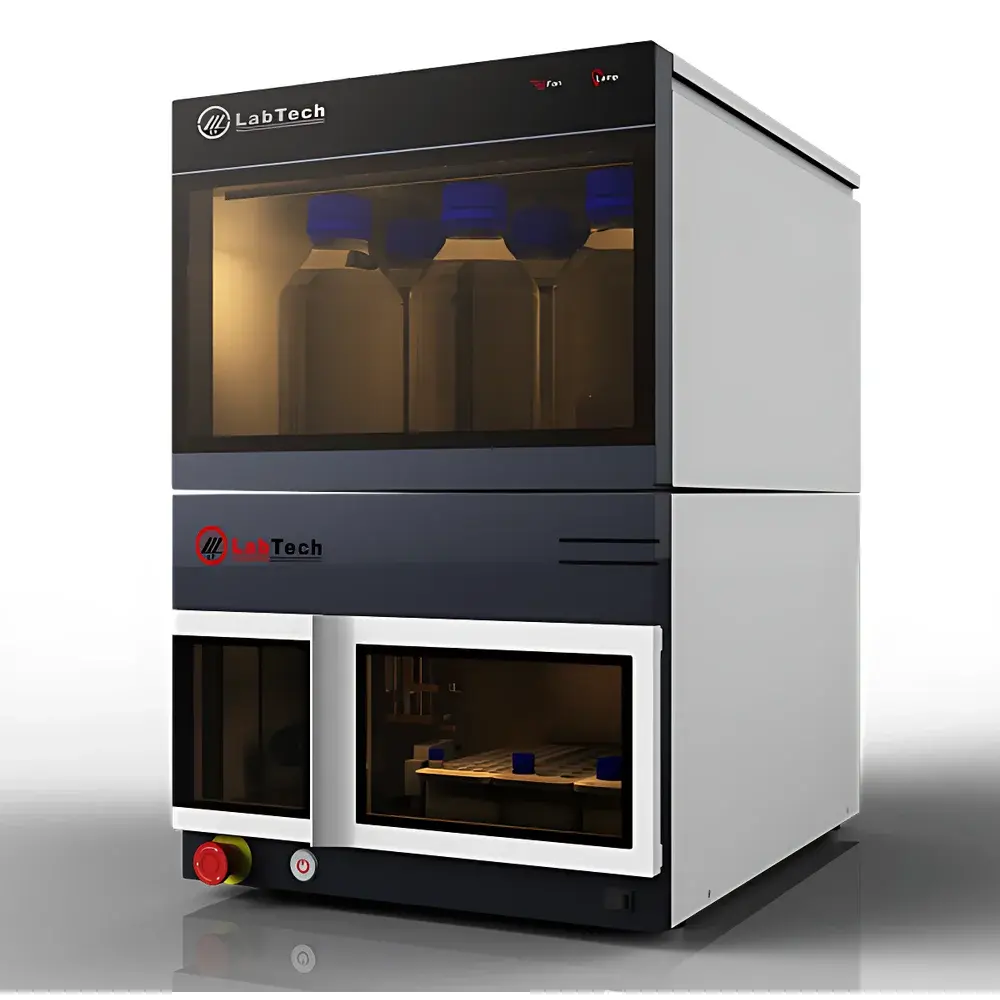
LabTech MiniLab-O Automated Liquid Handling Workstation
| Brand | LabTech |
|---|---|
| Origin | Beijing, China |
| Manufacturer Type | Original Equipment Manufacturer (OEM) |
| Country of Origin | China |
| Model | MiniLab-O |
| Dimensions | 300 mm (W) × 465 mm (D) × 555 mm (H) |
| Plate Capacity | Custom-configurable |
| Pipetting Range | 1 µL – 1000 µL (typical for dual-syringe architecture) |
| Pipetting Accuracy | ±0.5% CV at ≥10 µL (ISO 8655-compliant performance range) |
| Sample Throughput | Up to 192 positions per run (standard 96-well + 96-well configuration) |
| Mixing Modes | Air-gap aspiration/dispense, multi-cycle aspiration/dispense, programmable vortex-like mixing via tip motion, bubble-assisted mixing |
| Wash Protocol | Multi-stage solvent wash (up to 3 solvents), post-wash air-dry cycle |
| Solvent System | Integrated sealed, light-shielded reagent reservoirs with vapor-tight caps |
| Optional Module | Thermally controlled sample carrier (–10 °C to 60 °C) |
Overview
The LabTech MiniLab-O Automated Liquid Handling Workstation is an ISO 17025-aligned, GxP-ready platform engineered for high-integrity liquid preparation in regulated analytical laboratories. It implements a dual-syringe positive-displacement pipetting architecture—distinct from air-displacement systems—to eliminate compressibility errors and deliver consistent volumetric delivery across volatile organic solvents, viscous matrices, and low-surface-tension liquids commonly encountered in GC and LC sample preparation. The system executes end-to-end workflows including serial dilution, multi-level calibration curve generation, mixed standard formulation, internal standard spiking, QC sample fortification, and matrix-matched standardization—all without manual intervention. Its closed, light-attenuated solvent handling environment mitigates photodegradation of light-sensitive analytes (e.g., pesticides, PAHs, vitamins) and reduces solvent evaporation, ensuring stoichiometric fidelity throughout extended unattended runs.
Key Features
- Dual independent syringe pumps (100 µL and 1000 µL) automatically selected based on volume range and fluid properties—enabling trace-level accuracy (≤1 µL) and milliliter-scale dispensing within a single protocol.
- Programmable multi-phase mixing: air-gap aspiration/dispense cycles, tip-based agitation, and controlled bubble injection ensure homogeneous solution composition—even for low-solubility standards or viscous stock solutions.
- Multi-solvent, multi-step tip cleaning station with configurable rinse sequences (up to three solvents), followed by nitrogen-assisted drying to prevent cross-contamination and carryover (<0.001% as measured per ASTM D7820).
- Integrated solvent management system featuring UV-blocking, pressure-equalized reservoirs with integrated level sensors—designed to maintain chemical stability and minimize headspace vapor exposure.
- Modular thermal sample carrier (optional) supports temperature-controlled storage (–10 °C to +60 °C) for thermolabile standards, enzymatic reagents, or biological matrices—fully logged and auditable via system software.
- Real-time protocol visualization and remote monitoring via secure web interface and native iOS/Android application—supporting role-based access control and session logging per FDA 21 CFR Part 11 requirements.
Sample Compatibility & Compliance
The MiniLab-O accommodates standard ANSI/SLAS-format microplates (96-, 384-well), vial racks (12 × 75 mm, 16 × 100 mm), and custom tube carriers. It handles aqueous buffers, acetonitrile/methanol mixtures, chlorinated solvents, and high-viscosity glycerol-based stock solutions without recalibration. All liquid pathways are chemically inert (PTFE, PEEK, sapphire tips) and validated for compatibility with EPA Method 525.3, ISO 17034-certified reference materials, and USP Analytical Instrument Qualification protocols. System qualification documentation supports IQ/OQ/PQ execution under GLP and GMP environments—including full traceability of calibration certificates, maintenance logs, and software version history.
Software & Data Management
Controlled by LabTech LiquidStudio™ v4.x, the workstation provides audit-trail-enabled method development with drag-and-drop workflow builder, real-time error detection, and automatic calculation of dilution factors, mass balance, and uncertainty propagation (per GUM guidelines). All user actions, parameter changes, and hardware events are timestamped and digitally signed. Data export conforms to ASTM E1384 and CDISC SDTM standards; raw log files are stored in encrypted SQLite format with SHA-256 integrity verification. Electronic signatures comply with 21 CFR Part 11 Annex 11 requirements, including biometric authentication options and configurable retention policies aligned with ISO/IEC 27001.
Applications
- Environmental labs: Preparation of EPA 8270/8330 calibration sets for SVOC analysis, dioxin/furan surrogate spiking, and sediment extract dilution.
- Food safety testing: Multi-residue pesticide calibration curves (EN 15662), mycotoxin internal standard addition, and infant formula nutrient fortification verification.
- Pharmaceutical QC: USP method validation support—linearity assessment, LOQ determination, and system suitability standard preparation for HPLC assay.
- Clinical toxicology: Accurate dilution of whole blood specimens prior to LC-MS/MS analysis; preparation of deuterated internal standard working solutions.
- Agrochemical R&D: High-throughput formulation of gradient concentration series for dose-response studies and stability-indicating assays.
FAQ
Does the MiniLab-O support integration with LIMS or ELN systems?
Yes—via RESTful API and ASTM E1578-compliant instrument driver; supports bidirectional data exchange including sample ID mapping, result auto-import, and audit trail synchronization.
Can it handle viscous or foaming samples?
Yes—dual-syringe architecture eliminates air displacement artifacts; customizable aspiration/dispense speeds, surface-following Z-height adjustment, and anti-foam delay parameters are embedded in method templates.
Is validation documentation provided?
LabTech supplies full IQ/OQ documentation packages, including URS, FRS, DQ test scripts, and PQ protocols aligned with ISO/IEC 17025:2017 Clause 6.4.1.
What maintenance is required?
Scheduled tasks include quarterly syringe seal inspection, semi-annual pump calibration verification, and annual full-system performance qualification—each tracked in the built-in maintenance scheduler with email alerts.
How is software update compliance managed?
All firmware and software updates undergo change control review; release notes include impact assessment against 21 CFR Part 11, and rollback capability is retained for 90 days post-deployment.
Related Products



