
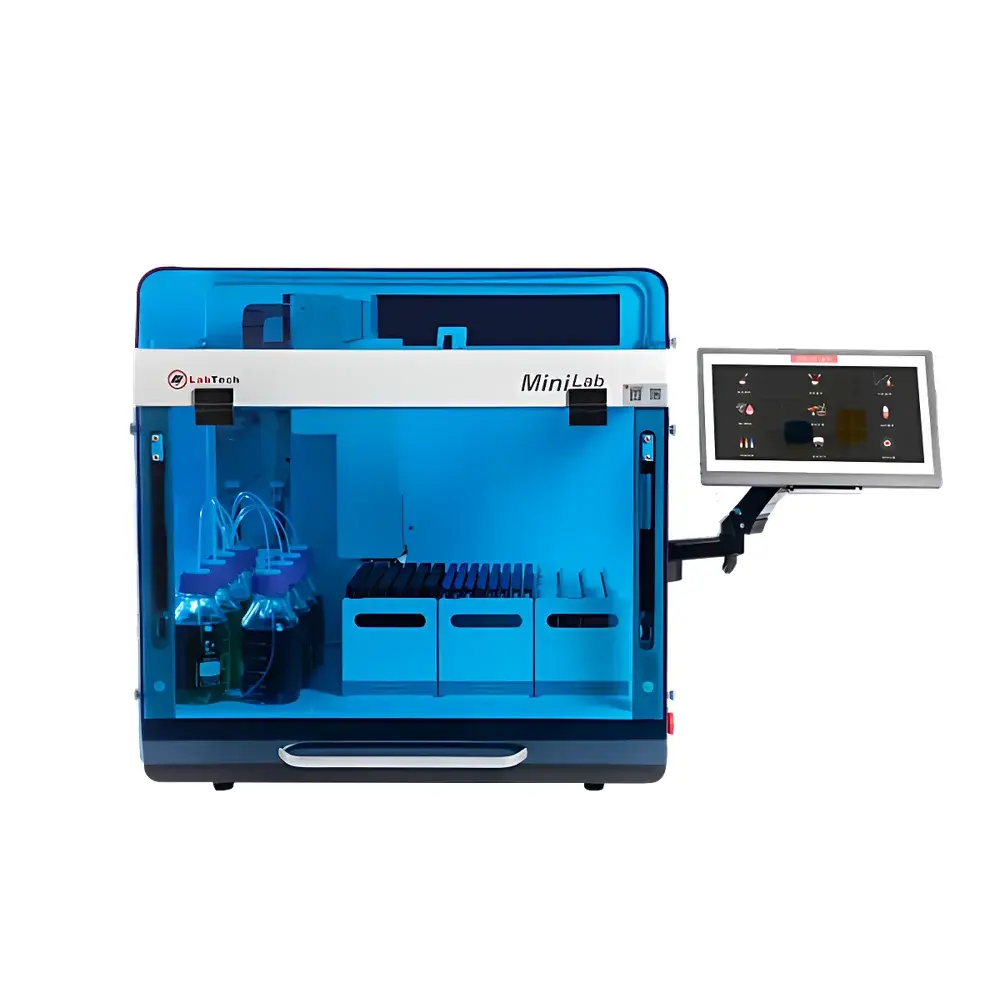
LabTech MiniLab3000 Automated Liquid Handling Workstation
| Brand | LabTech |
|---|---|
| Origin | Beijing, China |
| Manufacturer Type | Original Equipment Manufacturer (OEM) |
| Country of Origin | China |
| Model | MiniLab3000 |
| Pricing | Available upon request |
Overview
The LabTech MiniLab3000 Automated Liquid Handling Workstation is an integrated, benchtop-scale platform engineered for high-precision, unattended liquid manipulation in analytical laboratories. Based on positive-displacement dual-syringe pump architecture, it performs gravimetrically traceable liquid dispensing, dilution, standard curve generation, multi-component mixture preparation (e.g., pesticide residue cocktails), internal standard spiking, QC sample fortification, and matrix-matched calibration solution preparation. Designed to interface seamlessly with downstream GC, LC, GC-MS, and LC-MS systems, the MiniLab3000 eliminates manual pipetting variability and operator-dependent error—ensuring metrological integrity across sample preparation workflows. Its closed-system operation—including septum-piercing vial access, inert gas purging capability (optional), and sealed reagent reservoirs—minimizes solvent evaporation, analyte degradation, and ambient contamination, fulfilling core requirements for ISO/IEC 17025-compliant method validation and GLP-regulated environments.
Key Features
- Dual independent syringe pumps with auto-switching logic: Enables simultaneous or sequential handling of aqueous and organic solvents without cross-contamination; supports volumetric accuracy ≤ ±0.5% CV across 10 µL–10 mL range.
- Septum-piercing robotic arm with force-sensing feedback: Ensures consistent needle insertion depth and seal integrity across 2–100 mL vials; compatible with crimp-top, screw-cap, and snap-cap formats.
- Integrated vortex mixer station with programmable speed (0–3000 rpm) and duration: Enables homogeneous dissolution of poorly soluble analytes (e.g., pyrethroids, PCB congeners); sample tube transfer is fully automated via gripper mechanism.
- Multi-stage tip cleaning system: Includes external rinse (solvent A/B), internal aspiration-wash cycles, and active waste evacuation via dedicated peristaltic pump—validated to reduce carryover to < 0.001% per sequence.
- High-density deck configuration: Supports up to 288 × 2 mL vials (or mixed-format racks), enabling single-run preparation of >100-pesticide multiresidue standards compliant with EU SANTE/11312/2023 guidelines.
- Modular thermal control option: Optional Peltier-based sample deck heating (4–60 °C) and cooling (4–25 °C) modules support temperature-sensitive analyte stabilization and viscosity-compensated dispensing.
Sample Compatibility & Compliance
The MiniLab3000 accommodates a broad spectrum of sample matrices—including biological fluids (serum, urine), food homogenates, soil extracts, water filtrates, and pharmaceutical formulations—without modification to hardware. All wetted components (syringes, tubing, needles, wash stations) are chemically resistant to acetonitrile, methanol, hexane, toluene, and dilute acids/bases. The system meets mechanical safety requirements per IEC 61000-6-2/6-4 and carries CE marking. Software operation supports audit trail generation, electronic signatures, and user-level permission controls aligned with FDA 21 CFR Part 11 and EU Annex 11 expectations for regulated laboratories. Method files are exportable in XML format for traceability during regulatory inspections.
Software & Data Management
Controlled via LabTech’s proprietary LHS-Studio v3.x software, the MiniLab3000 provides intuitive drag-and-drop protocol building, real-time status monitoring, and full parameter logging (dispense volume, pressure profile, mixing duration, temperature). Each run generates a timestamped .csv report containing raw sensor data, error flags, and QC metrics (e.g., weight delta for gravimetric verification). Data exports integrate natively with LIMS platforms via ODBC drivers. The software architecture supports version-controlled method libraries, scheduled maintenance alerts, and remote diagnostics through secure TLS-encrypted connections—enabling centralized fleet management across multi-site laboratories.
Applications
- Food safety labs: Automated preparation of multi-analyte reference standards for QuEChERS-based pesticide residue analysis (AOAC 2007.01, EN 15662).
- Environmental testing: High-throughput calibration standard generation for PAHs, PCBs, and organochlorine pesticides in wastewater and sediment extracts.
- Clinical toxicology: Precise spiking of internal standards (e.g., deuterated amphetamines, benzodiazepines) into serum samples prior to LC-MS/MS quantitation.
- Pharmaceutical QA/QC: Dilution series preparation for assay validation (ICH Q2(R2)), stability-indicating method development, and forced degradation sample spiking.
- Agrochemical R&D: Formulation compatibility testing via automated serial dilution and co-solvent blending under inert atmosphere.
FAQ
Does the MiniLab3000 support gravimetric calibration verification?
Yes—optional integration with certified analytical balances enables real-time mass-based feedback for critical dispense steps, satisfying USP and ISO 8655-6 requirements.
Can the system handle viscous or volatile solvents?
Dual syringe pumps accommodate viscosities up to 500 cP (e.g., glycerol/water mixtures) and vapor pressures down to 5 kPa at 25 °C (e.g., dichloromethane); optional cold trap and vent-line scrubber mitigate volatility-related errors.
Is third-party instrument integration supported?
Yes—RS-232, Ethernet TCP/IP, and USB-HID interfaces enable bidirectional communication with autosamplers (e.g., CTC PAL, Gerstel MPS), balance systems, and chromatography data systems (Empower, Chromeleon, OpenLAB).
What maintenance intervals are recommended?
Syringe calibration every 200 hours; needle cleaning module inspection every 500 cycles; full fluidic path flush with IPA/H₂O every 30 days—documented in built-in maintenance scheduler.
Does LabTech provide IQ/OQ documentation packages?
Yes—factory-verified Installation Qualification (IQ) and Operational Qualification (OQ) protocols, including test scripts, acceptance criteria, and signed reports, are available as optional deliverables for GxP environments.



