
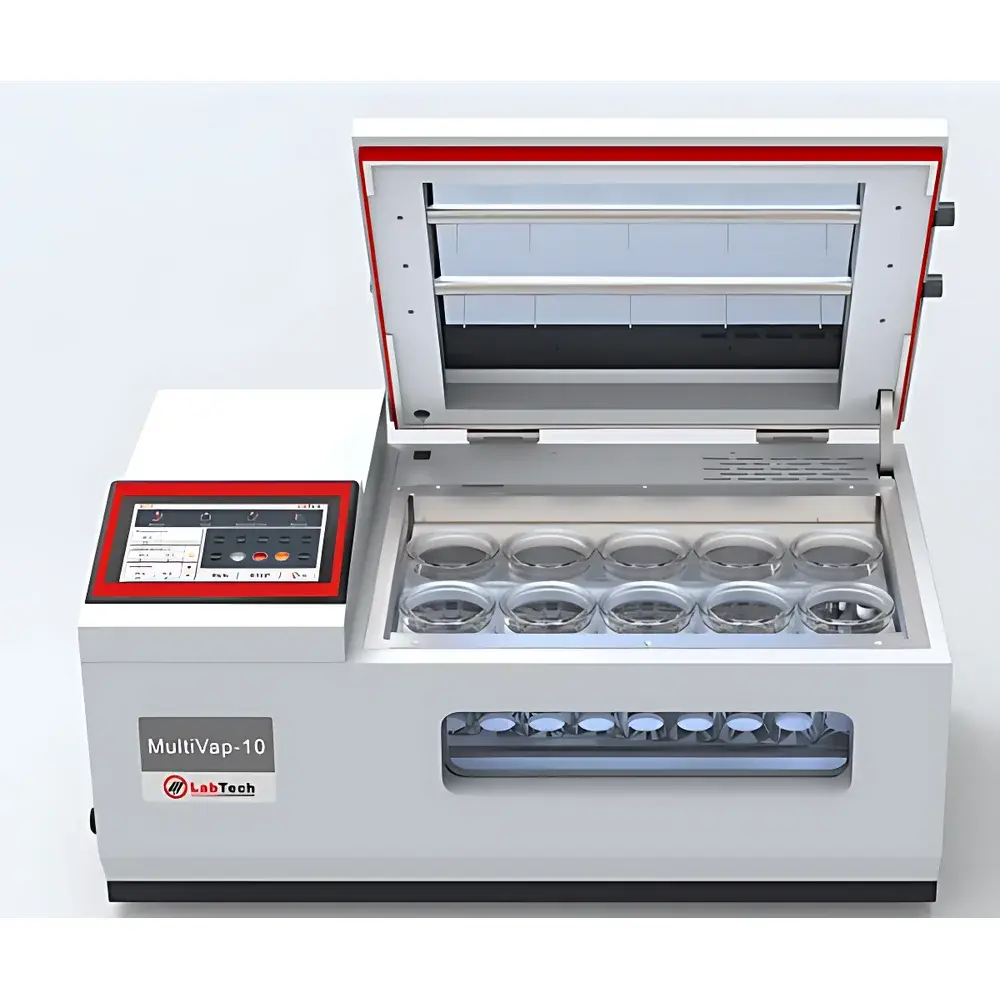
LabTech MultiVap-10 Quantitative Parallel Concentrator
| Brand | LabTech |
|---|---|
| Origin | Beijing, China |
| Manufacturer Type | Direct Manufacturer |
| Instrument Category | Nitrogen Blow-Down Concentrator |
| Temperature Range | Ambient to 100 °C |
| Temperature Control Accuracy | ±0.1 °C |
| Sample Channels | 10 independent parallel positions |
| Compatible Vessel Sizes | 50 mL and 200 mL concentric evaporating cups (simultaneous use supported) |
| Endpoint Detection | Automated optical/level-sensing termination |
| Safety Alarms | Over-pressure alarm, water-level limit alarm |
| User Interface | Capacitive touchscreen with graphical HMI |
Overview
The LabTech MultiVap-10 Quantitative Parallel Concentrator is an engineered solution for high-throughput, reproducible solvent evaporation in analytical laboratories performing sample preparation for GC, LC-MS, ICP-MS, and environmental testing workflows. It operates on the principle of regulated nitrogen gas flow combined with precise temperature-controlled heating—commonly referred to as “nitrogen blow-down concentration”—to accelerate solvent removal while preserving analyte integrity. Unlike rotary evaporators or generic nitrogen concentrators, the MultiVap-10 integrates real-time endpoint detection, adaptive gas flow distribution, and modular vessel support to enable quantitative concentration down to user-defined residual volumes without manual intervention. Its compact footprint and sealed enclosure eliminate the need for fume hood installation, reducing infrastructure dependency and improving lab space utilization.
Key Features
- 10-channel parallel processing: Independently controllable channels allow simultaneous concentration of heterogeneous sample sets—each with customizable gas flow rate, temperature setpoint, and run duration.
- Dual-vessel compatibility: Supports concurrent use of both 50 mL and 200 mL concentric evaporating cups; cup-specific nozzle alignment ensures optimal gas impingement angle and vortex formation for uniform evaporation kinetics.
- Precision thermal regulation: PID-controlled heating block maintains temperature stability within ±0.1 °C across the full 20–100 °C operating range, minimizing thermal degradation of thermolabile compounds.
- Automated endpoint detection: Integrated optical sensing system monitors liquid meniscus height in real time, terminating nitrogen flow and heating upon reaching the preprogrammed final volume—critical for quantitative recovery in regulated environments.
- Integrated safety architecture: Dual redundant alarms monitor system pressure and internal water reservoir level; automatic shutdown is triggered if either threshold is exceeded, ensuring compliance with ISO/IEC 17025 laboratory safety requirements.
- Touchscreen human-machine interface: 7-inch capacitive display with intuitive icon-driven navigation supports method storage, audit trail logging, and multi-user access control—facilitating 21 CFR Part 11–compliant operation when paired with optional software modules.
Sample Compatibility & Compliance
The MultiVap-10 accommodates a broad range of solvent systems including hexane, acetone, methanol, ethyl acetate, and dichloromethane—provided vapor pressure and flash point remain within safe operational limits per IEC 61010-1. Vessel geometry and gas dynamics are optimized for aqueous and organic extracts from solid-phase extraction (SPE), QuEChERS, and liquid–liquid partitioning protocols. The instrument meets CE marking requirements for electromagnetic compatibility (EMC Directive 2014/30/EU) and low-voltage safety (LVD Directive 2014/35/EU). While not certified under GLP or GMP out-of-the-box, its programmable parameters, electronic log generation, and alarm traceability support validation against USP , ASTM D5191, and EPA Method 502.2 documentation standards.
Software & Data Management
Local operation is fully managed via the embedded HMI, which stores up to 100 user-defined methods with timestamped execution records. Optional LabTech Connect™ PC software enables remote monitoring, method synchronization across multiple units, and export of CSV-formatted run logs—including start/stop times, actual vs. setpoint temperature profiles, pressure history, and endpoint confirmation events. All electronic records include operator ID, method name, and instrument serial number—supporting traceability for internal QA audits or regulatory inspections under ISO/IEC 17025 Clause 7.7 or FDA 21 CFR Part 11 Subpart B when configured with electronic signatures and audit trail activation.
Applications
- Environmental analysis: Pre-concentration of pesticide residues, PAHs, PCBs, and VOCs from water and soil extracts prior to GC-ECD or GC-MS analysis.
- Clinical toxicology: Reduction of large-volume urine or plasma extracts for targeted LC-MS/MS quantitation of drugs of abuse and metabolites.
- Food safety testing: Final cleanup step in multi-residue pesticide screening workflows compliant with EU SANTE/11312/2021 guidelines.
- Pharmaceutical R&D: Solvent exchange and volume reduction of reaction mixtures during synthetic intermediate purification.
- Forensic chemistry: High-reproducibility concentration of seized drug dilutions for confirmatory FTIR or NMR characterization.
FAQ
Is the MultiVap-10 suitable for volatile organic compound (VOC) analysis requiring minimal analyte loss?
Yes—its closed-loop gas delivery system, adjustable flow rates (0–15 L/min per channel), and low-temperature evaporation capability minimize volatilization artifacts commonly observed with open-tube nitrogen concentrators.
Can the instrument be validated for use in a GLP-certified laboratory?
Validation is achievable using LabTech’s IQ/OQ documentation package, which includes test protocols for temperature uniformity mapping, gas flow calibration, endpoint repeatability assessment, and alarm response verification.
What maintenance is required to ensure long-term performance?
Routine cleaning of gas nozzles and heating block surfaces is recommended after every 50 runs; annual calibration of the temperature sensor and pressure transducer is advised per ISO/IEC 17025 Section 6.5.
Does the system support integration with LIMS or laboratory automation platforms?
Yes—via RS-232 or Ethernet TCP/IP communication protocols, enabling bidirectional command exchange and status reporting compatible with major LIMS vendors including Thermo Fisher SampleManager and LabWare LIMS.



