
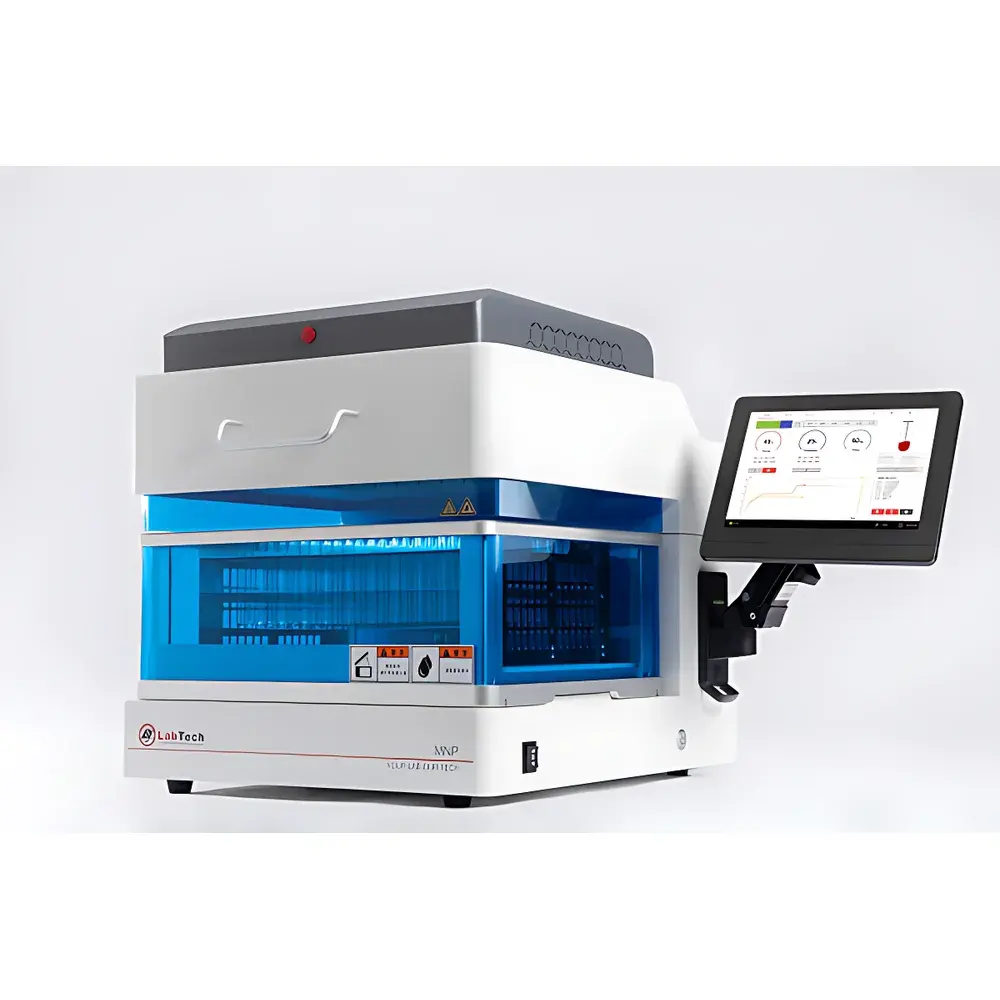
LabTech MVP Automated Vacuum Parallel Concentrator
| Brand | LabTech |
|---|---|
| Model | MVP |
| Type | Vacuum Parallel Concentrator |
| Origin | Beijing, China |
| Manufacturer | LabTech (OEM/ODM Producer) |
| Throughput Options | 12-, 16-, or 48-position configurations |
| Sample Vessel Compatibility | 50 mL to 1000 mL round-bottom flasks, vials, and custom tubes |
| Independent Sealed Channels | Yes (per-vessel vacuum & exhaust routing) |
| Dual-Cold Trap Design | Yes (solvent vapor + non-condensable gas separation and recovery) |
| Chamber | Fully transparent acrylic viewport with suspended sample cup mounting |
| Illumination | Integrated LED base lighting for real-time meniscus and endpoint observation |
| Control Interface | 10-inch capacitive touchscreen PC-based system |
| Software Capabilities | Real-time parameter adjustment (temperature, vacuum setpoint, oscillation frequency), programmable multi-step gradients, time-based scheduling, dynamic graphical display of all operational parameters |
| Compliance | Designed for GLP-compliant workflows |
Overview
The LabTech MVP Automated Vacuum Parallel Concentrator is an engineered solution for high-throughput solvent removal under controlled low-pressure conditions. It operates on the principle of simultaneous vacuum-assisted evaporation across multiple samples, enhanced by precise temperature regulation and programmable orbital agitation. Unlike single-sample rotary evaporators, the MVP leverages parallel processing architecture—each sample vessel maintains its own sealed vacuum path, eliminating cross-contamination risks inherent in shared manifold systems. The instrument integrates thermally regulated heating blocks, digitally controlled vacuum pumps with pressure feedback loops, and a dual-stage cold trap system capable of condensing volatile organic solvents while separately capturing non-condensable residual gases (e.g., nitrogen purge streams or trace air components). This design ensures consistent endpoint reproducibility across heterogeneous sample matrices—critical for quantitative workflows in regulated environments such as food safety testing, herbal medicine standardization, environmental residue analysis, and agricultural product quality control.
Key Features
- Modular throughput configuration: Select from 12-, 16-, or 48-position platforms to match laboratory batch size requirements without compromising thermal uniformity or vacuum stability.
- Independent channel architecture: Each sample position features dedicated vacuum tubing, pressure-sensing ports, and exhaust routing—preventing boil-over propagation and eliminating carryover between vessels during rapid solvent removal.
- Transparent process monitoring: A fully acrylic concentric chamber provides unobstructed 360° visual access; suspended cup mounting combined with bottom-mounted LED illumination enables direct observation of meniscus recession, crystallization onset, or dryness endpoints.
- Dual-cold trap recovery system: Two-stage condensation modules operate at differential temperatures—one optimized for high-boiling-point solvents (e.g., DMSO, ethylene glycol), the other for low-boiling volatiles (e.g., hexane, acetone, dichloromethane)—maximizing solvent recovery rates above 92% and minimizing atmospheric emissions.
- Intuitive 10-inch HMI interface: Touchscreen controls support multi-step method programming—including ramp-and-hold temperature profiles, dynamic vacuum setpoints (1–760 mbar absolute), oscillation frequency modulation (0–300 rpm), and timed termination triggers—with real-time graphical overlay of all active parameters.
Sample Compatibility & Compliance
The MVP accommodates a broad range of container formats—from standard 50 mL conical centrifuge tubes to 1000 mL round-bottom flasks—via adjustable height clamps and interchangeable heating block inserts. Its modular sealing gasket system ensures leak-tight performance across varying neck diameters and flask geometries. From a regulatory standpoint, the system supports Good Laboratory Practice (GLP) documentation requirements through timestamped method logs, user-access-controlled parameter locks, and exportable CSV-formatted run reports. While not pre-certified to ISO/IEC 17025 or FDA 21 CFR Part 11 out-of-the-box, the software architecture permits integration with third-party electronic lab notebooks (ELNs) and laboratory information management systems (LIMS) that provide full audit trail capabilities, electronic signatures, and role-based access control—enabling compliance-ready deployment in QC/QA laboratories subject to ISO 17025 accreditation or pharmaceutical GMP audits.
Software & Data Management
The embedded Windows-based control software delivers deterministic real-time execution of defined concentration protocols. All user inputs—including setpoints, dwell times, and gradient transitions—are logged with millisecond-resolution timestamps and associated metadata (operator ID, method name, instrument serial number). Graphical trend displays update at 1 Hz, plotting concurrent curves for bath temperature, chamber pressure, oscillation speed, and elapsed time. Data exports are generated in native .csv format compatible with statistical analysis packages (e.g., JMP, Minitab) and chromatography data systems (CDS). Optional firmware upgrades enable remote monitoring via Ethernet or Wi-Fi, allowing centralized oversight of multiple MVP units across facility-wide networks—ideal for core analytical facilities managing distributed sample preparation workflows.
Applications
The MVP serves as a critical front-end tool in analytical sample preparation pipelines where matrix simplification and analyte enrichment precede instrumental detection. In food testing laboratories, it accelerates pesticide residue cleanup prior to GC-MS/MS analysis. Environmental labs deploy it for concentrating aqueous extracts from solid-phase extraction (SPE) cartridges before LC-MS quantitation of PFAS compounds. Traditional Chinese medicine (TCM) research groups use it to standardize multi-component herb extracts under oxygen-limited conditions, preserving thermolabile glycosides and alkaloids. Agricultural testing centers rely on its reproducible volume reduction for heavy metal digestates prior to ICP-OES measurement. Its compatibility with acidic, basic, and saline matrices—coupled with corrosion-resistant stainless-steel and PTFE-wetted surfaces—ensures long-term reliability across diverse method development projects.
FAQ
What vacuum level range does the MVP support?
The system achieves and maintains absolute pressures from 1 mbar to atmospheric (760 mbar), with closed-loop digital regulation and real-time feedback compensation.
Can the MVP handle corrosive solvents such as hydrochloric acid or trifluoroacetic acid?
Yes—the wetted path includes 316L stainless steel, borosilicate glass, and PTFE seals; however, prolonged exposure to concentrated mineral acids requires optional Hastelloy C-276 vacuum pump oil and periodic cold trap inspection.
Is method transfer possible between different MVP throughput configurations?
Yes—software methods are platform-agnostic; only heating block geometry and maximum flask height require revalidation when switching between 12-, 16-, and 48-position modules.
Does the system meet CE or UL safety certification standards?
The MVP complies with IEC 61010-1:2010 for electrical safety and EMC Directive 2014/30/EU; full CE marking documentation is provided with each unit shipped to EEA destinations.
How is maintenance scheduled and tracked?
The onboard diagnostics monitor pump oil life, cold trap saturation, and heater calibration drift; automated alerts trigger service reminders based on cumulative runtime and vacuum cycle counts.



