
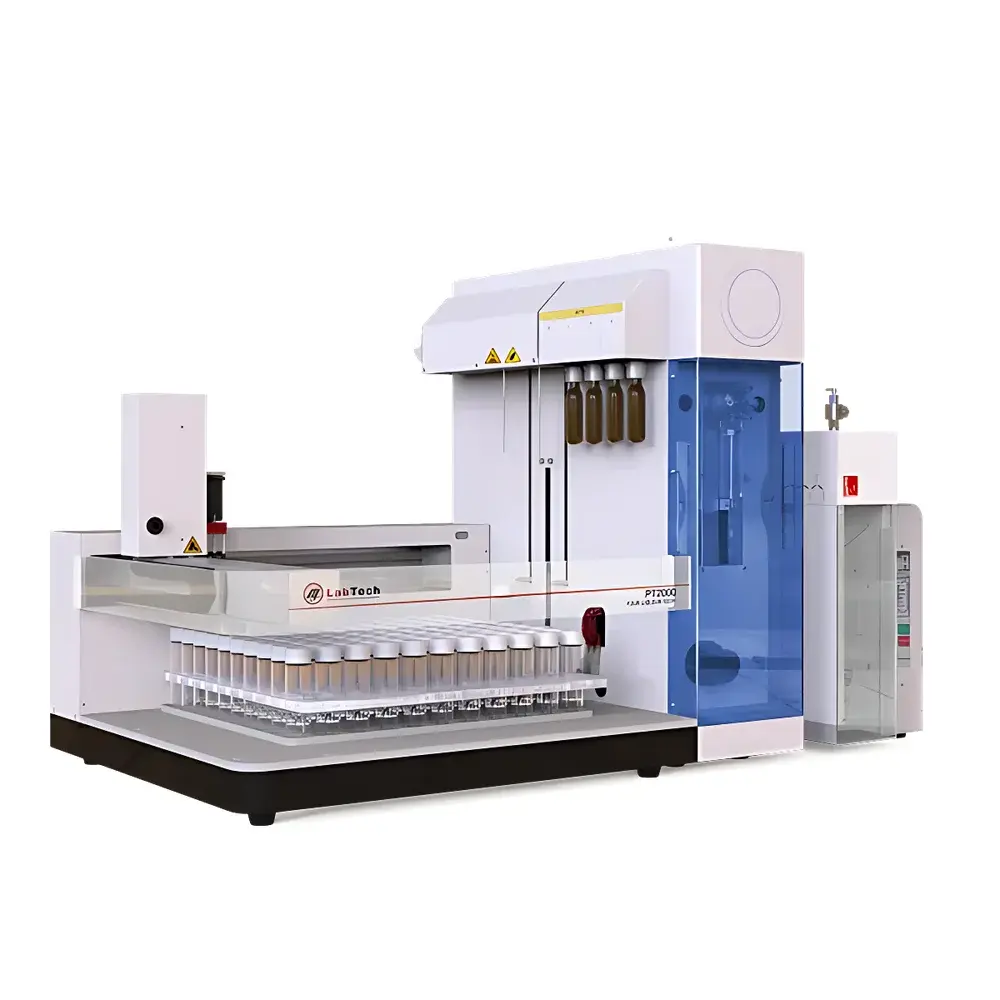
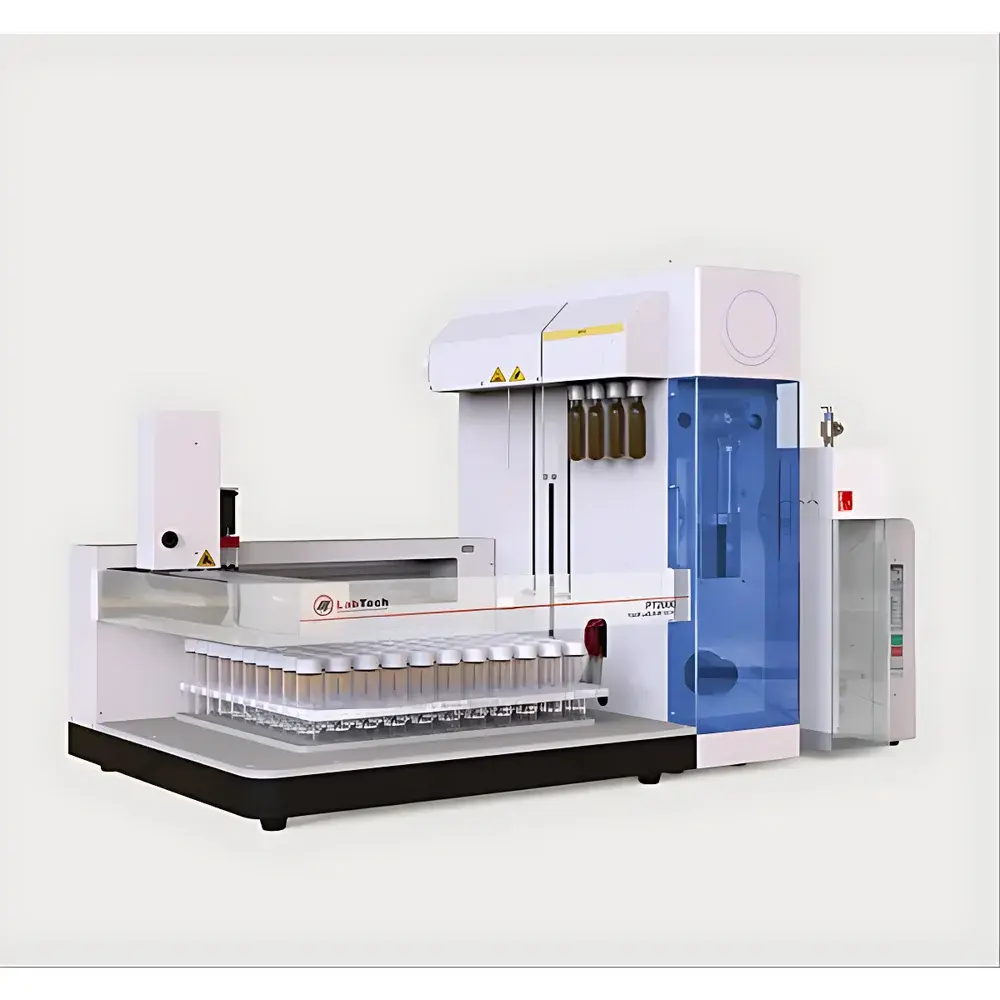
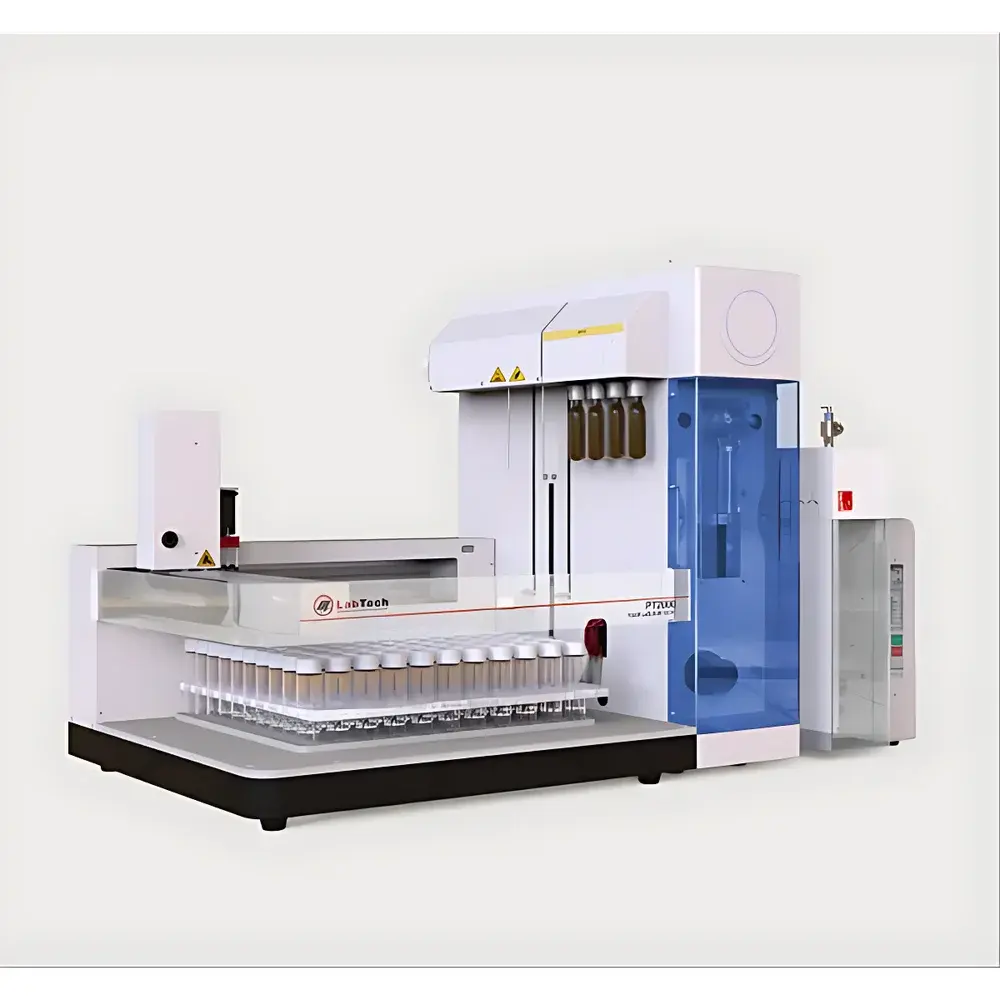
LabTech PT2000 Automated Solid-Liquid Purge and Trap Concentrator
| Brand | LabTech |
|---|---|
| Origin | Beijing, China |
| Model | PT2000 |
| Sample Capacity | 110 positions (water & soil) |
| Purge Temperature Range | Ambient to 95 °C |
| Trap Desorption Temperature | Up to 350 °C |
| Internal Standard Delivery | Electronic pressure-controlled, ≤1 s precision dispensing |
| Cleaning Protocol | Dual-mode (methanol + hot water) |
| Soil Penetration | Pneumatically assisted needle with back-pressure compensation and reverse purge |
| Software | Integrated method editor with emergency sample insertion, bake-in-method embedding, and automated calibration curve generation |
| Compliance | Designed for ASTM D6866, EPA Methods 502.2, 524.2, 624, 8260D, and ISO 15681-2 workflows |
Overview
The LabTech PT2000 Automated Solid-Liquid Purge and Trap Concentrator is an engineered solution for the quantitative preconcentration of volatile organic compounds (VOCs) from aqueous and solid environmental matrices prior to gas chromatographic analysis. Operating on the principle of dynamic headspace purging—where inert gas sweeps VOCs from the sample into a sorbent trap—the PT2000 integrates thermally controlled purge, cryogen-free ambient-temperature trapping, and rapid thermal desorption directly into the GC or GC/MS inlet. Unlike liquid nitrogen–dependent systems, its room-temperature trapping architecture eliminates condensation-related moisture and methanol carryover, significantly reducing background interference and column contamination. The instrument supports fully unattended operation across 110 sample positions, accommodating both liquid (e.g., groundwater, surface water) and heterogeneous solid samples (e.g., soil, sediment, sludge) without manual intervention or hardware reconfiguration.
Key Features
- Ambient-Temperature Trapping: Eliminates reliance on cryogens; prevents co-condensation of water and methanol, ensuring cleaner trap elution and extended sorbent life.
- Dual-Matrix Compatibility: Independent fluidic pathways and dedicated sampling probes prevent cross-contamination between water and soil samples—critical for regulatory-compliant environmental labs.
- Pneumatic Soil Penetration System: Equipped with pressure-assisted needle insertion, real-time back-pressure monitoring, and programmable reverse-purge cycles to mitigate clogging in high-clay or organic-rich soils.
- High-Precision Internal Standard Delivery: Electronically regulated pressure control delivers internal standards with ≤1 second response time; volume dispensed equals volume consumed—zero dead-volume loss or calibration drift.
- Automated Method Flexibility: Supports on-the-fly sample queue modification, including emergency sample insertion mid-run; bake-in methods can be embedded at any point in sequence without interrupting ongoing analysis.
- Integrated Cleaning Protocol: Sequential methanol rinse followed by hot water flush (up to 95 °C) removes residual organics and matrix interferences from transfer lines and traps, minimizing carryover between runs.
Sample Compatibility & Compliance
The PT2000 accommodates standard 40-mL VOA vials for water and 40-mL ASE-style jars for soil, with auto-sensing vial detection and position validation. Its design conforms to U.S. EPA Method requirements for VOC analysis—including Methods 502.2 (halogenated hydrocarbons), 524.2 (purgeable aromatics), 624 (nitrogen/phosphorus compounds), and 8260D (wide-spectrum VOCs)—and aligns with ASTM D6866 (radiocarbon-based biogenic VOC quantification) and ISO 15681-2 (water quality—determination of VOCs by purge-and-trap GC–MS). All method parameters—including purge time, temperature ramp profiles, desorption hold times, and bake-out cycles—are fully configurable and stored with audit-trail metadata compliant with GLP and 21 CFR Part 11 requirements when used with validated software configurations.
Software & Data Management
The PT2000 operates via LabTech’s unified instrument control platform, featuring a graphical method editor with drag-and-drop sequence building, real-time status dashboard, and integrated calibration curve generator. Users can define multi-point standard dilutions automatically—including serial dilution and spiking protocols—without external pipetting. All method files embed full parameter history, user login stamps, and electronic signatures. Raw acquisition logs are timestamped and exportable in .csv and .xml formats for LIMS integration. Audit trails record every parameter change, run start/stop event, and maintenance alert—enabling traceability for ISO/IEC 17025 accreditation and FDA inspection readiness.
Applications
The PT2000 serves environmental testing laboratories performing routine VOC monitoring in drinking water, wastewater, landfill leachate, and contaminated site soils. It is routinely deployed in EPA-certified labs for Superfund site assessments, RCRA compliance testing, and state-level groundwater surveillance programs. Its soil-capable configuration supports ASTM D5369 and EPA SW-846 Method 5035A applications, where VOC recovery from low-permeability matrices demands precise purge gas distribution and thermal management. Research institutions also utilize the system for method development in emerging contaminant studies—including halogenated ethers (e.g., 1,4-dioxane), fuel oxygenates (e.g., MTBE), and chlorinated solvents—where reproducibility and low method detection limits (<0.01 µg/L in water; <0.1 µg/kg in soil) are essential.
FAQ
Does the PT2000 require liquid nitrogen or other cryogens for trapping?
No. It utilizes ambient-temperature sorbent trapping, eliminating cryogen dependency and associated safety and logistical constraints.
Can the same trap be used for both water and soil analyses without cross-contamination?
Yes. The system employs physically segregated fluid paths and automatic probe cleaning between matrix types, validated per EPA 5035A cross-contamination protocols.
How is internal standard accuracy maintained across long unattended runs?
Electronic pressure control ensures volumetric delivery repeatability within ±0.5% RSD over 100+ injections; no syringe wear or evaporation losses occur.
Is the software compatible with third-party LIMS and chromatography data systems?
Yes. It supports ASTM E1384-compliant data export and offers optional OPC UA connectivity for enterprise-scale lab automation integration.
What maintenance intervals are recommended for routine operation?
Trap replacement every 200–300 runs; transfer line bake-out weekly; full system performance verification quarterly per ASTM D7827 guidelines.



