
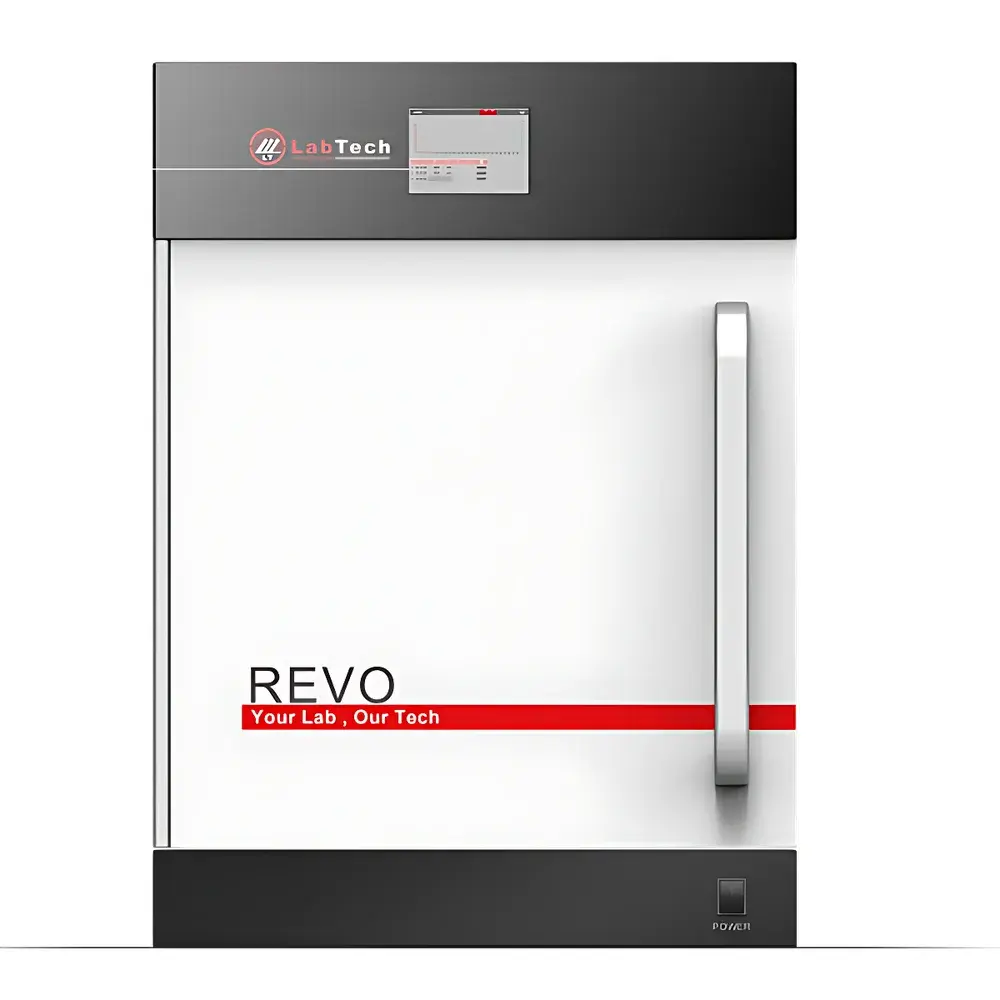
LabTech REVO Microwave Digestion and Extraction System
| Brand | LabTech |
|---|---|
| Origin | Beijing, China |
| Manufacturer Type | Direct Manufacturer |
| Origin Category | Domestic (China) |
| Model | REVO |
| Pricing | Available Upon Request |
| Cavity Grade | Industrial-Grade |
| Sample Capacity | 40 Vessels |
| Microwave Source | Dual Industrial Magnetrons |
| Max Operating Temperature | Up to 300 °C (typical for high-pressure digestion) |
| Temp. Measurement Accuracy | ±0.5 °C (infrared, full-vessel monitoring) |
| Temp. Control Stability | ±1 °C over 30 min |
| Temp. Uniformity Across Cavity | ±3 °C (validated per ASTM E2912-13) |
| Max Pressure Rating | 150 bar (burst-tested to 225 bar) |
Overview
The LabTech REVO Microwave Digestion and Extraction System is an industrial-grade, high-throughput platform engineered for reproducible, trace-metal–grade sample preparation in environmental, geological, clinical, and regulatory laboratories. Built upon LabTech’s two-decade expertise in inorganic sample preparation, the REVO integrates cavity-resonant microwave energy delivery with real-time, vessel-level process monitoring to meet stringent method requirements under EPA Method 3051A/3052, ISO 15587-1, and ASTM D5686. Its core architecture employs dual magnetron power generation (2 × 1000 W, 2450 MHz), coupled with a proprietary mode-stirring resonant cavity that ensures spatially uniform field distribution—critical for consistent thermal profiles across all 40 reaction vessels. Unlike consumer-grade systems, the REVO utilizes a monolithic, pressure-rated stainless-steel cavity structure with integrated RF gasketing and triple-interlocked safety latches, achieving microwave leakage <0.1 mW/cm² at 5 cm (IEC 61000-4-3 compliant; <1% of China’s GB 4706.21 limit).
Key Features
- Industrial-grade monolithic cavity: One-piece cast stainless-steel construction with reinforced structural integrity, eliminating seam-related hot spots and ensuring long-term pressure-cycle durability.
- Full-vessel E-TEM monitoring: Simultaneous infrared temperature and piezoresistive pressure sensing on all 40 vessels—no sampling delay or averaging artifacts; data logged at 1 Hz resolution.
- Dual-magnetron power management: Independent control of two 1000 W magnetrons enables dynamic power ramping, adaptive load compensation, and precise energy deposition—even with heterogeneous or low-absorbing matrices (e.g., silica-rich soils or polymer composites).
- Graphical touchscreen interface: 10.1″ capacitive color display with intuitive drag-and-drop method editor; supports live parameter adjustment during active runs—including ramp rate, hold time, and final setpoint—without interrupting digestion cycles.
- Modular chemistry platform: Configurable for closed-vessel microwave digestion, open-vessel solvent extraction, accelerated solvent extraction (ASE), and leaching protocols—enabling method harmonization across QC, R&D, and compliance labs.
- Comprehensive safety architecture: Includes pressure-relief rupture disks (certified to ISO 15587-2), redundant door interlocks, cavity temperature cutoff (<120 °C), and real-time arc detection with automatic power shutdown.
Sample Compatibility & Compliance
The REVO accommodates standard 55 mL quartz or PTFE-TFM digestion vessels (compatible with LabTech’s UltraClean™ and High-Pressure Xpress™ series), supporting sample masses up to 1.0 g for silicate matrices and 0.5 g for organic-rich samples. It meets ISO/IEC 17025:2017 requirements for method validation documentation and provides audit-ready electronic records compliant with FDA 21 CFR Part 11 (electronic signatures, user access controls, and immutable audit trails). All pressure/temperature calibration certificates are NIST-traceable, and system qualification reports include IQ/OQ/PQ templates aligned with GLP and GMP environments.
Software & Data Management
REVOControl™ software (v4.2+) delivers secure, role-based workflow management with encrypted local database storage and optional networked deployment. Each run generates a timestamped .CSV and .PDF report containing raw sensor data, method metadata, and pass/fail flags against user-defined acceptance criteria (e.g., max ΔT between vessels <5 °C). The software supports LIMS integration via ASTM E1384-compliant HL7 and CSV export, and includes built-in tools for statistical process control (SPC) charting—tracking %RSD of digestion efficiency across batches using internal recovery standards (e.g., NIST SRM 2711a).
Applications
- Environmental analysis: Total metal determination in soils, sediments, sludges, and airborne particulates (PM2.5/PM10 filters) per EPA SW-846 Methods 3051A and 3052.
- Clinical toxicology: Quantification of As, Cd, Pb, and Hg in whole blood, urine, and tissue homogenates under CLIA and CAP-accredited workflows.
- Geochemical exploration: Rapid dissolution of refractory minerals (e.g., zircon, monazite) for ICP-MS trace element fingerprinting.
- Pharmaceutical excipient testing: Residual catalyst metal screening (Pd, Pt, Ni) in APIs per USP /.
- Food safety surveillance: Multi-element analysis in fortified cereals, infant formula, and seafood per ISO 17294-2.
FAQ
What safety certifications does the REVO hold?
The REVO conforms to IEC 61010-1 (Electrical Safety), IEC 61000-4-3 (EMC Immunity), and GB 4706.21 (Microwave Oven Safety); full test reports available under NDA.
Can the system be validated for GMP use?
Yes—LabTech provides IQ/OQ/PQ documentation packages, including calibration logs, performance verification protocols, and 21 CFR Part 11 configuration reports.
Is remote monitoring supported?
REVOControl™ supports secure HTTPS-based remote viewing of live runs and historical data via authenticated web browser; no VNC or third-party remote desktop required.
What vessel types are compatible?
Standard 40-position rotor accepts LabTech UltraClean™ (quartz), Xpress™ (TFM-lined), and custom OEM vessels meeting ISO 15587-2 dimensional tolerances.
How is temperature uniformity verified?
Uniformity is confirmed per ASTM E2912-13 using 40 calibrated thermocouples placed at vessel positions; typical deviation is ≤±3 °C at 200 °C steady state.



