
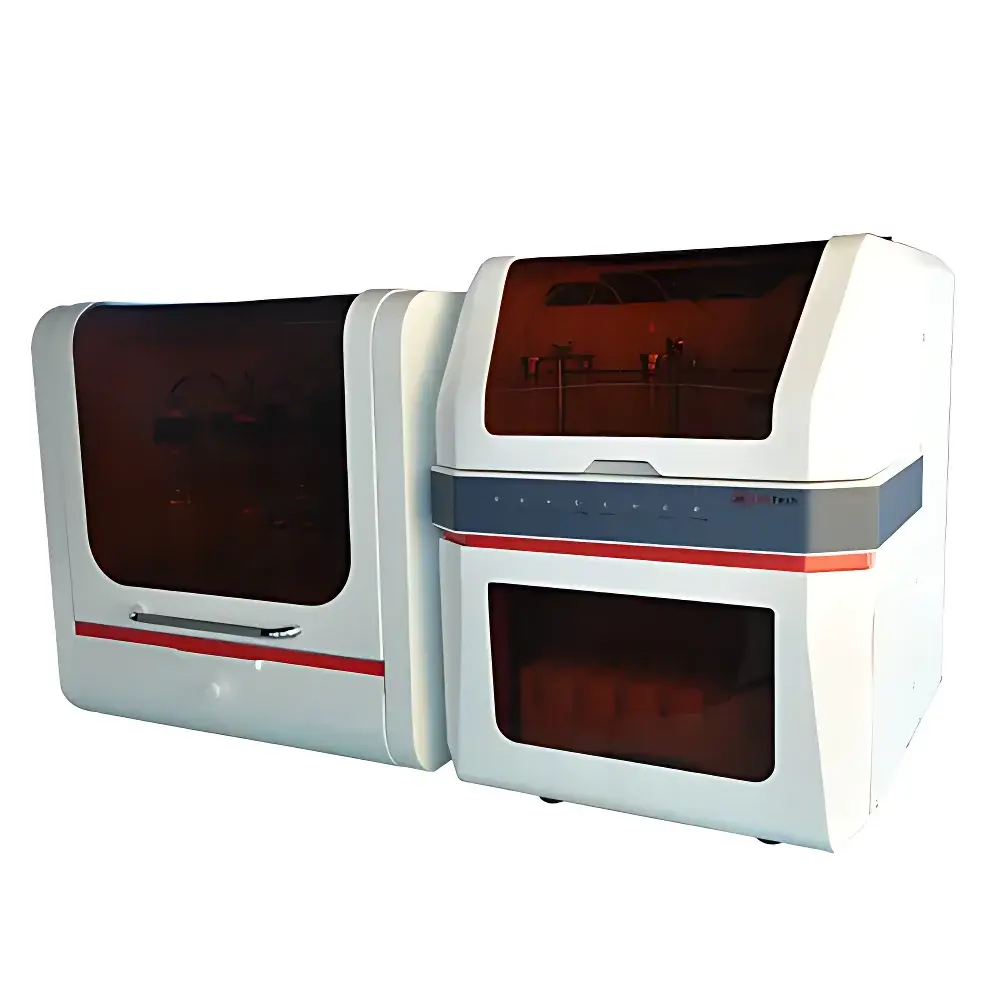
LabTech Sepaths UP Fully Automated Column-Membrane Universal Solid Phase Extraction System
| Brand | LabTech |
|---|---|
| Origin | USA |
| Manufacturer Type | Manufacturer |
| Product Origin | Imported |
| Model | Sepaths UP |
| Automation Level | Fully Automated |
| Number of Channels | Multi-channel |
| Extraction Mode | Membrane-based SPE |
| Flow Rate Control | 0–120 mL/min |
| Solvent Selection | Up to 8 different solvents |
| Sample Capacity | 12 samples simultaneously |
| Sample Loading Volume | 1–20 mL |
| Wetted Materials | PTFE, Stainless Steel |
Overview
The LabTech Sepaths UP Fully Automated Column-Membrane Universal Solid Phase Extraction System is an engineered solution for high-throughput, reproducible sample preparation in environmental, food safety, clinical, and regulatory laboratories. Designed around a dual-mode fluidic architecture, the system supports both conventional cartridge-based solid phase extraction (SPE) and membrane-based SPE—enabling method flexibility without hardware reconfiguration. Its core operation relies on precise positive-pressure solvent delivery, programmable sequential valve switching, and gravimetric or sensor-assisted liquid-level monitoring to ensure consistent flow dynamics across all channels. Unlike batch-processed manual systems, the Sepaths UP executes parallel processing of 1–12 independent samples with full method autonomy—including conditioning, loading, washing, drying, and elution—making it particularly suited for large-volume aqueous matrices (e.g., 1–20 mL drinking water, surface water, groundwater, and wastewater) where trace organic analytes (e.g., pesticides, pharmaceuticals, endocrine disruptors, PAHs) require quantitative enrichment prior to GC-MS or LC-MS/MS analysis.
Key Features
- Fully automated, unattended operation with pre-programmed or customizable method sequences
- Universal platform supporting both SPE cartridges (1–6 mL format) and Empore™-compatible extraction membranes—eliminating the need for separate instrumentation
- Multi-channel architecture with independent flow control per channel (0–120 mL/min), enabling method-matched flow rates across heterogeneous sample sets
- Integrated immersion function: capacitive level sensors detect solvent meniscus height to automatically initiate controlled soaking of membranes or cartridges, enhancing analyte retention and improving breakthrough resistance
- Complete sample loading assurance: post-loading bottle rinse with defined solvent volume ensures quantitative transfer of entire sample volume—critical for achieving >95% recovery in low-concentration environmental applications
- Chemically inert fluid path constructed entirely from PTFE and 316 stainless steel, ensuring compatibility with aggressive solvents (e.g., dichloromethane, acetonitrile, methanol) and minimizing background contamination
- Sealed, ventilated solvent management cabinet with integrated LED lighting, pressure-regulated exhaust, and leak-detection safeguards—designed for safe operation in standard laboratory environments
Sample Compatibility & Compliance
The Sepaths UP accommodates diverse aqueous sample types including potable water, freshwater, seawater (with appropriate filtration), wastewater effluents, and biological extracts (e.g., urine, plasma after protein precipitation). It complies with method requirements outlined in EPA Methods 508.1, 525.3, 537.1, and ISO 17923:2019 for trace organic analysis. All wetted components meet USP Class VI biocompatibility standards, and the system’s closed-loop solvent handling supports GLP and GMP-aligned workflows. Audit trail functionality—including user login, method versioning, run timestamps, and parameter change logs—is available when paired with LabTech’s optional LIMS-integrated software suite, satisfying FDA 21 CFR Part 11 data integrity requirements.
Software & Data Management
Controlled via LabTech’s proprietary SPEware™ v4.x software, the Sepaths UP offers intuitive graphical method building, real-time status monitoring, and remote diagnostics. Method templates adhere to SOP-driven logic trees, allowing users to define conditional steps (e.g., “if conductivity > X, trigger additional wash cycle”). Raw execution logs are stored in encrypted SQLite databases with SHA-256 hashing; export options include CSV, PDF reports, and XML for integration into enterprise LIMS or ELN platforms. Software validation packages—including IQ/OQ documentation and electronic signature support—are available upon request for regulated laboratories.
Applications
- High-volume screening of regulated contaminants in municipal drinking water supplies (e.g., PFAS, neonicotinoids)
- Routine monitoring of pesticide residues in surface water under national surveillance programs
- Pre-concentration of polar pharmaceuticals and metabolites from wastewater influent/effluent for ecotoxicological assessment
- Extraction of brominated flame retardants (BFRs) and organophosphate esters (OPEs) from groundwater near industrial sites
- Method development and validation studies requiring direct comparison of column vs. membrane performance under identical flow and solvent conditions
FAQ
Does the Sepaths UP support method validation per ISO/IEC 17025?
Yes—the system’s traceable calibration routines, documented maintenance logs, and software audit trails are structured to align with ISO/IEC 17025 clause 7.7 (Ensuring validity of results) and clause 7.8 (Reporting of results).
Can I use third-party SPE membranes or only Empore™?
The platform accepts any disk-shaped membrane with standard 47 mm diameter and compatible housing geometry; however, optimal flow characteristics and soak time algorithms are validated for Empore™ and LabTech-certified alternatives.
Is remote monitoring supported over LAN or VPN?
Yes—SPEware™ includes secure HTTP/S API endpoints and VNC-compatible remote desktop access, configurable within institutional firewall policies.
What maintenance intervals are recommended for long-term reliability?
PTFE tubing and solvent selector valves require inspection every 500 runs; pump calibration is advised quarterly; full system performance verification is included in annual service contracts.
How does the system handle viscous or particulate-laden samples?
Pre-filtration (0.45 µm or 0.22 µm) is required for all samples; the system does not include inline filtration but supports integration with LabTech’s optional autosampler-mounted filter modules.
Related Products



