
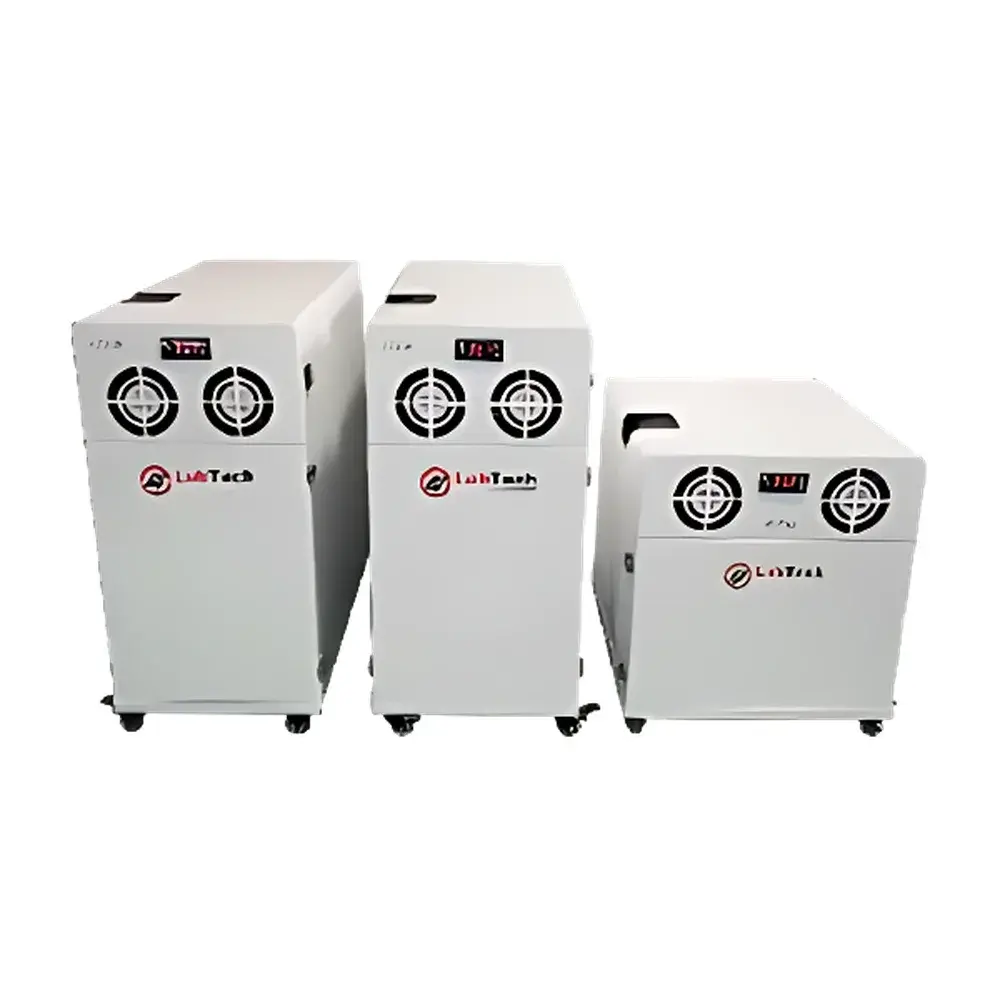
LabTech Silent Enclosure for Vacuum Pumps
| Brand | LabTech |
|---|---|
| Origin | Beijing, China |
| Manufacturer Type | Authorized Distributor |
| Country of Origin | China |
| Model | Silent Enclosure |
| Price | Upon Request |
| Translation Stage | Not Applicable |
| Displacement Platform | Not Integrated — Custom Mounting Available per Pump Configuration |
Overview
The LabTech Silent Enclosure is an engineered acoustic containment solution designed specifically for rotary vane and diaphragm vacuum pumps commonly deployed in mass spectrometry (MS), gas chromatography–mass spectrometry (GC-MS), liquid chromatography–mass spectrometry (LC-MS), and other high-sensitivity analytical laboratories. Operating on the principle of broadband sound absorption combined with controlled convective airflow management, the enclosure mitigates airborne noise transmission—primarily in the 50–8,000 Hz frequency range—generated by pump motor vibration, oil circulation, and exhaust pulsation. Unlike passive foam-lined boxes, this system integrates active thermal regulation and real-time operational awareness to ensure pump reliability without compromising acoustic performance. It complies with ISO 717-1:2015 for airborne sound insulation rating methodology and aligns with laboratory environmental requirements defined in ISO/IEC 17025:2017 Clause 6.3 (Facilities and Environmental Conditions).
Key Features
- Acoustic Performance: Surface-mounted micro-perforated wave-pattern acoustic panels—constructed from open-cell melamine formaldehyde foam—dissipate incident sound energy via viscous losses across >10⁶ internal microchannels; validated attenuation ≥70% (A-weighted SPL reduction of ≥18 dB(A) at 1 m distance under typical 60 Hz pump operation).
- Thermal Management: Dual asymmetric ventilation architecture: a low-turbulence intake grille (front-bottom) and a high-capacity axial exhaust (rear-top) sustain laminar flow paths; rated volumetric airflow: 300 m³/h at ΔP = 120 Pa, maintaining internal temperature rise ≤8 °C above ambient during continuous 24/7 operation.
- Intelligent Thermal Monitoring: Embedded NTC thermistor array continuously samples internal air temperature near pump exhaust manifold; LED display shows real-time reading (±0.5 °C accuracy); fan activation threshold configurable between 35–55 °C; audible alarm triggers at ≥65 °C with latching fault indication.
- Non-Intrusive Installation: Modular aluminum frame with tool-free quick-lock hinges and magnetic gasket seals enables field assembly in <15 minutes; pump remains fully operational during installation—no disconnection of vacuum lines, power cords, or cooling hoses required.
- Mobility & Stability: Four 100 mm polyurethane casters (two with dual-action brake levers) support safe repositioning on epoxy-coated or vinyl flooring; static load capacity: 120 kg; footprint optimized for standard MS bench layouts (W × D × H: 650 × 520 × 680 mm).
Sample Compatibility & Compliance
The enclosure accommodates most commercially available vacuum pumps with external dimensions ≤620 mm (L) × 490 mm (W) × 380 mm (H), including models from Agilent, Thermo Fisher Scientific, Shimadzu, and Edwards. It has been verified for compatibility with oil-lubricated rotary vane pumps (e.g., Agilent TWIS series, Edwards RV8) and dry scroll pumps (e.g., Leybold DURA series). All materials meet UL 94 V-0 flame-retardancy standards. Acoustic testing follows ASTM E90-09 procedures; thermal validation conducted per IEC 60034-6. Documentation supports GLP-compliant lab audits, including calibration records for embedded sensors and maintenance logs for filter replacement cycles.
Software & Data Management
While the enclosure operates autonomously, optional RS-485 Modbus RTU interface (available upon request) enables integration into centralized laboratory infrastructure monitoring systems (e.g., LabVantage LIMS, Siemens Desigo CC). Temperature logs can be exported as CSV via USB-C port (firmware v2.1+). Audit trails comply with FDA 21 CFR Part 11 requirements when deployed with validated electronic signature modules and role-based access control on host SCADA platforms.
Applications
- Noise-sensitive environments: ISO Class 5 cleanrooms, open-plan MS core facilities, university teaching labs with shared instrumentation bays.
- Regulatory compliance: Reducing occupational noise exposure below OSHA PEL (85 dB(A) TWA) and EU Directive 2003/10/EC limits.
- Pump longevity extension: Mitigating thermal stress-induced oil degradation and bearing wear in high-duty-cycle applications (e.g., multi-user LC-MS/MS platforms).
- Workflow continuity: Eliminating scheduled pump shutdowns for acoustic retrofitting or facility upgrades.
FAQ
Does the enclosure require electrical connection beyond the pump’s own power supply?
Yes — the enclosure’s fan control circuit, LED display, and alarm system operate on a dedicated 24 V DC input (included universal AC/DC adapter, 100–240 V AC input).
Can it be used with pumps that have rear-mounted exhaust ports?
Yes — the rear panel includes a customizable cutout kit with silicone gasketing for direct duct coupling to existing exhaust manifolds or activated carbon filters.
Is routine maintenance required?
Annual inspection of acoustic panel integrity and cleaning of intake/exhaust grilles with compressed air (≤3 bar) is recommended; replaceable pre-filters (optional accessory) should be changed every 6 months in dusty environments.
Does it affect pump ultimate vacuum or pumping speed?
No — independent verification using calibrated Pirani and capacitance manometers confirms no measurable deviation (<±2%) in base pressure or conductance across the full operating range of compatible pumps.



