
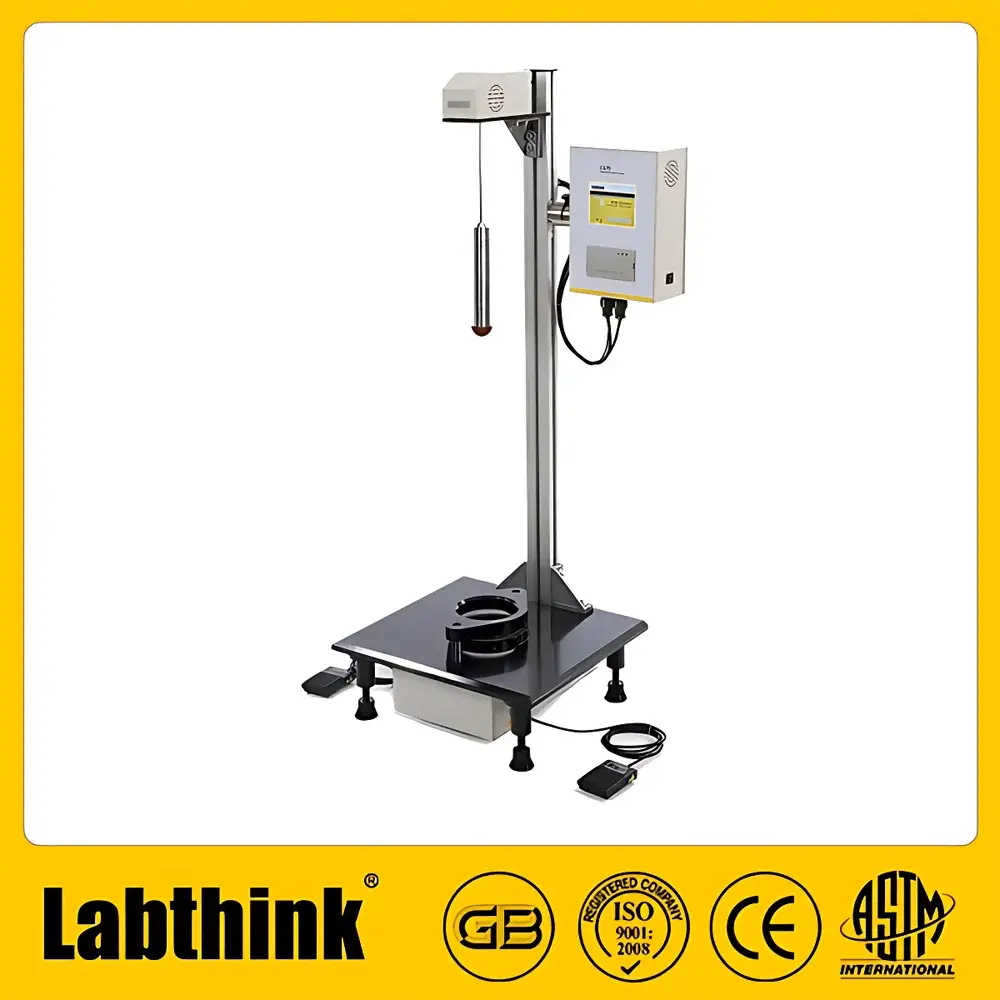
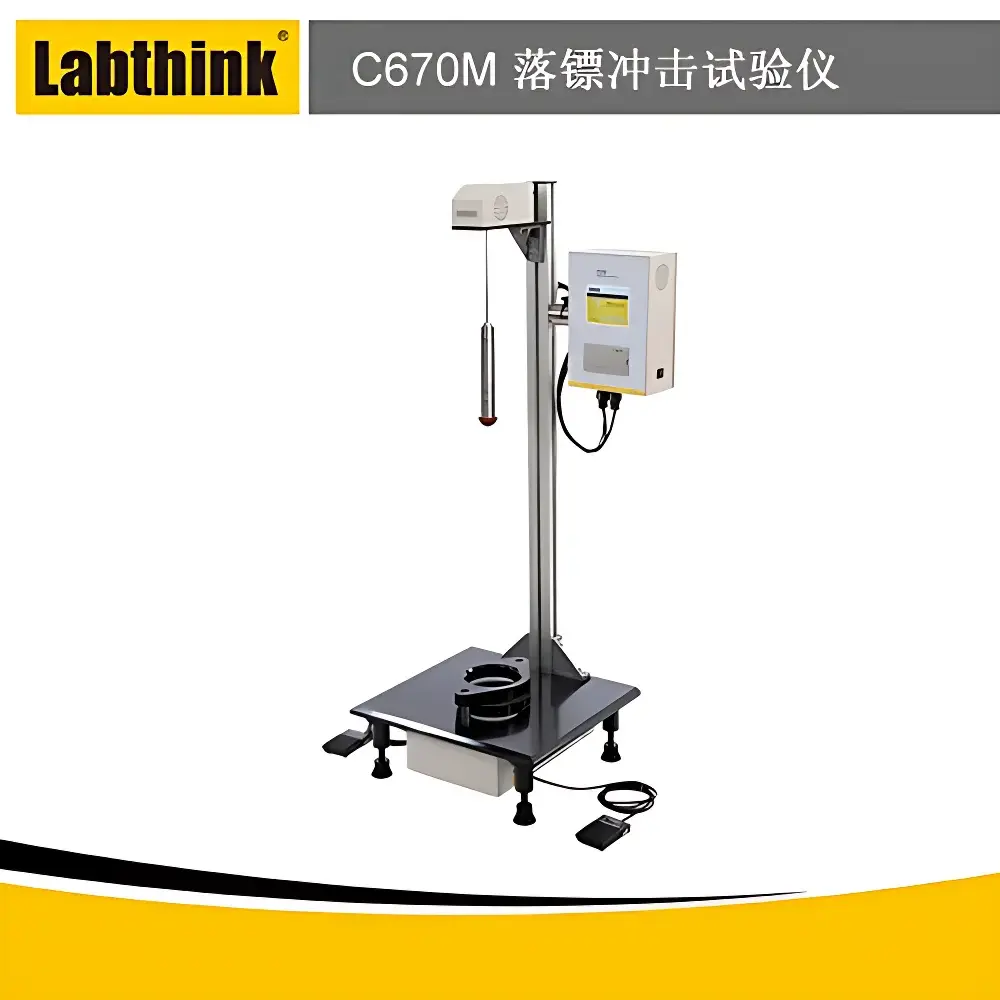
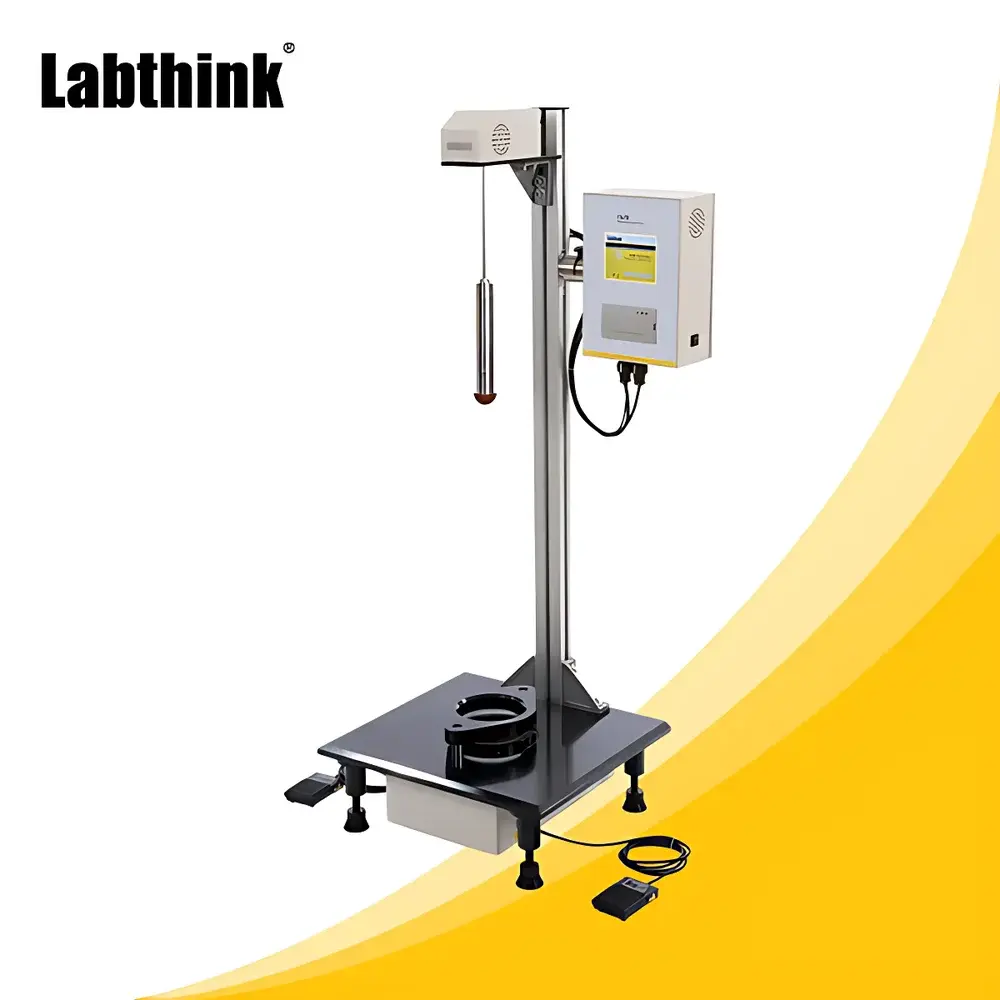
Labthink C670M Dart Impact Tester for Plastic Films and Packaging Materials
| Brand | Labthink |
|---|---|
| Model | C670M |
| Origin | Shandong, China |
| Manufacturer Type | Direct Manufacturer |
| Product Category | Domestic (China-Made) |
| Test Methods | ASTM D1709 (Method A & B), ISO 7765-1:1988, GB/T 9639.1–2008, JIS K7124-1 |
| Measurement Range | Method A: 50–2000 g |
| Method B | 300–2000 g |
| Mass Resolution | ±0.5% |
| Sample Clamping | Pneumatic (0.6 MPa required, Φ8 mm polyurethane tubing interface) |
| Sample Size | >150 mm × 150 mm |
| Power Supply | 220 VAC 50 Hz / 120 VAC 60 Hz |
| Net Weight | 70 kg |
| Dimensions (A Method) | 500 × 450 × 1320 mm (L×W×H) |
| (B Method) | 500 × 450 × 2160 mm (L×W×H) |
| Standard Configuration | Method A setup, 7″ color touchscreen HMI, built-in thermal printer |
| Optional Accessories | Method B conversion kit, Labthink SmartTest™ software suite, RS232 communication cable |
Overview
The Labthink C670M Dart Impact Tester is a precision-engineered instrument designed to quantify the impact resistance of flexible packaging materials—primarily plastic films, laminates, foils, and thin sheets—under controlled free-fall conditions. It operates on the fundamental principle of energy-based failure analysis: a standardized dart (weighted impactor) is released from a fixed height onto a horizontally clamped specimen; the mass at which 50% of test specimens fail defines the material’s impact strength. This probabilistic endpoint—determined via the staircase (up-and-down) method per ASTM D1709 and ISO 7765-1—is critical for evaluating seal integrity, puncture resistance, and structural robustness in food packaging applications where mechanical abuse during distribution, stacking, or handling poses real-world risk. The system supports two internationally recognized test protocols: Method A (lower-mass range, suited for thin films like LDPE wrap or CPP liners) and Method B (higher-mass range, optimized for thicker structures such as stand-up pouches or heavy-duty shipping bags). Its rigid frame, electromagnetic dart release mechanism, and pneumatic clamping ensure high reproducibility (<2% RSD across repeated trials under GLP-compliant operation) and eliminate operator-induced variability inherent in manual release systems.
Key Features
- Electromagnetic dart suspension and release: Ensures precise, zero-delay detachment with no mechanical trigger interference—critical for eliminating kinetic bias in impact velocity.
- Pneumatic sample clamping system: Applies uniform, repeatable pressure (0.6 MPa) across the full clamping area (>150 mm × 150 mm), minimizing edge slippage and ensuring consistent stress distribution during impact.
- Dual-mode operational logic: Fully automated execution of ASTM D1709 Method A and optional Method B, including real-time pass/fail classification, adaptive mass adjustment (±Δm), and termination criteria based on cumulative failure count (N = 10).
- 7-inch capacitive color touchscreen HMI: Menu-driven interface with multilingual support (English, Spanish, Chinese), intuitive parameter entry, live status feedback, and embedded LED illumination for visual inspection of specimen deformation post-impact.
- Modular hardware architecture: Field-upgradable configuration—Method A base unit can be extended to Method B via certified mechanical retrofit kit without recalibration.
- Dual activation modes: Manual button press or footswitch engagement, enabling hands-free operation during high-throughput lab workflows.
Sample Compatibility & Compliance
The C670M accommodates a broad spectrum of planar, non-rigid substrates up to 1 mm thickness, including monolayer polymers (e.g., PET, OPP, PE), coextruded films, metallized laminates (Al/PE, Al/PET), aluminum foil, paperboard, and composite packaging structures. It complies fully with ISO/IEC 17025-aligned testing practices when operated within validated environmental conditions (23 ± 2 °C, 50 ± 5% RH). All firmware and calibration records adhere to FDA 21 CFR Part 11 requirements for electronic records and signatures when paired with Labthink SmartTest™ software. Test reports generated meet audit-ready formatting standards for ISO 9001, IATF 16949, and BRCGS Packaging Material certification pathways. Reference standards implemented include ASTM D1709–22 (Standard Test Methods for Impact Resistance of Plastic Film by the Free-Falling Dart Method), ISO 7765-1:1988 (Plastics — Film and Sheeting — Determination of Impact Resistance — Part 1: Free-Falling Dart Method), GB/T 9639.1–2008 (Chinese national standard equivalent), and JIS K7124-1:2011 (Japanese Industrial Standard).
Software & Data Management
Labthink SmartTest™ software (optional) provides comprehensive data acquisition, visualization, and reporting functionality. It captures raw impact events—including mass value, pass/fail outcome, timestamp, operator ID, and environmental metadata—and renders real-time force–displacement curves (derived from calibrated mass–height–failure correlation models). Results are exportable in CSV, PDF, and XML formats compatible with LIMS integration. Audit trails record all user actions, parameter changes, and calibration events with tamper-proof timestamps. The system supports 21 CFR Part 11 compliance through role-based access control, electronic signatures, and encrypted database storage. Built-in RS232 serial interface enables bidirectional communication with laboratory information systems; optional Ethernet/Wi-Fi modules facilitate networked deployment in centralized QC environments.
Applications
Primary use cases span quality assurance and R&D laboratories in food, pharmaceutical, and consumer goods packaging supply chains. Typical applications include: evaluation of heat-seal strength retention after sterilization cycles; comparative assessment of recyclable mono-material structures versus traditional laminates; validation of barrier film performance under mechanical stress; shelf-life prediction modeling for pouch integrity under simulated logistics conditions; and incoming inspection of rollstock from extrusion or coating lines. Extended configurations support shoulder pad impact testing (per internal automotive textile specifications) and controlled-ball impact assessment for rigid sheet materials using accessory fixtures—enabling cross-industry utility while maintaining metrological traceability to NIST-traceable mass standards.
FAQ
What is the difference between Method A and Method B in ASTM D1709?
Method A uses a 38 mm diameter hemispherical dart and is intended for thinner films (typically <125 µm); Method B employs a 50 mm dart and targets thicker, higher-strength materials (e.g., >125 µm or multi-layer laminates). The C670M supports both via hardware reconfiguration.
Is an external air supply required?
Yes—a clean, dry compressed air source delivering 0.6 MPa (6 bar) is mandatory for pneumatic clamping. The unit includes a Φ8 mm polyurethane quick-connect fitting; users must provide regulated air infrastructure.
Can test data be exported to Excel or LIMS?
Yes. With SmartTest™ software installed, results export directly to CSV (Excel-compatible) and support HL7/LabVantage LIMS integration via configurable API endpoints.
Does the instrument require annual recalibration?
Per ISO/IEC 17025 guidelines, mass calibration of the dart weights and verification of drop height accuracy should be performed annually by an accredited metrology provider; Labthink offers certified calibration services with NIST-traceable documentation.
What safety certifications does the C670M hold?
It carries CE marking per Machinery Directive 2006/42/EC and EMC Directive 2014/30/EU, and conforms to UL 61010-1:2012 for electrical safety in laboratory equipment.





