
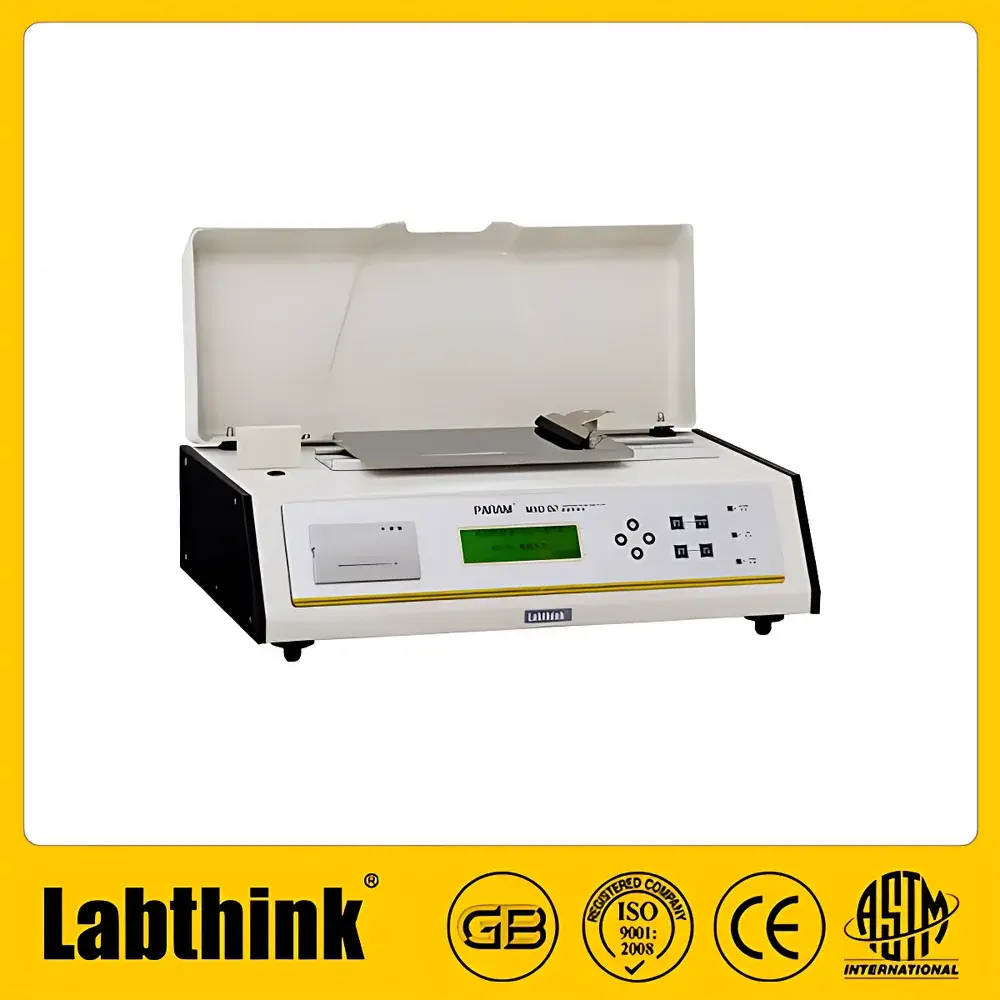
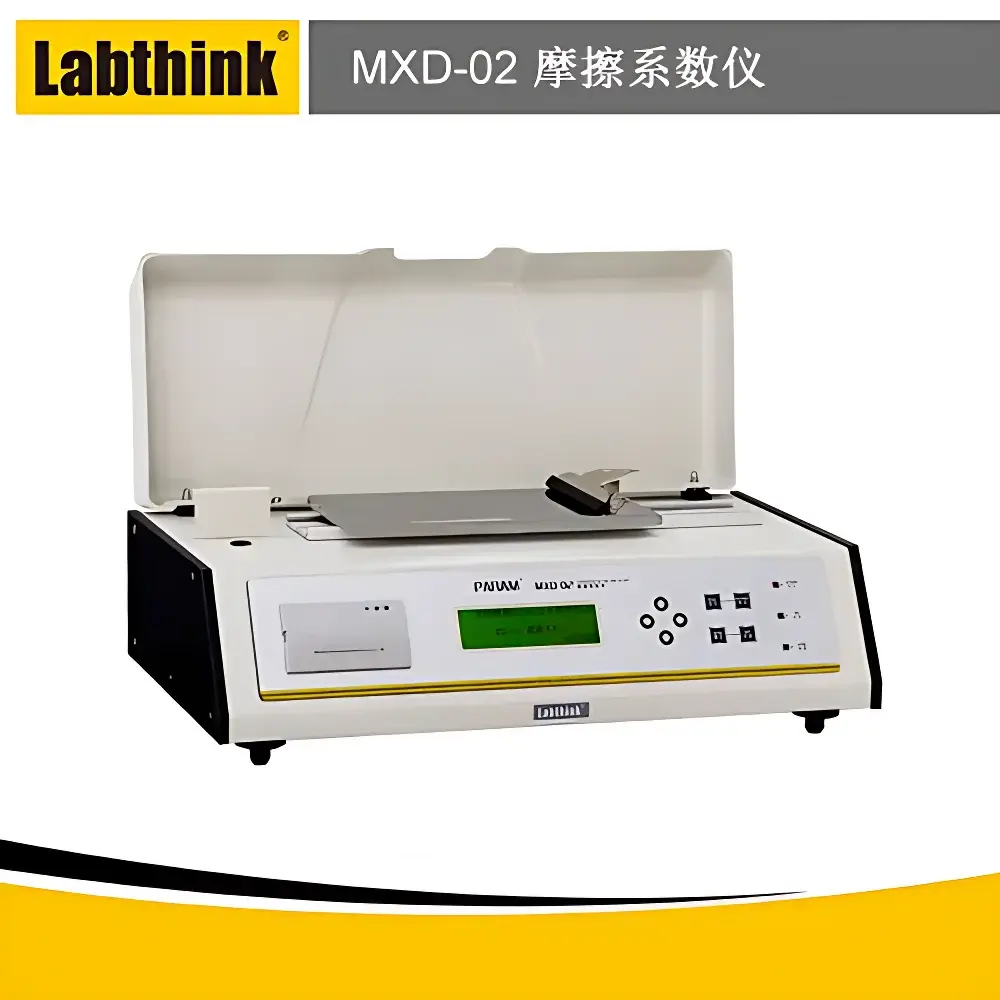
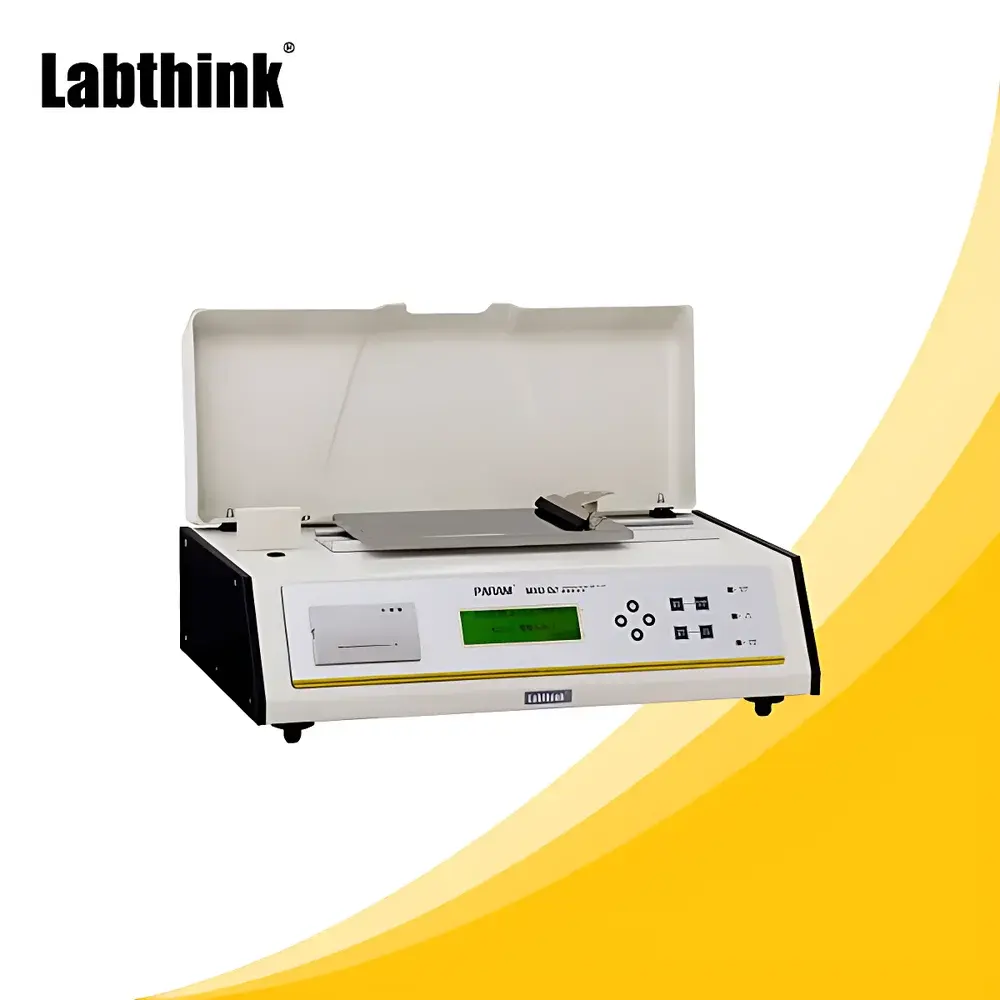
Labthink MXD-02 Coefficient of Friction Tester (Static & Kinetic)
| Brand | Labthink |
|---|---|
| Model | MXD-02 |
| Origin | Shandong, China |
| Manufacturer Type | Direct Manufacturer |
| Country of Origin | China |
| Load Range | 0–5 N |
| Accuracy Class | 0.5 |
| Travel Distance | 70 mm / 150 mm |
| Standard Slider Mass | 200 g (customizable) |
| Test Speeds | 100 mm/min, 150 mm/min (adjustable) |
| Ambient Conditions | 23 ± 2 °C, 20–70 %RH |
| Power Supply | 220 VAC 50 Hz / 120 VAC 60 Hz |
| Dimensions (L×W×H) | 630 × 360 × 230 mm |
| Net Weight | 33 kg |
| Compliance | GB 10006, ISO 8295, ASTM D1894, TAPPI T816 |
Overview
The Labthink MXD-02 Coefficient of Friction Tester is an electromechanical instrument engineered for precise, repeatable measurement of static (μs) and kinetic (μk) coefficients of friction in solid material interfaces under controlled sliding conditions. Based on the fundamental principle of horizontal pull testing—where a standardized slider is drawn across a stationary test surface at defined normal load and velocity—the MXD-02 quantifies the peak force required to initiate motion (static friction) and the sustained force during steady-state sliding (kinetic friction). This methodology aligns with internationally recognized tribological test protocols and serves as a critical quality control metric for materials where surface interaction directly impacts functional performance, safety, and manufacturability.
Key Features
- Simultaneous dual-mode measurement: Single-test acquisition of both static and kinetic friction coefficients without manual reconfiguration.
- Programmable test parameters: Adjustable traverse speed (100 mm/min and 150 mm/min standard; extended range available), selectable slider mass (200 g standard; optional 500 g or custom masses), and configurable normal load (0–5 N).
- Electromagnetic integrity assurance: Test platform and slider undergo certified demagnetization and residual magnetism verification to eliminate parasitic magnetic interference—a known source of signal drift in high-sensitivity force transduction systems.
- Microprocessor-based control architecture: Integrated microcontroller with PVC membrane keypad and LCD display enables intuitive menu-driven operation, real-time parameter monitoring, and immediate result readout.
- High-stability hardware design: Critical components—including load cell, stepper motor drive, and position encoder—are sourced from internationally qualified suppliers to ensure long-term metrological stability and mechanical repeatability.
- Dual data output pathways: Built-in thermal mini-printer for on-site hardcopy reporting and RS232 serial interface for bidirectional communication with external PCs.
Sample Compatibility & Compliance
The MXD-02 accommodates a broad spectrum of planar, flexible, and semi-rigid substrates used across packaging, automotive, construction, and consumer goods industries. Validated applications include plastic films and sheets (e.g., PE, PET, BOPP), rubber compounds, paperboard, woven and nonwoven textiles, coated metals (e.g., aluminum foil laminates), wood flooring composites, elastomeric brake linings, tire tread compounds, footwear outsoles, and cosmetic packaging films. All test procedures conform to mandatory regulatory and industry-standard methods: GB 10006 (China), ISO 8295 (International Organization for Standardization), ASTM D1894 (American Society for Testing and Materials), and TAPPI T816 (Technical Association of the Pulp and Paper Industry). The system supports method selection per user-defined protocol, enabling cross-laboratory comparability and audit-ready traceability in GLP- and GMP-regulated environments.
Software & Data Management
Optional Lystem™ Laboratory Data Sharing System software provides comprehensive post-test analysis capabilities. It enables automated statistical evaluation (mean, SD, CV%, confidence intervals) for single or grouped test sets, raw data reprocessing with modified filtering or baseline correction, overlay visualization of comparative friction curves, and customizable report generation compliant with internal QA documentation requirements. Audit trail functionality records operator ID, timestamp, method version, calibration status, and parameter changes—supporting compliance with FDA 21 CFR Part 11 electronic record and signature provisions when deployed in regulated manufacturing settings.
Applications
- Packaging development: Optimizing film slip characteristics for high-speed filling, sealing, and stacking operations.
- Flooring quality assurance: Verifying anti-slip performance of laminate, engineered wood, and vinyl planks per ASTM F2508 and EN 13893.
- Automotive component validation: Assessing coefficient consistency of interior trim films, seat fabrics, and pedal surfaces under varying humidity conditions.
- Pharmaceutical packaging: Ensuring consistent draw resistance of blister cavity lidding foils and carton board foldability.
- Personal care product formulation: Quantifying tactile glide behavior of tube extrusion films and applicator coatings.
- Research & standards laboratories: Supporting interlaboratory round-robin studies and reference material certification.
FAQ
What standards does the MXD-02 comply with?
The instrument fully implements GB 10006, ISO 8295, ASTM D1894, and TAPPI T816 test methods, with hardware and firmware calibrated to meet the force resolution, speed tolerance, and environmental control requirements specified in each standard.
Can the MXD-02 measure friction on curved or textured surfaces?
It is designed for flat, macroscopically uniform specimens. Surface curvature or pronounced topography exceeding ±25 µm deviation over the 63 mm contact length may introduce measurement uncertainty and is not recommended without prior method validation.
Is calibration traceable to national metrology institutes?
Yes—load cell calibration is performed using NIST-traceable deadweight standards, and velocity verification is conducted via laser interferometry. A full calibration certificate with uncertainty budget is supplied with each unit.
Does the system support 21 CFR Part 11 compliance?
When configured with Lystem™ software, user authentication, electronic signatures, and immutable audit trails are enabled—meeting core technical requirements for regulated data integrity in pharmaceutical and medical device manufacturing.
What maintenance is required for long-term accuracy?
Routine verification includes monthly slider mass calibration check, biannual load cell linearity verification, and annual full-system recalibration by authorized Labthink service engineers using certified reference artifacts.







