
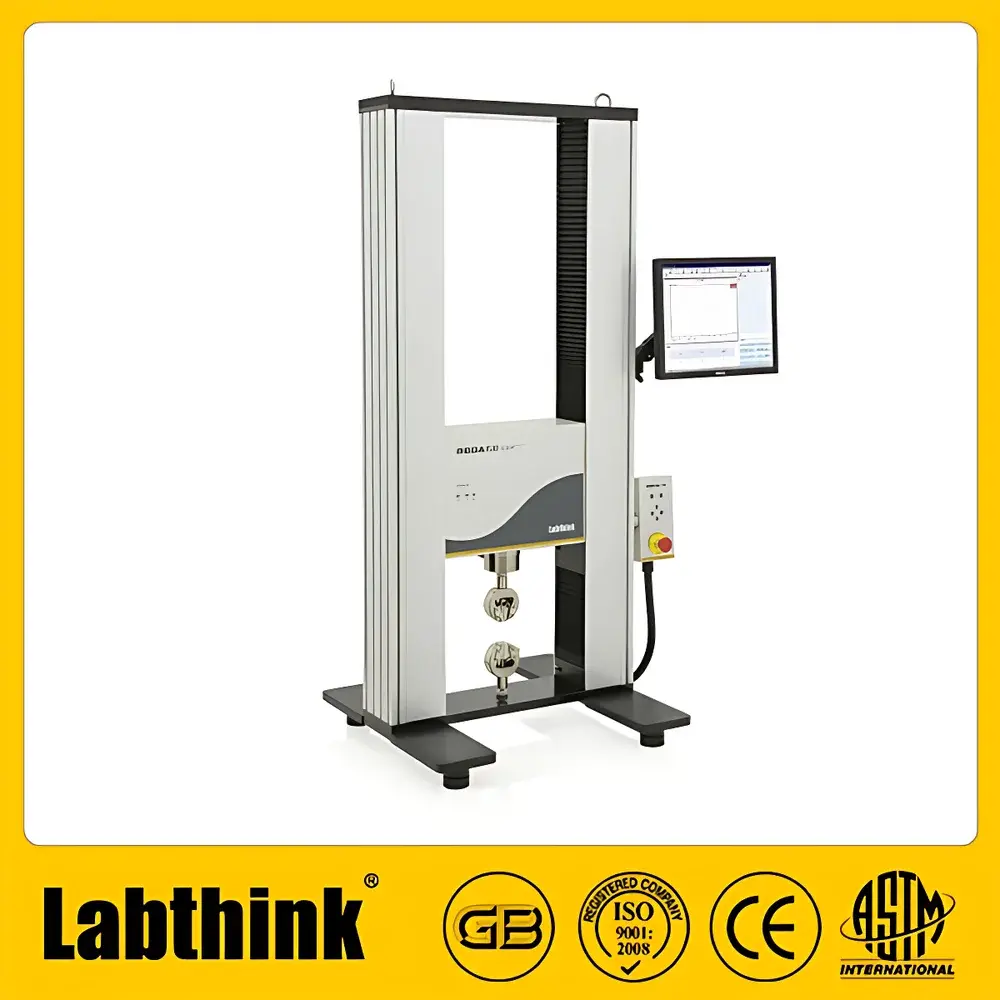
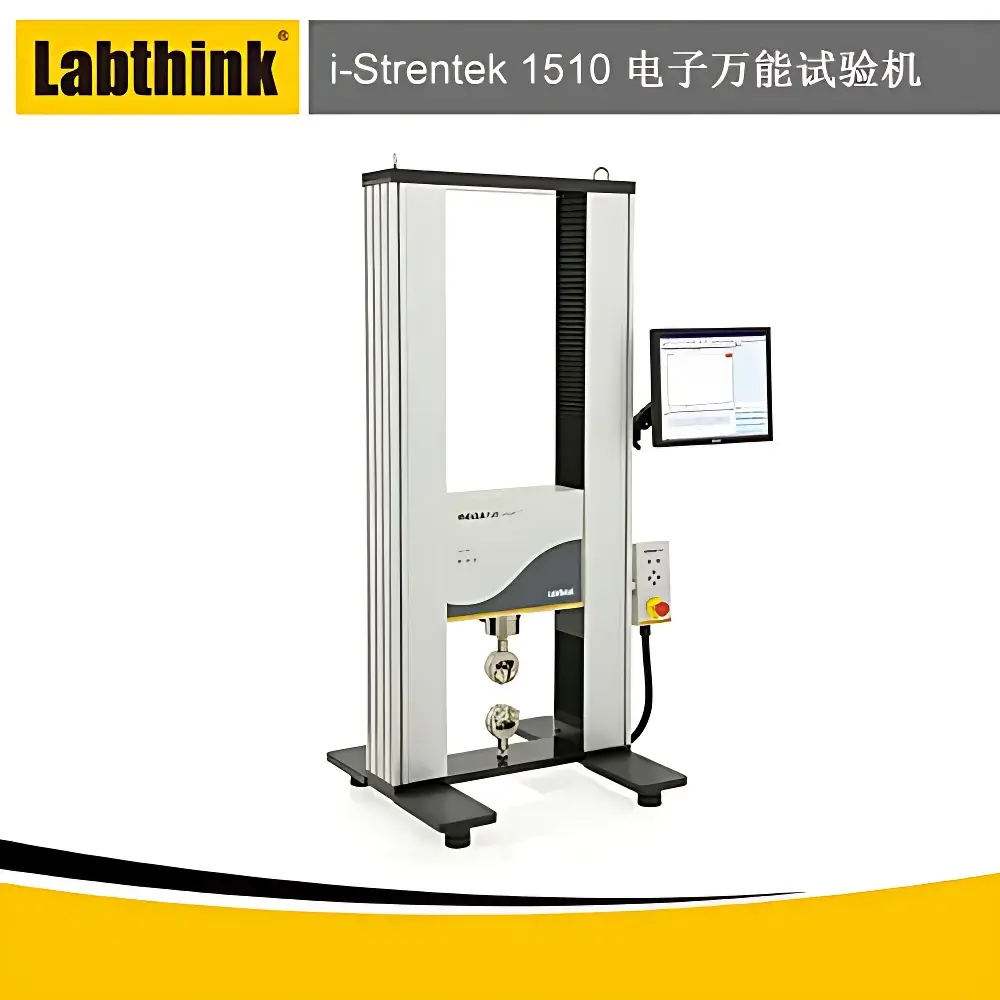
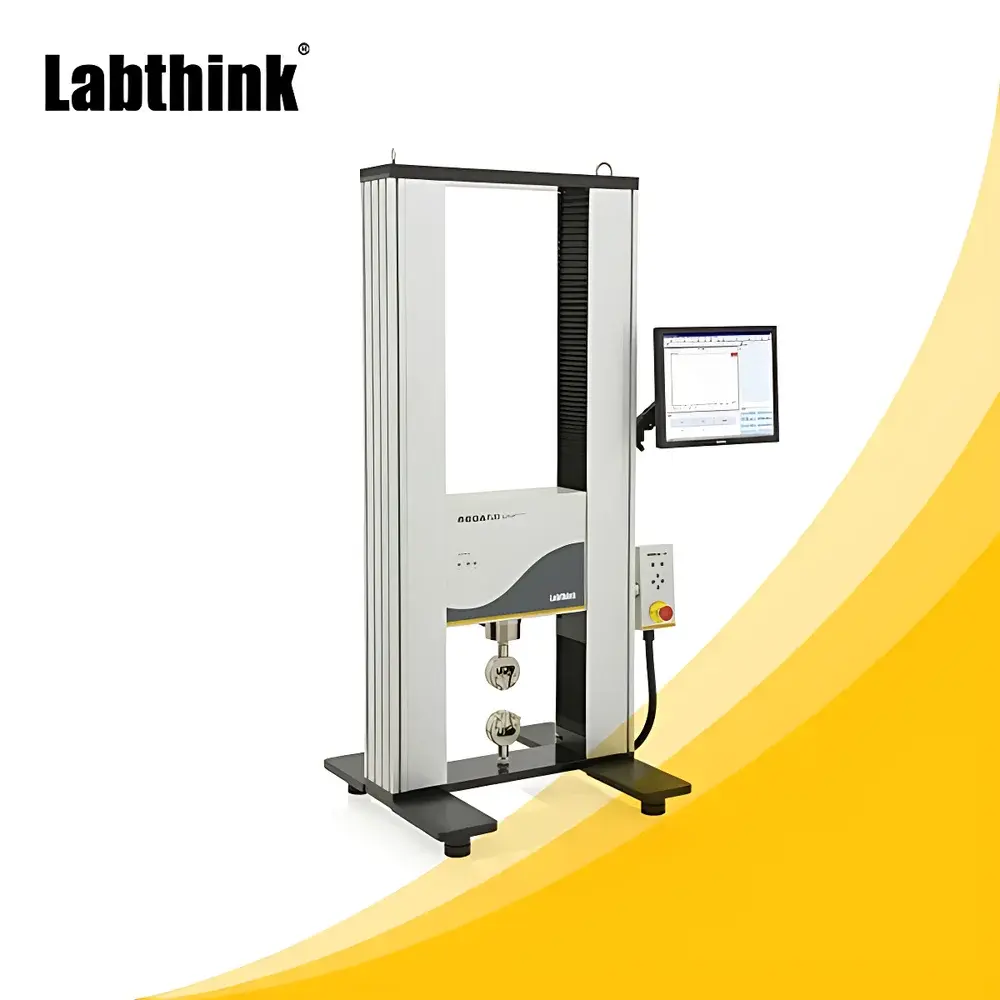
Labthink i-Strentek 1510 Universal Testing Machine
| Brand | Labthink |
|---|---|
| Model | i-Strentek 1510 |
| Type | Electromechanical Universal Testing Machine |
| Load Capacity Options | 50 N, 100 N, 250 N, 500 N (standard), 1,000 N, 2,000 N, 5,000 N, 10,000 N |
| Accuracy Class | Class 1 per ISO 7500-1 / ASTM E4 |
| Test Speed Range | 1–500 mm/min (infinitely variable) |
| Maximum Travel | 800 mm |
| Drive System | Dual-column, ball-screw with preloaded nut transmission |
| Control System | Embedded real-time OS with membrane keypad interface |
| Data Interfaces | 4× USB 2.0 ports, 2× RJ45 Ethernet ports |
| Power Supply | 220 VAC 50 Hz or 120 VAC 60 Hz |
| Dimensions (L×W×H) | 850 × 700 × 1630 mm |
| Net Weight | 150 kg |
| Sample Clamping | Pneumatic or manual |
| Compliance Standards | GB/T 1040, GB/T 2792, GB/T 4850, ISO 37, ASTM D882, ASTM D1938, ASTM F88, ASTM F904, JIS P8113, YBB pharmaceutical packaging standards |
Overview
The Labthink i-Strentek 1510 Universal Testing Machine is an electromechanical force-testing platform engineered for high-reproducibility mechanical characterization of flexible and semi-rigid materials across R&D, QC, and regulatory-compliant environments. It operates on the fundamental principle of controlled uniaxial displacement: a precision-driven crosshead moves relative to a fixed base, applying tensile, compressive, flexural, or peel loads to specimens clamped between upper and lower fixtures. Force is measured via a calibrated load cell mounted in the moving crosshead, while displacement is tracked using a high-resolution linear encoder integrated into the ball-screw drive train. All signal acquisition occurs at ≥1 kHz sampling rate, ensuring fidelity in transient event capture—critical for peel initiation detection, tear propagation analysis, or burst point identification. The system’s rigid dual-column architecture minimizes deflection under load, supporting repeatable measurements within ±0.5% of reading across its full speed range (1–500 mm/min), meeting ISO 7500-1 Class 1 verification requirements.
Key Features
- Modular test capability: Integrates standardized protocols for tensile strength, elongation at break, Young’s modulus, 90°/180° peel, trouser tear, puncture resistance, compression (e.g., corrugated boxes, IBC totes), seal strength, and cap removal torque simulation—all within a single hardware platform.
- Precision motion control: Preloaded ball-screw transmission with recirculating ball nuts ensures backlash-free, low-friction actuation and sub-micron positional repeatability over 800 mm stroke.
- Intelligent safety architecture: Multi-tier protection includes mechanical end-limit switches, electronic overload cutoff (adjustable threshold), automatic rapid return upon test completion, and real-time fault diagnostics displayed on the embedded LCD interface.
- Flexible clamping ecosystem: Supports pneumatic (0.5–0.7 MPa) and manual fixture actuation; compatible with >100 application-specific grips—including floating-roll peel, eccentric, wide-specimen, Japanese/UK-style, and pharmaceutical container fixtures.
- Embedded deterministic control: Real-time operating system eliminates PC dependency for core test execution; firmware supports GLP/GMP audit trails when paired with optional DataShield™ software.
Sample Compatibility & Compliance
The i-Strentek 1510 accommodates specimens ranging from ultra-thin polymer films (≥12 µm) to structural packaging components (e.g., 200-L IBC drums, honeycomb panels). Its validated test methods align with globally recognized standards including ISO 37 (rubber tensile), ASTM D882 (thin plastic films), ASTM F88 (heat seal strength), ASTM D1938 (tear propagation), and pharmaceutical packaging standards YBB00042005 (aluminum-plastic blister), YBB00112004 (plastic infusion containers). For regulated environments, the system supports 21 CFR Part 11-compliant electronic records when configured with DataShield™—enabling user access control, immutable audit logs, digital signatures, and encrypted report generation. All mechanical verifications conform to ISO 7500-1 and ASTM E4 calibration traceability frameworks.
Software & Data Management
The embedded test software provides intuitive workflow navigation via tactile membrane keys and a backlit LCD display. It enables direct setup of multi-step test profiles (e.g., preconditioning hold → ramp → dwell → return), real-time curve overlay of up to eight concurrent tests, and automated calculation of ISO/ASTM-defined parameters: tensile strength (MPa), elongation (%), secant modulus, peel adhesion (N/15 mm), and compressive yield load (N). Raw data exports to CSV or XML formats; statistical summaries include mean, SD, min/max, and coefficient of variation. Optional DataShield™ adds role-based permissions, encrypted local database storage, tamper-evident PDF reporting, and integration with LIMS via HTTP API or ODBC drivers—ensuring full ALCOA+ (Attributable, Legible, Contemporaneous, Original, Accurate, Complete, Consistent, Enduring, Available) compliance.
Applications
Primary applications span packaging integrity validation (flexible pouches, laminates, medical device pouches), polymer film development (BOPP, PET, PE), adhesive formulation testing (PSAs, hot melts), and pharmaceutical primary packaging (vial stoppers, syringe plungers, IV bag seals). Extended use cases include mechanical evaluation of hygiene products (wet wipes, diaper leg cuffs), consumer goods (toothbrush bristle pull-out, cosmetic brush durability), and industrial components (hose coupling retention, catheter connector separation force). Over 1,000 material-specific test configurations are pre-programmed, with Labthink offering custom fixture and method development services—including DIN/ISO-compliant compression platens for fiberboard and foam resilience testing.
FAQ
What load cell capacities are available, and how is calibration maintained?
Standard configuration includes a 500 N load cell; optional ranges extend from 50 N to 10,000 N. Each transducer is factory-calibrated per ISO 376 and supplied with NIST-traceable certificate. Internal verification routines support daily user checks using certified reference weights.
Does the system support automated test sequence programming?
Yes—the embedded controller allows creation of multi-stage protocols (e.g., pre-load → stress relaxation → cyclic loading) with programmable dwell times, speed transitions, and pass/fail criteria triggering audible alerts or auto-archiving.
Can third-party software interface with the i-Strentek 1510?
Via Ethernet or USB, the device exposes raw sensor streams and command sets compliant with Modbus TCP and LabVIEW-compatible VISA drivers; custom SCADA or MES integrations are supported under Labthink’s OEM partnership program.
Is pneumatic clamping mandatory for all tests?
No—manual wedge grips are standard for routine tensile tests; pneumatic actuation is recommended for high-throughput peel or compression applications requiring consistent clamp pressure (0.5–0.7 MPa air supply required).
How does the system ensure data integrity for FDA-regulated submissions?
When equipped with DataShield™, it enforces 21 CFR Part 11 requirements: electronic signatures, audit trail encryption, permission-based access levels, and immutable report generation with digital watermarks and cryptographic hashes.



