
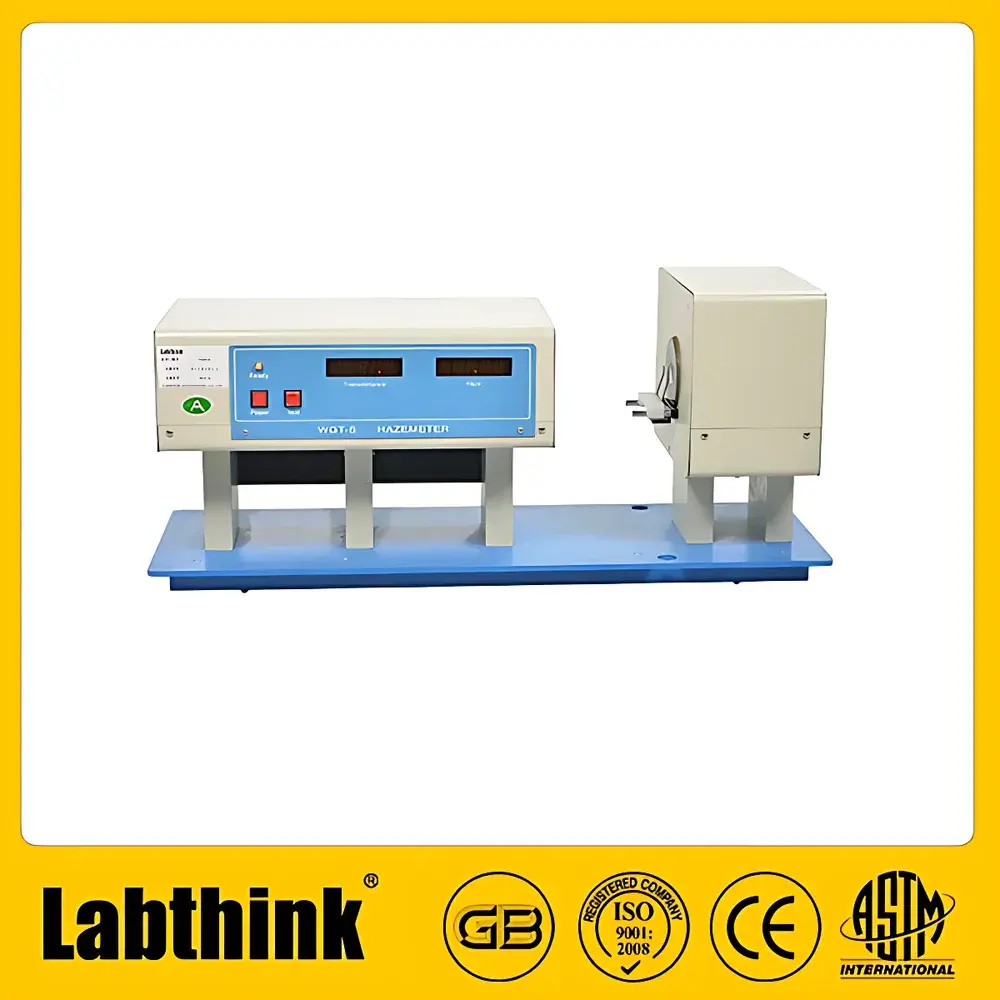
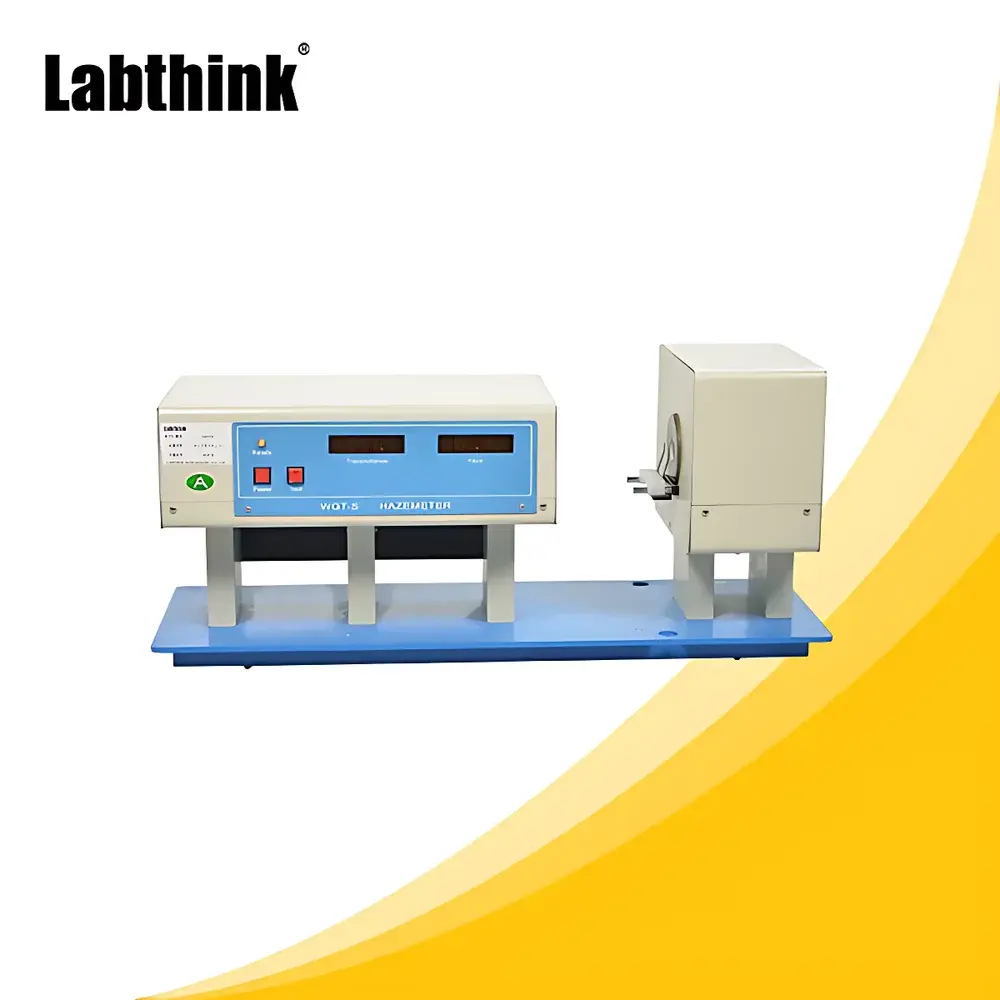
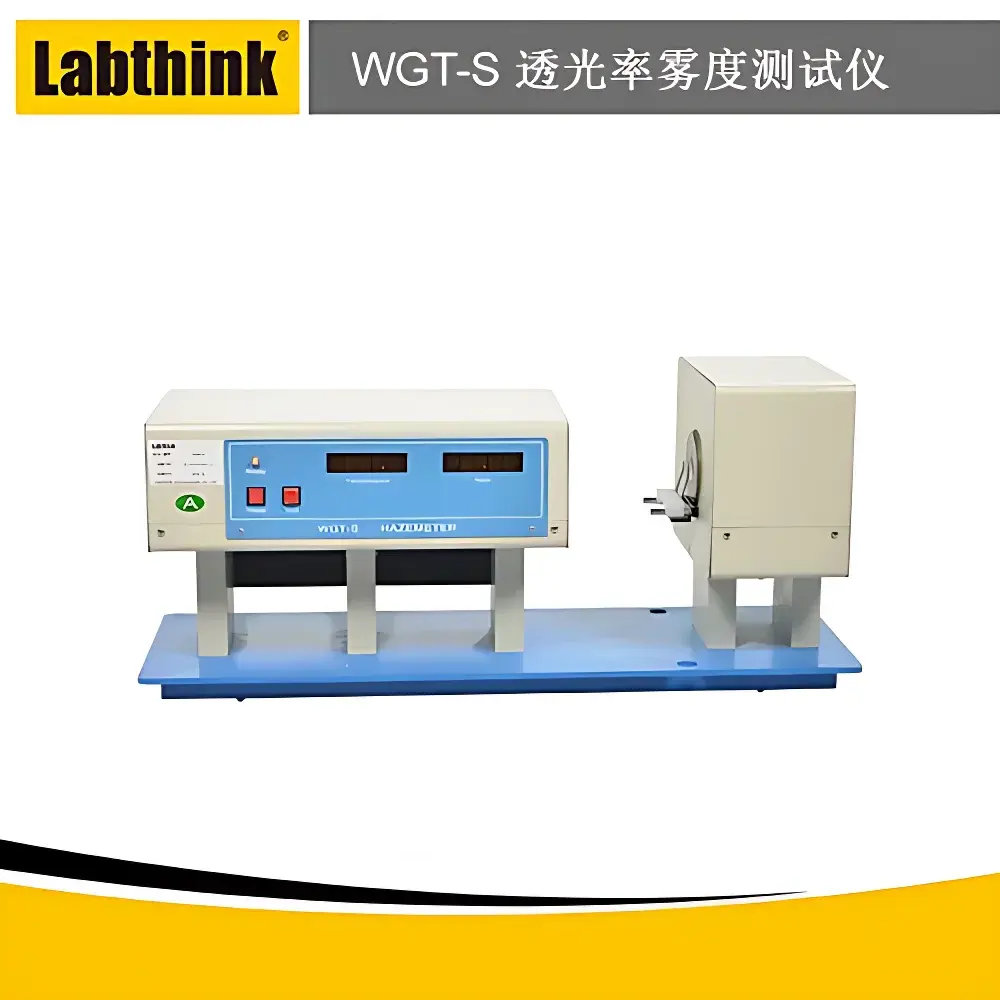
Labthink WGT-S Manual Transmittance and Haze Tester
| Brand | Labthink |
|---|---|
| Model | WGT-S |
| Origin | Shandong, China |
| Manufacturer Type | Direct Manufacturer |
| Product Category | Domestic |
| Type | Manual Operation |
| Haze Range | 0–30.00% |
| Transmittance Range | 0–100.0% |
| Haze Repeatability | ±0.05% (when H ≤ 0.5%) |
| Transmittance Repeatability | ±0.5% |
| Light Source | C-illuminant (12 V DC, 50 W tungsten-halogen lamp + color temperature correction filter) |
| Sample Port Diameter | Input Ø25 mm, Output Ø21 mm |
| Sample Holder | 50 mm × 50 mm film fixture |
| Detector | Silicon photodiode with photopic luminosity correction (V(λ) compliant) |
| Instrument Dimensions | 740 mm (L) × 270 mm (W) × 300 mm (H) |
| Net Weight | 21 kg |
| Power Supply | 220 V, 50 Hz |
| Standards Compliance | GB/T 2410, ASTM D1003–07 (reapproved 2013), JIS K7105–1981 |
Overview
The Labthink WGT-S Manual Transmittance and Haze Tester is a precision optical instrument engineered for the quantitative evaluation of light transmission behavior in planar transparent and translucent materials. It operates on standardized photometric principles defined in ASTM D1003, GB/T 2410, and JIS K7105—specifically measuring two fundamental optical properties: total transmittance (Tt) and haze (H). Transmittance is calculated as the ratio of total transmitted radiant flux to incident flux, expressed as a percentage; haze quantifies the fraction of transmitted light that deviates from the incident beam direction by more than 2.5°, relative to total transmitted flux. The system employs a C-illuminant source (tungsten-halogen lamp with color temperature correction) and a V(λ)-corrected silicon photodiode detector integrated within an integrating sphere geometry. This configuration ensures spectral response aligned with human photopic vision, enabling metrologically traceable results suitable for QC laboratories, R&D departments, and regulatory documentation under GLP-compliant workflows.
Key Features
- Manual operation platform designed for controlled, operator-initiated measurement cycles—ideal for low-throughput labs requiring full procedural transparency and minimal automation overhead.
- Dual-parameter simultaneous readout: real-time digital display of both transmittance (%) and haze (%) on integrated LED indicators, with automatic range switching and internal calibration validation.
- High-stability C-illuminant optical path: 12 V DC, 50 W tungsten-halogen lamp paired with certified color temperature correction filters to maintain consistent spectral power distribution across repeated measurements.
- V(λ)-compliant detection architecture: silicon photodiode coupled with photopic luminosity correction filter ensures compliance with CIE standard observer function, critical for regulatory reporting and inter-laboratory comparability.
- Standardized sample interface: fixed 50 mm × 50 mm film holder with precisely machined 25 mm input and 21 mm output apertures—enabling repeatable positioning and minimizing edge-scatter artifacts.
- Onboard data handling: automatic averaging of sequential readings, BCD serial output capability, and parallel printer interface (Centronics) for direct hardcopy generation without external software dependency.
Sample Compatibility & Compliance
The WGT-S accommodates rigid and flexible flat specimens including plastic sheets, acrylic panels, polycarbonate films, glass substrates, and laminated composites—provided they exhibit parallel surfaces and fit within the 50 mm × 50 mm dimensional constraint. Liquid samples (e.g., purified water, pharmaceutical solutions, beverage concentrates) may be evaluated in standardized cuvettes placed in the sample chamber, supporting turbidity-related assessments per USP and EP 2.2.1 guidelines. All measurement protocols conform to ASTM D1003–07 (Standard Test Method for Haze and Luminous Transmittance of Transparent Plastics), GB/T 2410–2008 (Test Method for Transmittance and Haze of Plastics), and JIS K7105–1981. Instrument design supports audit-ready documentation when used within ISO/IEC 17025-accredited environments or FDA-regulated manufacturing settings where raw data integrity and operator intervention logs are required.
Software & Data Management
While the WGT-S operates as a standalone manual instrument without embedded PC-based software, its hardware-level data infrastructure supports integration into broader laboratory information management systems (LIMS). BCD serial output enables direct connection to programmable logic controllers (PLCs) or legacy industrial PCs for automated log capture. The Centronics-standard parallel port allows seamless interfacing with dot-matrix or thermal label printers for GMP-aligned batch record generation. Calibration verification routines follow NIST-traceable reference standards (e.g., certified haze standards SRM 1979, transmittance reference filters), and all measurement events—including zero adjustment, calibration confirmation, and sample insertion—are manually timestamped and logged in bound lab notebooks per 21 CFR Part 11 Annex 11 expectations for non-electronic records.
Applications
- Quality control of extruded polymer films (PET, PP, PE) during roll-to-roll production.
- Validation of anti-fog coatings on automotive glazing and medical device packaging.
- Comparative analysis of UV-stabilized vs. unstabilized acrylic sheets for architectural glazing specifications.
- Turbidity screening of ophthalmic solutions and injectable drug formulations against pharmacopoeial limits.
- Material qualification for optical diffusers, light guide plates, and display cover lenses in consumer electronics.
- Research-grade characterization of nanoparticle-filled composites where scattering cross-section correlates with filler dispersion homogeneity.
FAQ
What standards does the WGT-S comply with for regulatory submissions?
ASTM D1003–07, GB/T 2410–2008, and JIS K7105–1981 are fully supported; instrument geometry and photometric calibration satisfy essential requirements for inclusion in FDA IND/NDA dossiers and EU MDR technical files.
Can the WGT-S measure curved or non-planar samples?
No—only flat, parallel-surface specimens within the 50 mm × 50 mm footprint are compatible. Curved, textured, or optically anisotropic materials require alternative instrumentation such as goniophotometers or imaging haze analyzers.
Is lamp replacement user-serviceable?
Yes—the 12 V, 50 W tungsten-halogen lamp is field-replaceable using standard alignment tools; Labthink provides lamp alignment jig and spectral verification checklist with each unit.
How often should calibration verification be performed?
Per ISO/IEC 17025:2017 Clause 7.7, daily zero-check and weekly verification with certified reference standards are recommended; formal recalibration every 12 months by an accredited metrology provider is advised for audited environments.
Does the WGT-S support automated pass/fail decision logic?
Not natively—pass/fail thresholds must be applied externally via manual comparison against specification limits or integrated into LIMS-driven workflows using BCD output signals.





