
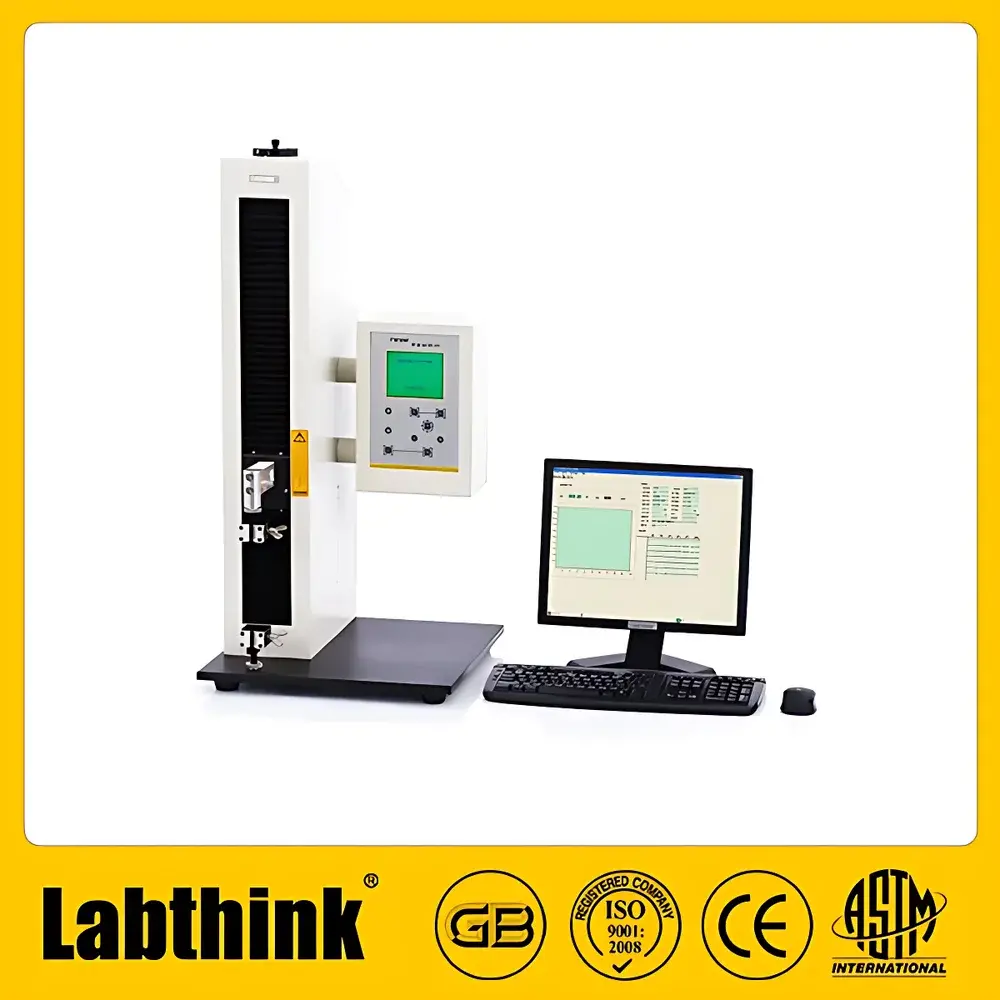
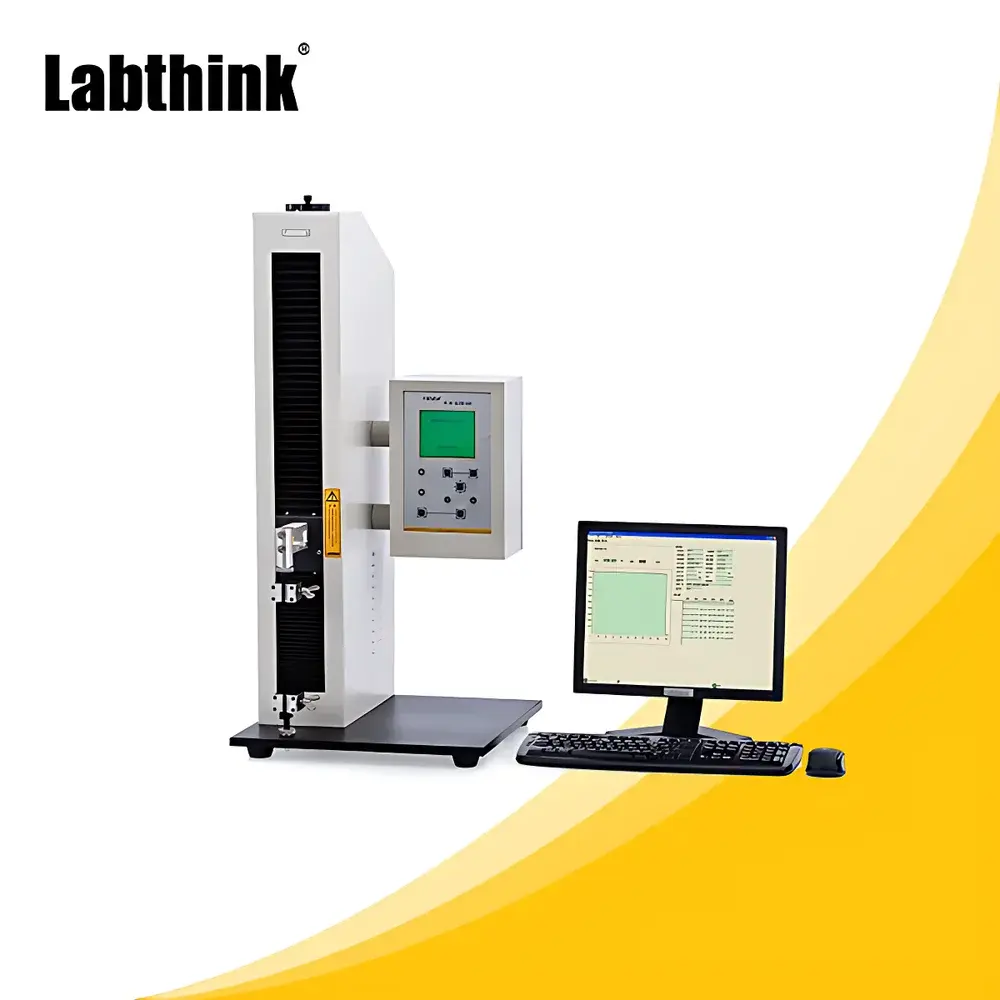
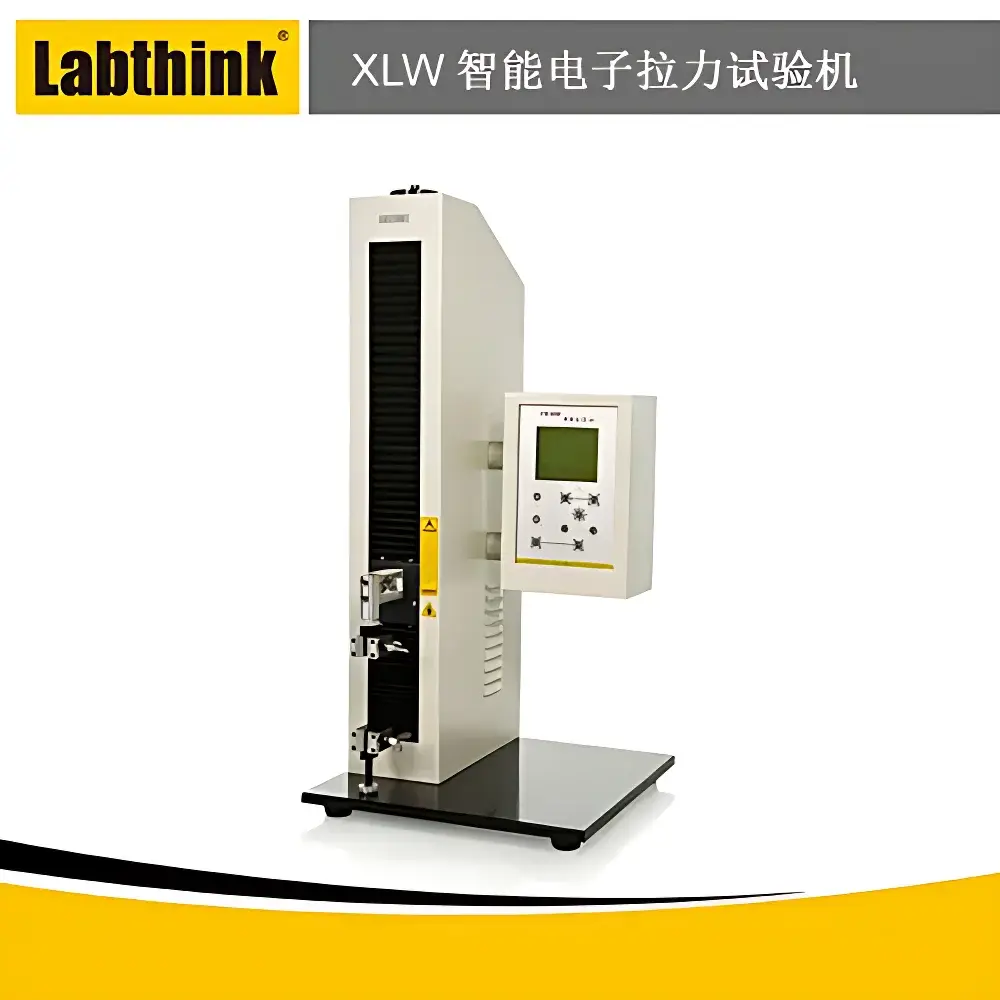
Labthink XLW Intelligent Electronic Tensile Tester for Seal Strength and Physical Property Testing of Flexible Food Packaging
| Brand | Labthink |
|---|---|
| Origin | Shandong, China |
| Manufacturer Type | Direct Manufacturer |
| Product Category | Domestic |
| Model | XLW |
| Price Range | USD 2,800 – 8,500 |
| Instrument Type | Electromechanical Tensile Testing Machine |
| Maximum Test Load | 500 N (0.5 kN) |
| Force Accuracy Class | Class 1 |
| Travel Distance | 600 mm |
| Standard Clamp Width | 30 mm (50 mm optional) |
| Test Speed Options | 50, 100, 150, 200, 250, 300, 500 mm/min |
| Sample Quantity per Test | 1 |
| Dimensions (L×W×H) | 450 × 450 × 980 mm |
| Compliance Standards | ISO 37, ASTM F88, ASTM D882, ASTM D1938, ASTM D3330, GB/T 1040.1–1040.5, GB/T 8808, QB/T 2358-1998, GB/T 17200, GB/T 16578.1-2008 |
Overview
The Labthink XLW Intelligent Electronic Tensile Tester is a precision-engineered electromechanical testing system designed specifically for quantitative mechanical evaluation of flexible packaging materials used in food, pharmaceutical, and consumer goods industries. It operates on the fundamental principle of uniaxial tensile loading under controlled displacement rate, measuring force response via high-stability load cells and positional feedback from integrated linear displacement transducers. The instrument delivers traceable, repeatable data for critical quality control parameters—including seal strength (per ASTM F88 and QB/T 2358-1998), peel adhesion (ASTM D903, GB/T 2790), tear resistance (ASTM D1938), puncture force (GB/T 1040.3), and tensile properties (ISO 37, ASTM D882)—all within a single platform. Its architecture conforms to international metrological requirements for Class 1 force accuracy (per ISO 7500-1 and GB/T 16491), ensuring alignment with GLP-compliant laboratory practices and regulatory audit readiness.
Key Features
- Seven pre-programmed test modes—tensile, peel, tear, seal strength, puncture, opening force, and low-speed unwind—each configured with dedicated algorithmic compensation for material-specific deformation behavior.
- Modular load cell options (100 N, 200 N, 500 N) enable optimal resolution across diverse specimen stiffness ranges without manual recalibration.
- Seven selectable crosshead speeds (50–500 mm/min) accommodate both quasi-static compliance testing and dynamic seal integrity assessment under realistic processing conditions.
- Microprocessor-based control with PVC membrane keypad, large backlit LCD display, and intuitive menu navigation reduces operator training time and minimizes input error.
- Integrated safety protocols include mechanical limit switches, overload cutoff (±110% full scale), automatic return-to-start positioning, and power-loss memory retention for uninterrupted test continuity.
- RS232 serial interface and parallel printer port support real-time data export and hard-copy reporting; compatible with Lystem™ Laboratory Data Management System for centralized result archiving, version-controlled report generation, and multi-user access logging.
Sample Compatibility & Compliance
The XLW system accepts standard-width specimens (30 mm default; 50 mm optional fixtures available) from a broad spectrum of flexible substrates: laminated pouches for meat canning, retortable polyolefin films, aluminum foil composites, medical-grade sterile barrier materials, pressure-sensitive adhesive tapes, protective release liners, and fiber-reinforced backing papers. All test configurations comply with harmonized international standards—including ISO 37 (rubber tensile properties), ASTM F88 (seal strength of flexible barrier materials), ASTM D882 (tensile properties of thin plastic sheeting), and QB/T 2358-1998 (heat-seal strength of plastic film packaging)—making it suitable for internal QC, third-party certification labs, and regulatory submission dossiers requiring ISO/IEC 17025 traceability.
Software & Data Management
The proprietary control software provides full test parameter configuration, real-time curve visualization (force vs. displacement), and post-test analytical tools including group statistical summaries (mean, SD, CV%), curve superposition for comparative analysis, elastic modulus derivation (initial slope of stress–strain curve), and customizable report templates compliant with FDA 21 CFR Part 11 requirements (audit trail, electronic signature support, data integrity safeguards). Raw data exports are supported in CSV and XML formats for integration into enterprise LIMS or ERP platforms. All firmware and software updates are distributed through Labthink’s secure customer portal, maintaining version consistency across global installations.
Applications
- Quantitative validation of thermal seal integrity for retorted meat pouches and vacuum-sealed ready-to-eat meals.
- Comparative evaluation of heat-seal performance across different sealing temperatures, dwell times, and jaw pressures during packaging line qualification.
- Tensile property mapping of multilayer coextruded films subjected to sterilization cycles (e.g., 121°C steam autoclave).
- Peel strength assessment of cold-seal adhesives used in pharmaceutical blister lidding.
- Tear propagation resistance measurement of high-barrier metallized PET/PE laminates per ASTM D1938.
- Puncture resistance profiling of stand-up pouch gussets under simulated distribution handling loads.
- Quality conformance testing against supplier specifications per ISO 22332 (packaging—flexible materials—determination of seal strength).
FAQ
What standards does the XLW tester support for seal strength testing?
It fully supports ASTM F88, QB/T 2358-1998, ISO 11607-2, and GB/T 1040.3 for seal strength evaluation of flexible packaging.
Can the instrument perform simultaneous multi-specimen testing?
No—it processes one specimen per test cycle; however, automated batch sequencing and statistical grouping reduce throughput latency.
Is calibration traceable to national metrology institutes?
Yes—load cells are supplied with NIST-traceable calibration certificates; annual verification follows ISO/IEC 17025 procedures.
Does the system meet FDA 21 CFR Part 11 requirements?
The Lystem™ software module provides full Part 11 compliance: role-based access control, electronic signatures, and immutable audit trails.
What maintenance is required for long-term accuracy?
Annual recalibration of load cell and displacement sensor is recommended; routine cleaning of guide rails and lubrication of lead screws every 6 months ensures mechanical fidelity.



