
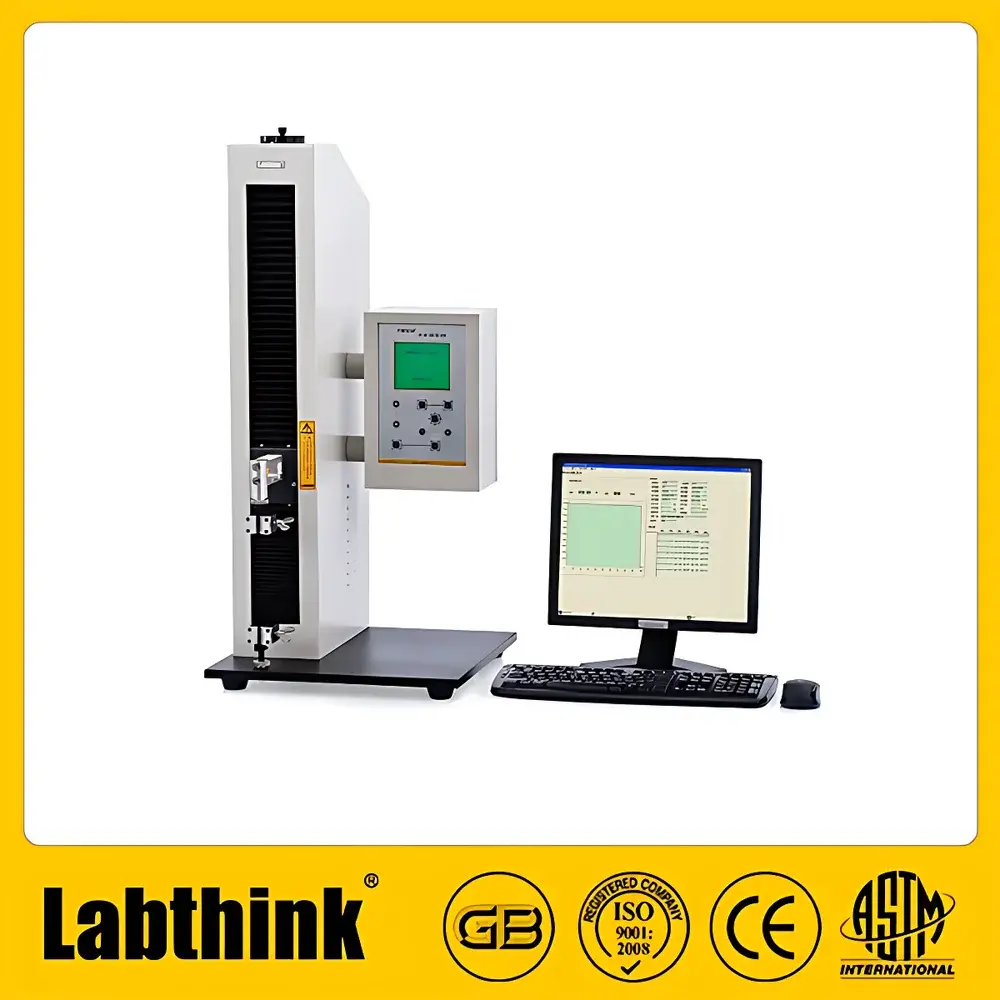
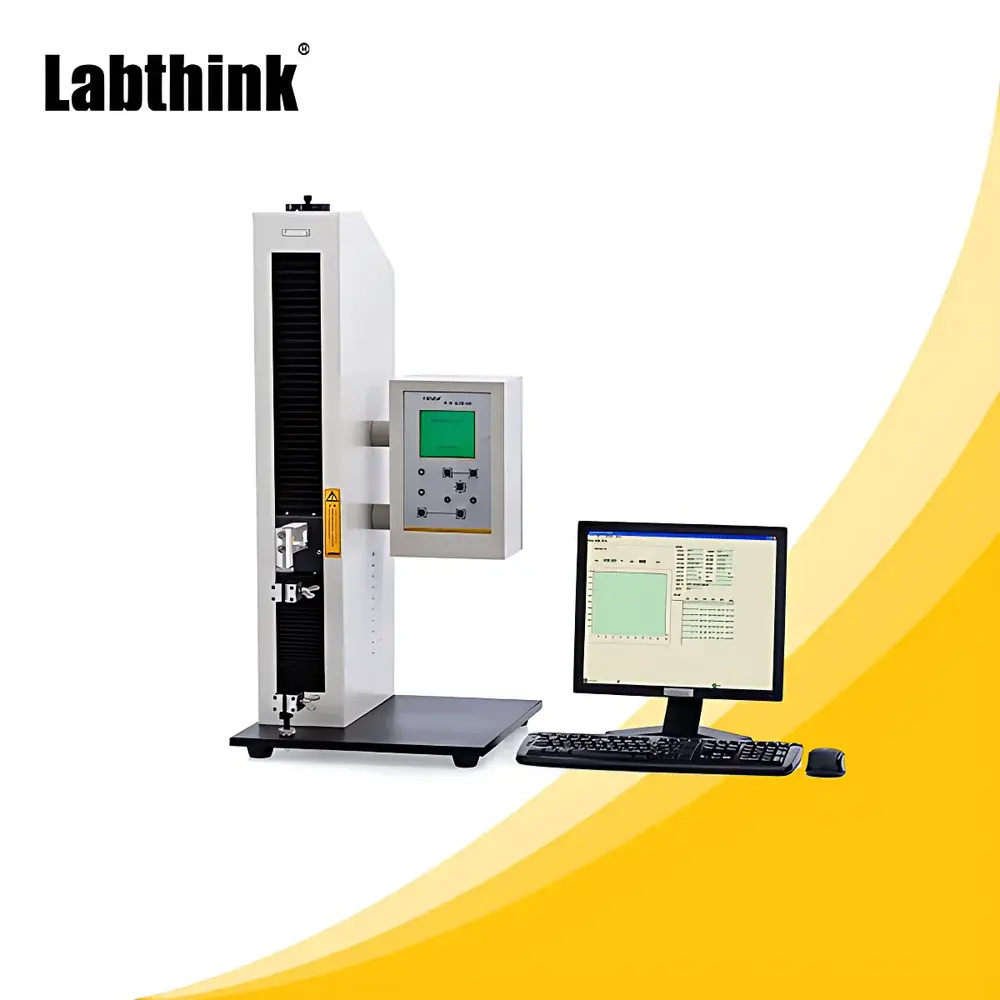
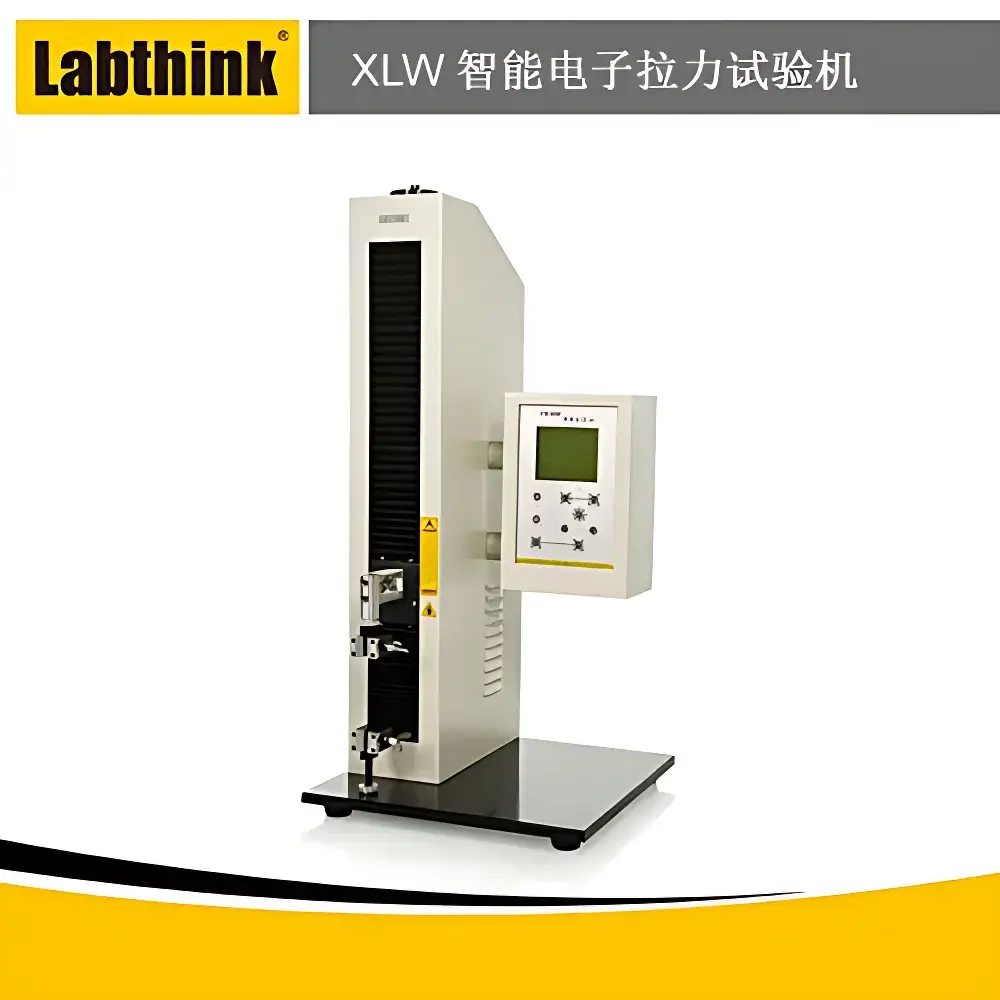
Labthink XLW Series 45° Peel Strength Tester for Bottle Caps and Sealing Films
| Brand | Labthink |
|---|---|
| Origin | Shandong, China |
| Manufacturer Type | Direct Manufacturer |
| Country of Origin | China |
| Model | XLW |
| Instrument Type | Electronic Tensile Testing Machine |
| Max Test Load | 0.5 kN |
| Force Accuracy Class | Class 1 |
| Test Stroke | 600 mm |
| Displacement Resolution | 1 mm |
Overview
The Labthink XLW Series 45° Peel Strength Tester is an electromechanical tensile testing system engineered for precise quantification of interfacial adhesion strength between sealing films and rigid or semi-rigid substrates—particularly bottle caps, blister lidding foils, pouch seals, and medical packaging closures. It operates on the fundamental principle of controlled angular peel separation: a specimen is clamped at a fixed 45° angle relative to the direction of motion, and the moving jaw applies uniaxial tensile force to progressively separate the adhered layers. Force and displacement data are acquired in real time via a high-stability load cell and optical encoder-based position sensor, enabling calculation of peel force (N), average peel strength (N/15 mm or N/mm), and energy dissipation profiles. Designed for compliance with international standard test methods—including ASTM F88 (Standard Test Method for Seal Strength of Flexible Barrier Materials), ISO 37 (Rubber—Determination of Tensile Strength and Elongation at Break), and GB/T 2792 (Peel Resistance of Pressure-sensitive Adhesive Tapes)—the XLW delivers repeatable, traceable results suitable for QC release testing, R&D material evaluation, and regulatory documentation.
Key Features
- Class 1 force accuracy per ISO 7500-1 and ASTM E4, validated across the full 30–500 N operational range using certified reference standards.
- Seven preprogrammed test modes: 45° peel, 90° peel, tensile strength, tear resistance, heat seal strength, puncture, and opening force—each with independent parameter presets and pass/fail thresholds.
- Seven selectable crosshead speeds (50–500 mm/min) with ±0.5% speed stability, supporting both slow-speed adhesion characterization and rapid QC throughput.
- Microprocessor-controlled interface with backlit LCD display, tactile PVC membrane keypad, and intuitive menu navigation—no PC required for routine operation.
- Integrated safety architecture: mechanical limit switches, overload cutoff (110% FS), automatic return-to-start after test completion, and non-volatile memory retention during power interruption.
- Modular load cell options (30 N, 50 N, 100 N, 200 N, 500 N standard; 750 N / 1000 N on request) ensure optimal signal-to-noise ratio for low-force peel applications such as pediatric blister foil or thin PET/Alu laminates.
Sample Compatibility & Compliance
The XLW accommodates a broad spectrum of flexible and semi-flexible packaging materials, including but not limited to: aluminum foil laminates, PET/PE coextrusions, PP-based sealants, medical-grade Tyvek®/film composites, silicone-coated release liners, and multi-layer barrier films used in pharmaceutical blister cards and IV bag ports. Standard 30 mm wide specimen clamps comply with ASTM F88 and GB/T 2792; optional 50 mm jaws support wider film formats per ISO 11607-2 Annex D. All test configurations adhere to GLP-aligned documentation practices: audit trails record operator ID, timestamp, calibration status, and environmental conditions (optional temperature/humidity logging via external sensors). The instrument satisfies essential requirements for FDA 21 CFR Part 11 compliance when paired with Lystem™ Laboratory Data Management System (LDMS), enabling electronic signatures, role-based access control, and immutable data archiving.
Software & Data Management
The included Lystem™ Professional Software provides full test lifecycle management: method creation, batch assignment, real-time curve visualization (force vs. displacement), statistical analysis (mean, SD, CV%, min/max), and overlay comparison of up to 12 curves per report. Elastic modulus, yield point, and elongation at break are automatically derived from raw tensile data per ISO 527-3. Reports conform to ISO/IEC 17025 formatting guidelines and export natively to PDF, CSV, and XML. RS232 serial interface enables bidirectional communication with LIMS or ERP systems; optional USB-to-RS232 adapter supports legacy infrastructure integration. Firmware updates and method libraries are distributed via secure HTTPS portal—no physical media required.
Applications
- Quantifying peel initiation and propagation forces for child-resistant bottle closures and tamper-evident seals.
- Evaluating thermal seal integrity of pharmaceutical blister lidding foils under accelerated aging conditions.
- Comparing adhesive performance of pressure-sensitive labels on HDPE, PETG, and glass containers.
- Validating delamination resistance in multilayer battery separator films (e.g., PE/PP/PE trilayer).
- Assessing bond durability of medical device pouch seals subjected to sterilization cycles (EtO, gamma, steam).
- Supporting formulation development for hot-melt adhesives used in flexible food packaging laminates.
FAQ
What peel angles does the XLW support?
The instrument is mechanically calibrated for fixed 45° peel geometry per ASTM F88 and GB/T 2792. Custom fixtures for 90° and 180° configurations are available as optional accessories.
Can the XLW perform tests according to USP particulate matter requirements?
No—this instrument measures mechanical adhesion properties only. Particulate assessment requires light obscuration or microscopic particle counting systems.
Is calibration traceable to NIST or CNAS standards?
Yes. Factory calibration certificates include uncertainty budgets referenced to national metrology institutes (CNAS-accredited labs in China; NIST-traceable weights available upon request).
Does the system meet ISO 17025 accreditation requirements for testing laboratories?
When operated within documented SOPs—including daily verification checks, annual third-party calibration, and software validation—the XLW meets technical competence criteria outlined in ISO/IEC 17025:2017 Clause 6.4 (Equipment) and Clause 7.7 (Ensuring Validity of Results).
How is data integrity ensured during long-term deployment?
Lystem™ LDMS enforces ALCOA+ principles (Attributable, Legible, Contemporaneous, Original, Accurate, Complete, Consistent, Enduring, Available) through encrypted database storage, automated backup scheduling, and configurable retention policies aligned with 21 CFR Part 11 §11.10(e).



