
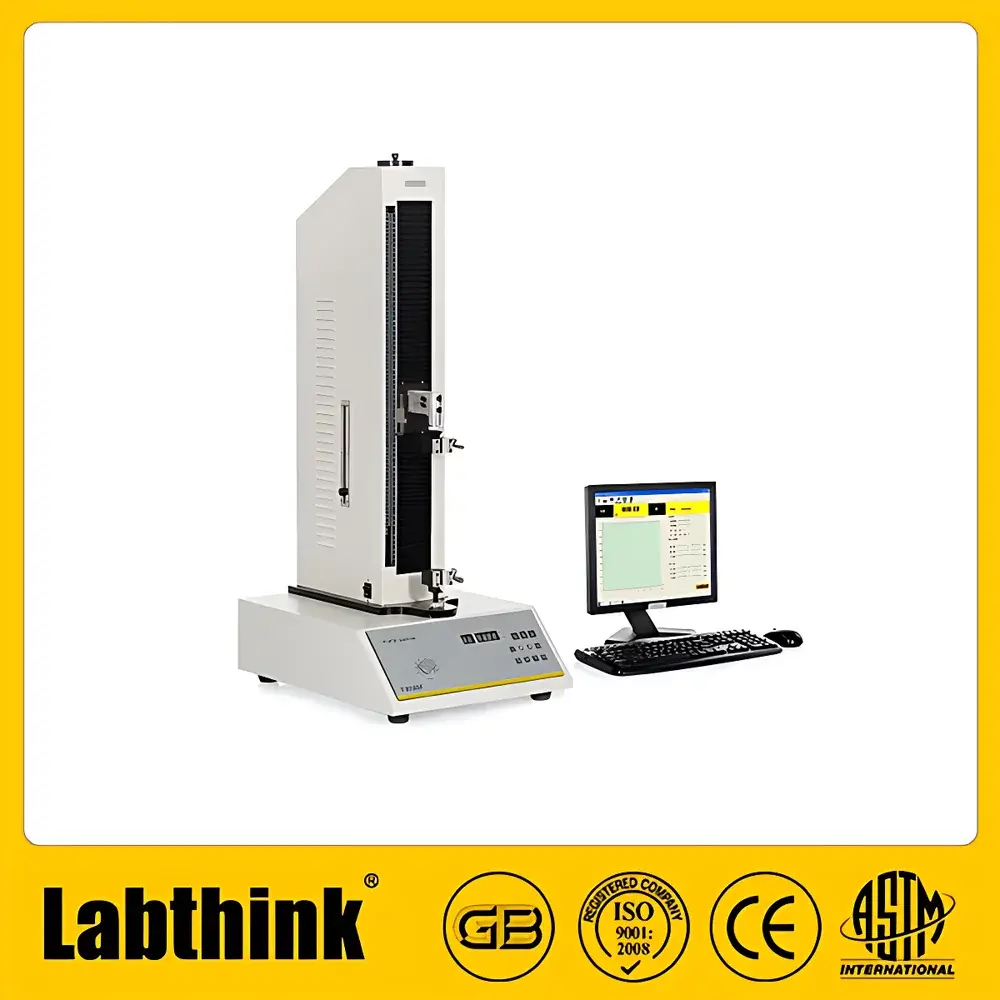
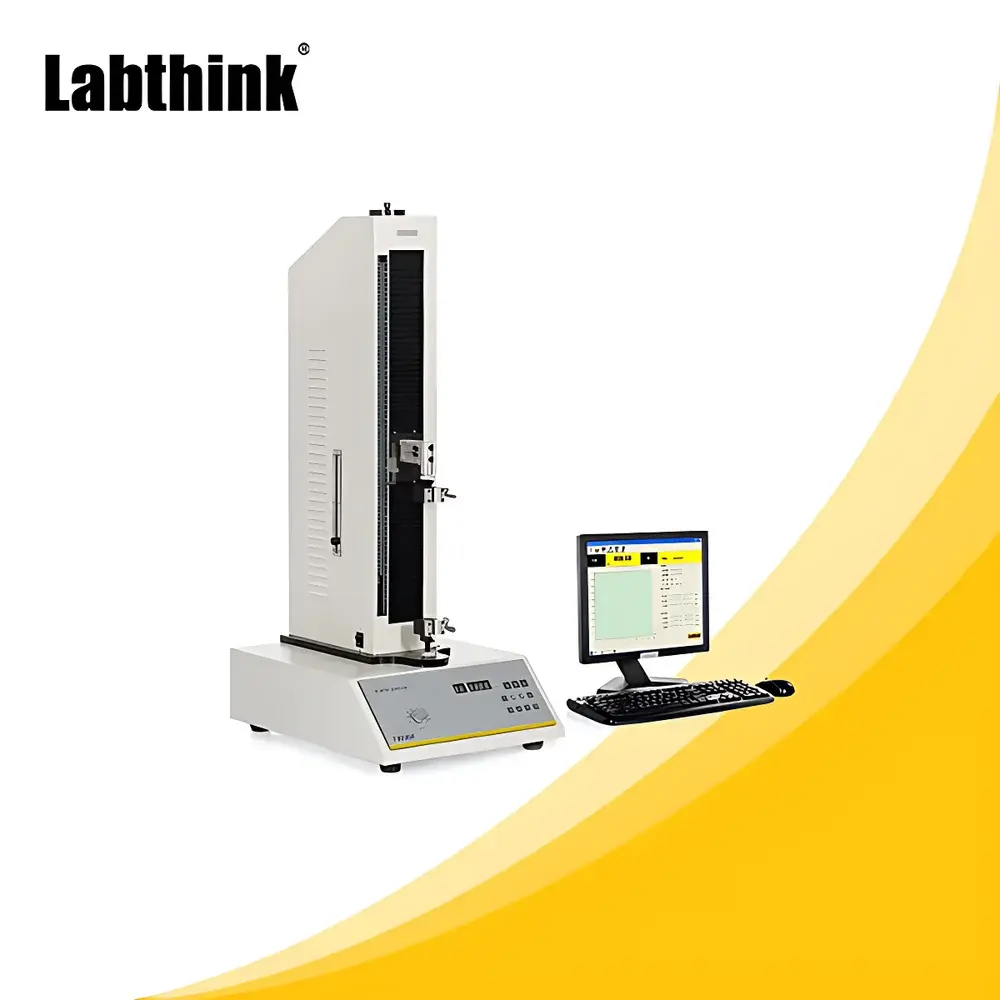
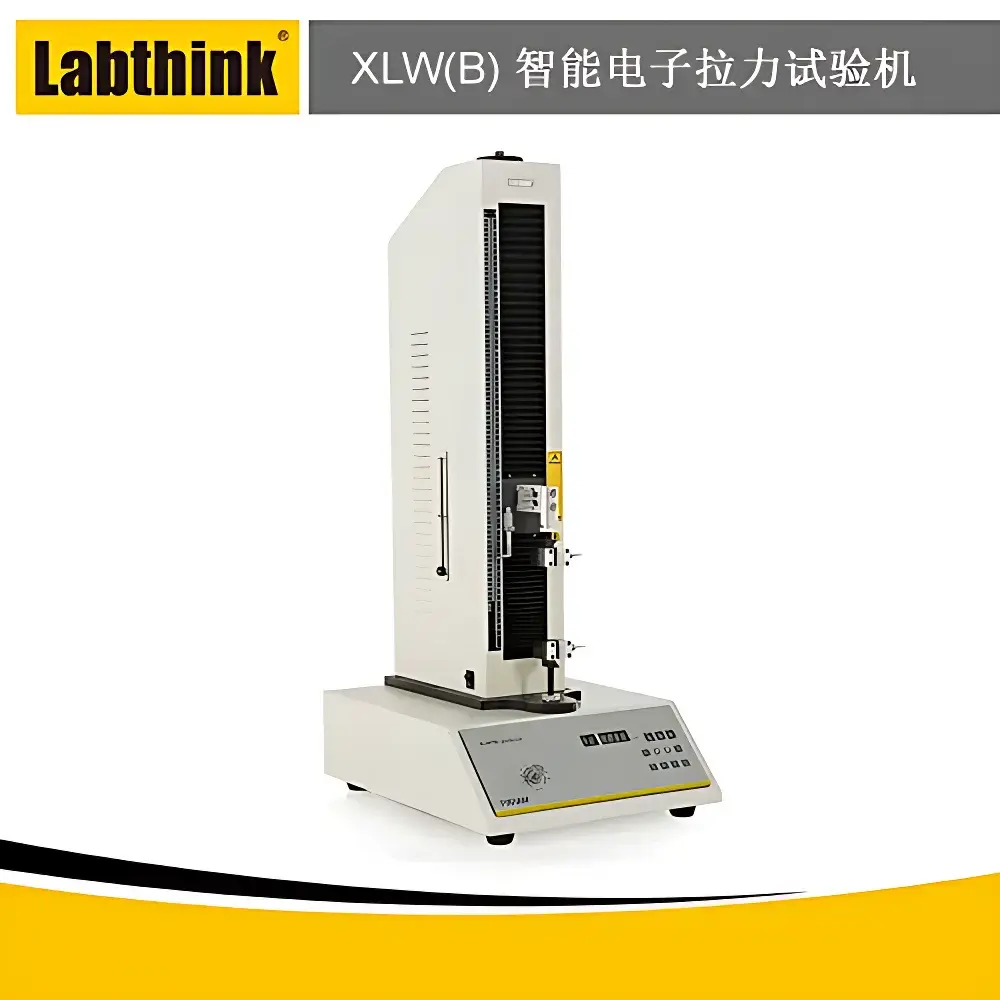
Labthink XLW(B) Pharmaceutical Rubber Stopper Piercing Force Tester
| Brand | Labthink |
|---|---|
| Model | XLW(B) |
| Type | Electronic Tensile Testing Machine |
| Max Test Load | 0.5 kN |
| Load Accuracy Class | Class 1 |
| Stroke | 600 mm |
| Displacement Resolution | 1 mm |
| Standard Load Cell | 200 N |
| Optional Load Cells | 30 N, 50 N, 100 N, 500 N, 750 N (customizable) |
| Test Speeds | 50, 100, 150, 200, 250, 300, 500 mm/min |
| Sample Width | 30 mm (standard fixture), 50 mm (optional) |
| Power Supply | 220 VAC 50 Hz / 120 VAC 60 Hz |
| Net Weight | 61 kg |
| Dimensions (L×W×H) | 450 × 580 × 1100 mm |
Overview
The Labthink XLW(B) Pharmaceutical Rubber Stopper Piercing Force Tester is a precision-engineered electronic tensile testing system designed specifically for the quantitative evaluation of piercing resistance in pharmaceutical-grade rubber stoppers—critical components in vial and syringe closures. It operates on the fundamental principle of controlled axial force application: a standardized stainless-steel needle (per ISO 8536-2, USP , and Ph. Eur. 3.2.9) is driven at a defined speed into a conditioned rubber stopper mounted on a rigid support plate. The system continuously records the peak puncture force (in Newtons), the force profile across penetration depth, and the post-puncture recovery behavior. This measurement directly correlates with container closure integrity (CCI), resealability, and patient safety during drug administration. While optimized for stopper piercing per pharmacopoeial standards, the XLW(B) platform is fully compliant with universal mechanical testing methodologies—including tensile, peel, and tear modes—making it suitable for validating packaging materials such as laminated films, adhesive tapes, medical device seals, and protective barrier layers used in sterile manufacturing environments.
Key Features
- Class 1 load accuracy per ISO 7500-1 and ASTM E4, ensuring traceable, reproducible force measurements across the full 30–500 N operating range (with optional load cells)
- Dual-mode test architecture: dedicated piercing protocol with programmable needle dwell time and retract sequence, plus independent tensile and peel test routines compliant with ASTM D882, ASTM D903, and ISO 11339
- Seven selectable crosshead speeds (50–500 mm/min), each calibrated and verified per ISO 527-1, enabling precise simulation of clinical needle insertion dynamics or industrial packaging line conditions
- Integrated displacement sensor with 1 mm resolution and 600 mm travel range, supporting full-stroke compliance verification and elongation-at-break calculation per ISO 527-2
- Microprocessor-controlled operation with LED digital display, PVC membrane keypad, and real-time force/displacement curve visualization on integrated screen
- Comprehensive hardware protection: mechanical stroke limit switches, electronic overload cutoff (±110% FS), automatic zero-reset, and fault-code diagnostics for GMP-aligned operational continuity
- RS232 serial interface and parallel printer port for direct data export; compatible with Lystem™ Laboratory Data Management System for audit-ready report generation and multi-instrument result harmonization
Sample Compatibility & Compliance
The XLW(B) accommodates standard pharmaceutical stoppers (e.g., bromobutyl, chlorobutyl, silicone-coated) per ISO 8362-1 dimensions, using a fixed-height support plate and interchangeable needle holders. Optional fixtures extend capability to ISO 15378-compliant elastomeric components, pre-filled syringe plungers, and laminated aluminum-polymer blister lidding. All test methods align with global regulatory frameworks: GB/T 4850–2000 (peel strength), GB/T 1040.3–2006 (tensile properties), GB/T 2792 (adhesive tape peel), and ISO 8536-2 (rubber stopper piercing). For quality systems operating under FDA 21 CFR Part 11, the Lystem™ software provides electronic signatures, user access control, and immutable audit trails—fully supporting GLP and GMP validation requirements.
Software & Data Management
The embedded firmware supports automatic calculation of mean, min, and max values per test group (n ≥ 3), coefficient of variation (CV%), and statistical trend analysis across batches. Raw force–displacement datasets are exportable in CSV format for secondary analysis in MATLAB, JMP, or Minitab. When connected to Lystem™, the XLW(B) contributes to centralized database archiving with metadata tagging (operator ID, environmental conditions, calibration status, SOP version). All reports include instrument identification, sensor calibration certificate reference, test standard citation, and graphical overlay of comparative runs—meeting ICH Q5C stability protocol documentation expectations.
Applications
- Pharmaceutical packaging QA/QC: routine release testing of rubber stoppers per USP and EP 3.2.9
- Formulation development: evaluating silicone oil migration effects on piercing force over accelerated aging cycles
- Supplier qualification: comparative assessment of halogenated vs. non-halogenated elastomer performance
- Medical device packaging: seal strength validation of Tyvek®/foil pouches and peel-open features
- Regulatory submission support: generating data packages for ANDA, NDA, and CMC sections requiring mechanical integrity evidence
- Process validation: correlation of stopper piercing force with crimping torque and vial sealing pressure
FAQ
What pharmacopoeial standards does the XLW(B) support for rubber stopper testing?
ISO 8536-2, USP , Ph. Eur. 3.2.9, and JP 17 General Test 2.05.
Can the system be validated for 21 CFR Part 11 compliance?
Yes—when used with Lystem™ software configured with role-based permissions, electronic signatures, and audit trail logging.
Is calibration traceable to national metrology institutes?
All load cells are factory-calibrated against NIST-traceable deadweight standards, with certificates provided per ISO/IEC 17025.
What sample preparation is required for stopper piercing tests?
Stoppers must be conditioned at 23 ± 2 °C and 50 ± 5% RH for ≥48 h prior to testing, per ISO 291 and USP .
Does the system support custom test protocols beyond pre-programmed methods?
Yes—the firmware allows user-defined speed profiles, dwell times, and trigger thresholds via ASCII command set or Lystem™ scripting interface.



