
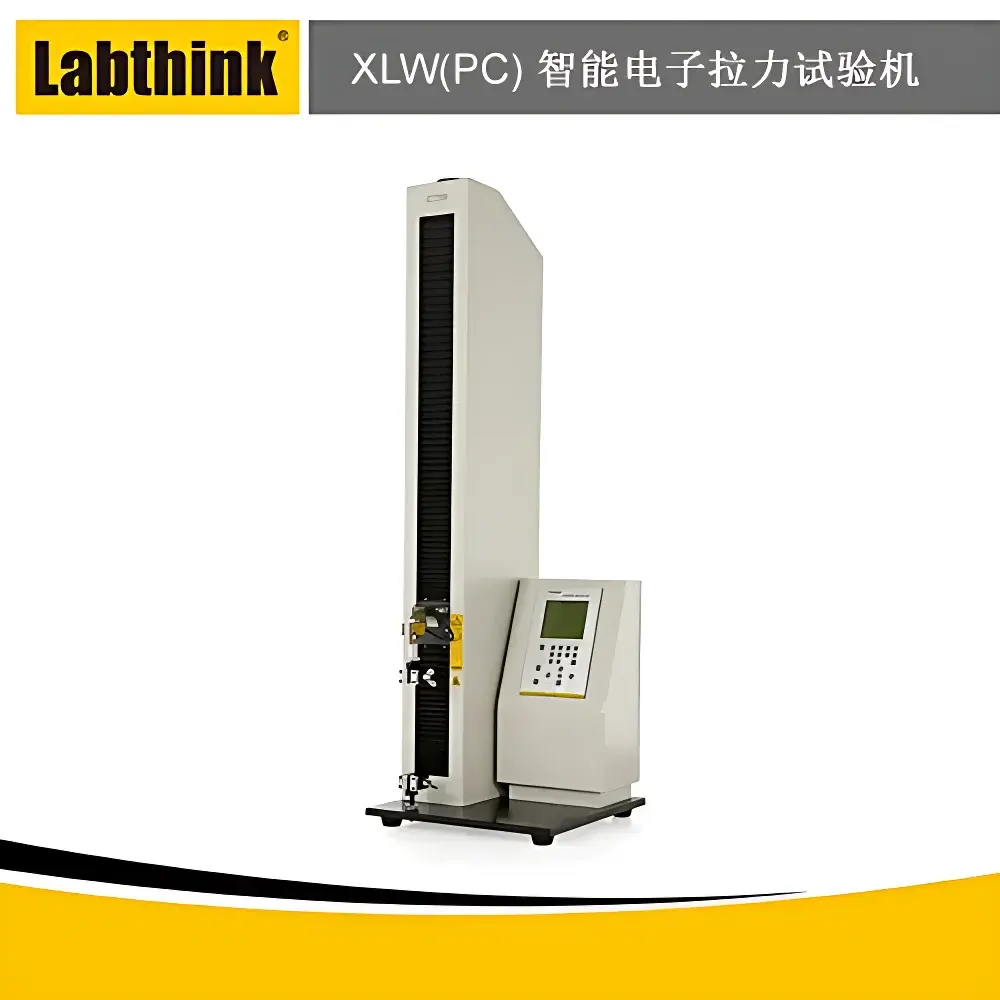
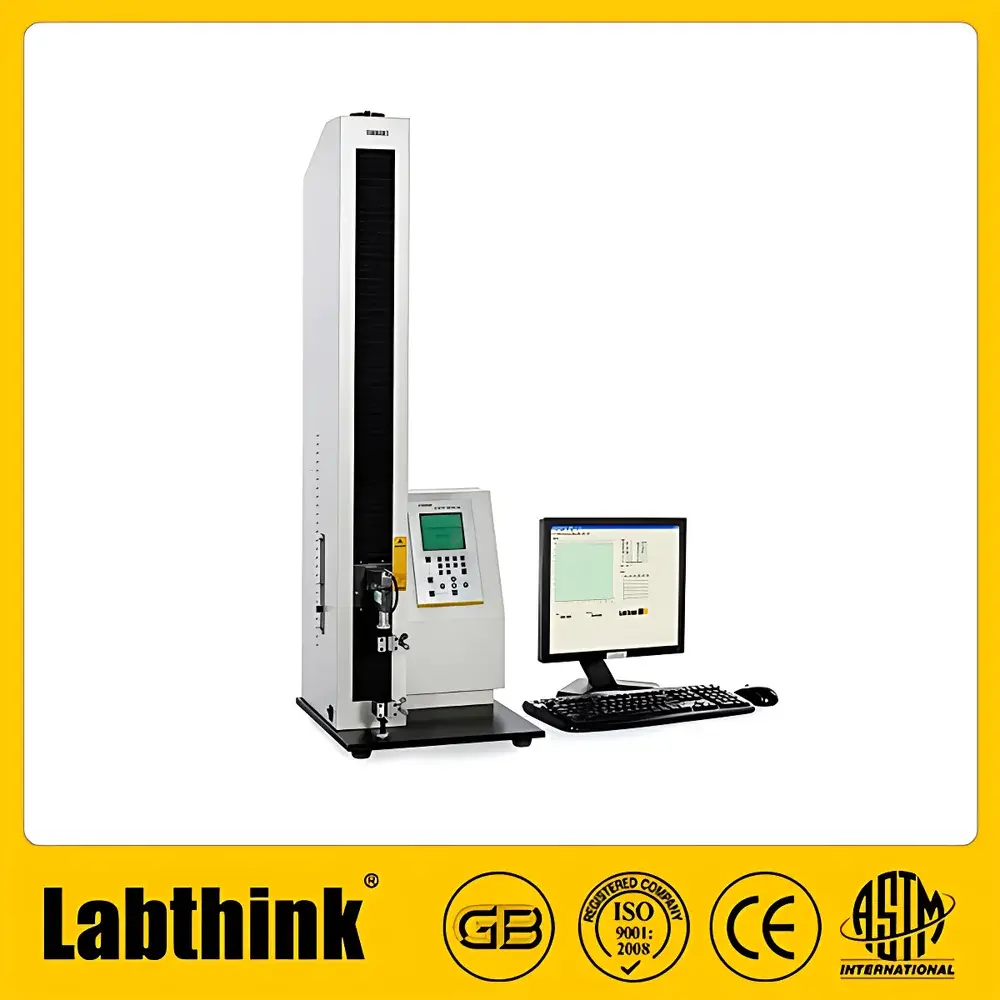
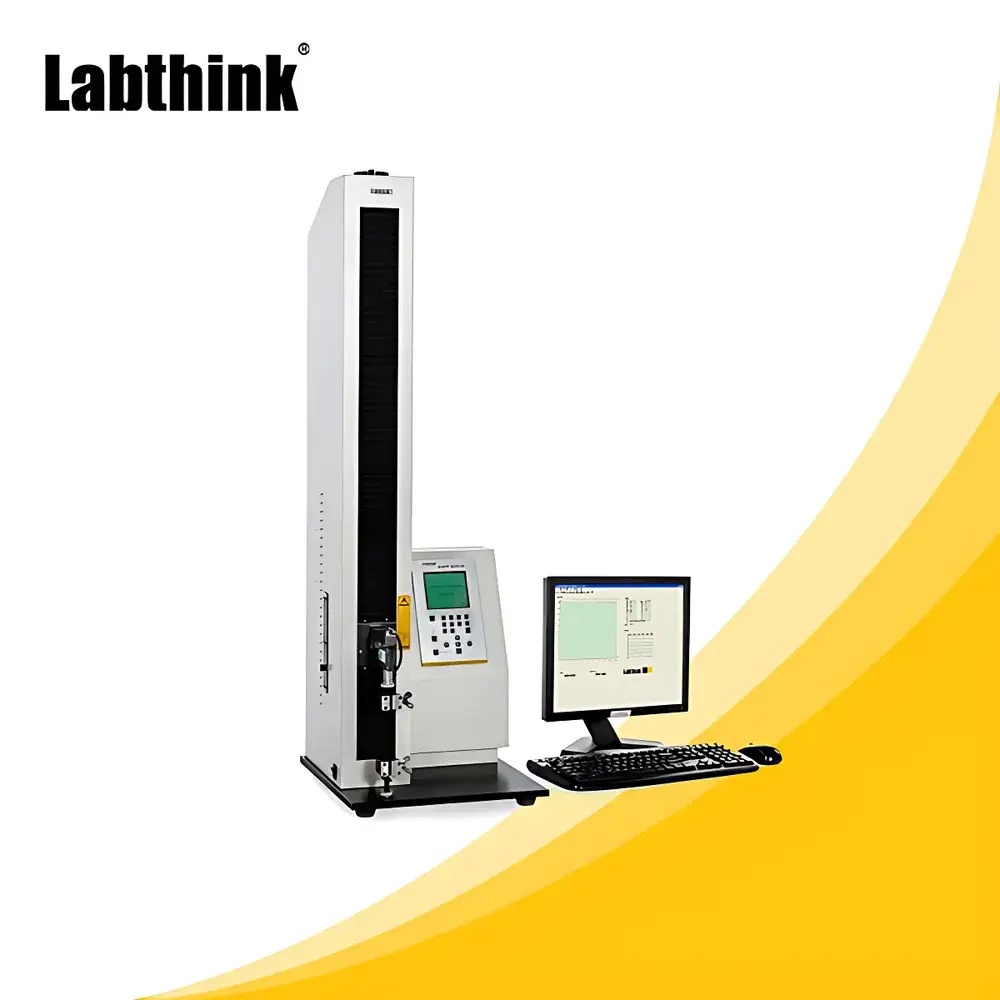
Labthink XLW(PC) Intelligent Electronic Tensile Testing Machine
| Brand | Labthink |
|---|---|
| Origin | Shandong, China |
| Manufacturer | Labthink International Co., Ltd. |
| Model | XLW(PC) |
| Type | Electronic Tensile Testing Machine |
| Max Test Load | 0.05–1 kN |
| Force Accuracy Class | 0.5 |
| Travel Range | 1000 mm |
| Displacement Resolution | 1 mm |
| Standard Load Cell | 500 N |
| Optional Load Cells | 50 N, 100 N, 250 N, 750 N, 1000 N |
| Test Speeds | 50, 100, 150, 200, 250, 300, 500 mm/min |
| Specimen Width (Standard Fixture) | 30 mm |
| Optional Fixture Width | 50 mm |
| Dimensions (L×W×H) | 450 × 450 × 1410 mm |
| Weight | 68 kg |
| Power Supply | 220 VAC 50 Hz / 120 VAC 60 Hz |
Overview
The Labthink XLW(PC) Intelligent Electronic Tensile Testing Machine is a precision-engineered universal testing system designed for the quantitative mechanical characterization of flexible packaging materials and thin-film substrates. It operates on the fundamental principle of uniaxial tensile loading in accordance with standardized force-displacement transduction: test specimens are clamped between two parallel grips; one grip remains stationary while the other moves at a controlled, programmable rate. Force is measured via high-stability load cells mounted on the moving crosshead, while displacement is captured by an integrated linear encoder. Real-time acquisition of force and displacement data enables calculation of critical mechanical parameters—including tensile strength, elongation at break, Young’s modulus, peel strength, tear resistance, puncture force, and heat seal strength—according to internationally recognized test methodologies.
Key Features
- Class 0.5 force accuracy per ISO 7500-1 and ASTM E4, ensuring metrological traceability and repeatability across laboratories.
- Seven preconfigured, independent test routines—tensile, peel, tear, heat seal, puncture, shear, and friction—eliminating manual parameter reconfiguration between test types.
- Extended 1000 mm travel range accommodates high-elongation materials such as elastomeric films, hydrogels, and nonwovens without mechanical interference or premature limit activation.
- Modular load cell architecture supports seven selectable force ranges (50 N to 1000 N), enabling optimal signal-to-noise ratio for both ultra-low-force adhesive peel tests and high-load structural film evaluations.
- Seven discrete test speeds (50–500 mm/min) comply with material-specific standards including ASTM D882 (plastic films), ASTM F88 (heat seal strength), and ISO 37 (vulcanized rubber).
- Microprocessor-based control with PVC membrane keypad, large LCD display, and intuitive menu navigation ensures rapid setup and operator independence.
- Integrated safety architecture includes mechanical end-stop limit switches, electronic overload cutoff, automatic return-to-start positioning, and power-loss memory retention for uninterrupted workflow continuity.
Sample Compatibility & Compliance
The XLW(PC) is validated for use with a broad spectrum of low-modulus, high-ductility materials common in pharmaceutical, food, medical device, and consumer packaging sectors. Compatible specimen types include biaxially oriented polypropylene (BOPP), polyethylene terephthalate (PET), aluminum-laminated foils, pressure-sensitive adhesives (PSAs), medical transdermal patches, spunbonded polypropylene nonwovens, silicone-coated release liners, and thermoformed tray sealants. The instrument conforms to over 25 international and national standards—including ISO 37, ASTM D882, ASTM D1938, ASTM F88, GB/T 1040 series, GB/T 2792, and JIS P8113—supporting regulatory submissions under FDA 21 CFR Part 11, EU Annex 11, and GLP/GMP environments when paired with audit-trail-enabled software configurations.
Software & Data Management
The embedded Lystem™ Laboratory Data Sharing System provides full lifecycle data governance: from method definition and test execution to statistical analysis and report generation. Software capabilities include group-sample statistical evaluation (mean, SD, CV%), overlay of multiple stress–strain curves for comparative material assessment, historical dataset correlation, pass/fail threshold enforcement, and customizable PDF/Excel export. All user actions—including method edits, test starts, and result approvals—are logged with timestamped, non-erasable audit trails compliant with 21 CFR Part 11 requirements. Data synchronization across networked instruments enables centralized quality control dashboards and multi-site method harmonization.
Applications
- Quantification of tensile properties (UTS, yield point, elongation) of polymer films per ASTM D882 and ISO 527-3.
- Peel strength measurement of laminated structures (e.g., foil–polymer composites) per ASTM D903 and GB/T 2792.
- Resistance-to-tear evaluation using constant-rate-of-traverse (CRT) protocols per ASTM D1938 and ISO 6383-2.
- Heat seal integrity validation for pouches and blister lidding per ASTM F88 and ISO 11607-2.
- Puncture force determination for protective medical packaging per ISO 11607-1 Annex B.
- Adhesive shear holding time and loop tack assessment per PSTC-101 and FINAT FTM 1.
- Friction coefficient measurement of film surfaces per ASTM D1894 and ISO 8295.
FAQ
What standards does the XLW(PC) support for tensile testing of plastic films?
ASTM D882, ISO 527-3, GB/T 1040.3, and JIS K7127 are fully supported through preloaded test methods and calibration traceability.
Can the instrument perform peel testing on medical device packaging?
Yes—it complies with ASTM F88 for seal strength and ASTM F904 for comparative peel testing of sterile barrier systems.
Is the software compliant with FDA 21 CFR Part 11?
When deployed with Lystem™ v3.0 or later and configured with electronic signatures, role-based access, and immutable audit logs, it meets Part 11 technical and procedural requirements.
What is the minimum measurable force with the 50 N load cell option?
The 50 N sensor achieves a resolution of 0.01 N with Class 0.5 accuracy, suitable for low-force PSA and thin-film applications.
Does the system support custom fixture design for non-standard samples?
Yes—Labthink offers engineering consultation and CNC-manufactured fixtures for specialized geometries, including floating roller grips, pneumatic clamps, and micro-tensile holders.



