
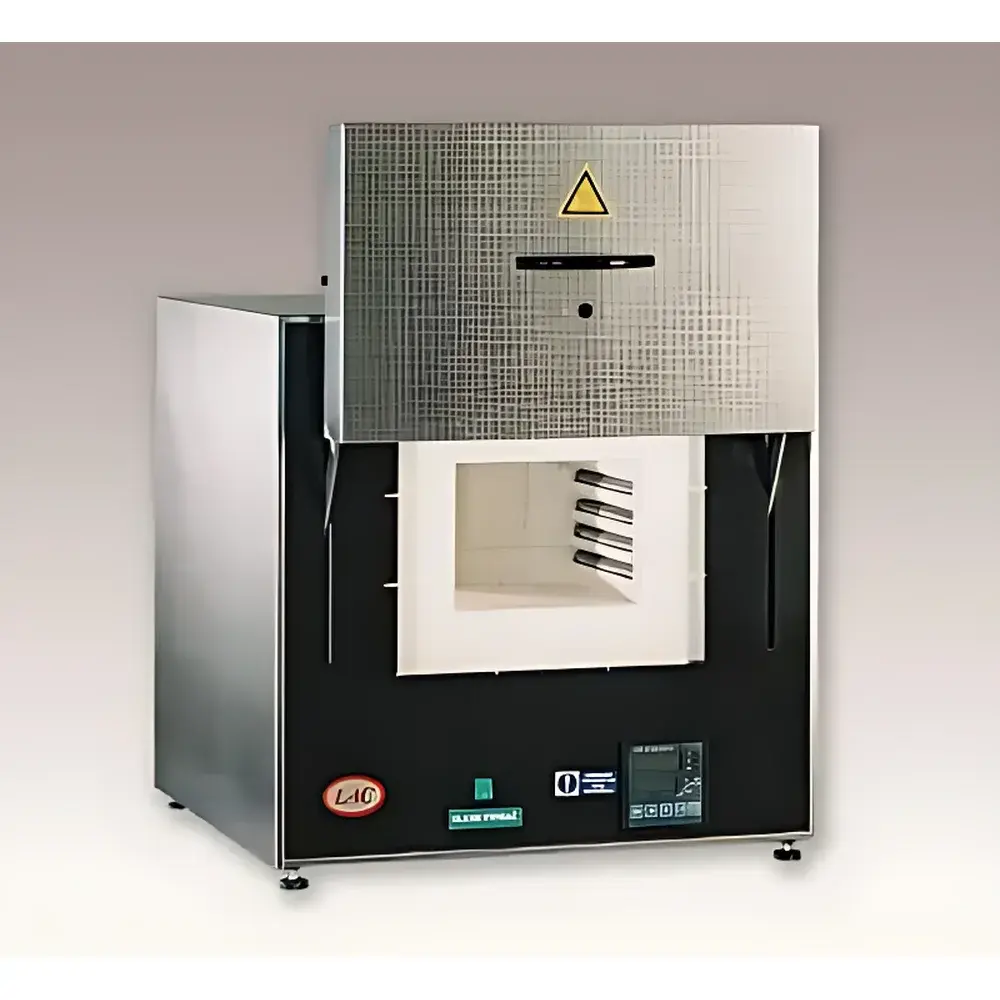
LAC LH Series Laboratory Muffle Furnace
| Brand | LAC |
|---|---|
| Model | LH Series |
| Temperature Range | Up to 1340 °C |
| Internal Volume | 6–30 L |
| Power Supply | 230 V AC, Single-Phase |
| Control System | HT40A Programmable Temperature Controller |
| Heating Element | Kanthal A1 Wire Wound on Mullite Tubes |
| Thermocouple | Type S (Platinum/Rhodium), Rear-Mounted |
| Insulation | High-Density Refractory Ceramic Fiber |
| Door Mechanism | Spring-Loaded Top-Hinged with Safety Interlock |
| Cooling | Integrated Axial Fan for Rapid Cool-Down |
| Compliance | Designed for GLP-compliant thermal processing in non-corrosive atmospheres |
Overview
The LAC LH Series Laboratory Muffle Furnace is a precision-engineered, high-temperature thermal processing instrument designed for controlled heat treatment, ashing, calcination, sintering, and annealing applications in research laboratories, quality control facilities, and materials development environments. Operating on the principle of radiant heating within a fully insulated muffle chamber, the furnace isolates samples from direct contact with heating elements and combustion byproducts—ensuring contamination-free thermal exposure. Its maximum operating temperature of 1340 °C is sustained with exceptional stability (±1 °C at setpoint under steady-state conditions), enabled by a robust thermal architecture comprising multi-layer ceramic fiber insulation, optimized airflow management, and closed-loop feedback via a rear-mounted Type S thermocouple. The furnace is engineered for non-corrosive atmospheres only and is not rated for reducing, oxidizing, or inert gas environments without optional accessories.
Key Features
- Stainless steel outer casing (AISI 304) providing long-term corrosion resistance and mechanical rigidity
- Top-hinged, spring-assisted door with integrated safety interlock switch—automatically de-energizes heating elements upon opening
- Blue-tinted borosilicate observation window enabling real-time visual monitoring without thermal interruption
- High-efficiency insulation system using low-conductivity refractory ceramic fiber (density ≥ 128 kg/m³), minimizing external surface temperature (<50 °C at 1300 °C internal)
- Kanthal A1 resistance wire wound on high-purity mullite tubes—offering excellent oxidation resistance and thermal cycling durability up to 1340 °C
- HT40A programmable temperature controller with PID algorithm, ramp-soak profiling, and 16-segment program capability
- Integrated axial cooling fan mounted on the top housing—reducing cooldown time by up to 40% compared to passive dissipation
- Zero-crossing solid-state relay (SSR) drive ensuring electromagnetic compatibility (EMC) and eliminating voltage spikes that could interfere with adjacent instrumentation
- Single-phase 230 V AC input with power ratings scalable from 1.5 kW to 3.2 kW across LH model variants
Sample Compatibility & Compliance
The LH Series is validated for use with ceramic crucibles (alumina, zirconia), quartz boats, and stainless steel trays—suitable for ash content analysis per ASTM D3174, ISO 1171, and USP . It complies with IEC 61000-6-3 (EMI emission limits) and IEC 61000-6-2 (immunity to electrostatic discharge and fast transients). While not intrinsically rated for hazardous locations, its design supports integration into GLP- and GMP-aligned workflows when paired with audit-trail-capable data loggers (e.g., compliant with FDA 21 CFR Part 11 when used with validated software). The furnace must not be operated with halogenated, sulfur-containing, or acidic compounds, as these may degrade insulation integrity and compromise thermocouple accuracy.
Software & Data Management
The HT40A controller supports analog output (4–20 mA) and digital communication via RS232 or RS485 interfaces (optional). When connected to third-party SCADA or LIMS platforms, it enables remote parameter setting, real-time temperature logging, and event-triggered alarms (e.g., over-temperature, door-open, thermocouple failure). Firmware updates are performed via USB interface; configuration backups can be exported in CSV format. For regulated environments, traceability is enhanced through timestamped operation logs—including start/stop times, profile execution history, and deviation alerts—with user-access levels configurable via password protection.
Applications
- Residue and ash determination in food, feed, pharmaceuticals, and environmental samples
- Thermal gravimetric pre-treatment prior to XRD or SEM sample preparation
- Heat treatment of metal oxides, catalyst precursors, and battery electrode materials
- Calibration of thermocouples and reference standards in metrology labs
- Pre-firing of ceramic green bodies and glass frit sintering trials
- LOI (Loss on Ignition) testing per ASTM C114 and EN 196-2
FAQ
What is the maximum recommended continuous operating temperature?
The LH Series is rated for continuous operation at up to 1300 °C; 1340 °C is specified as the absolute upper limit for short-duration processes (≤30 minutes) and requires strict adherence to manufacturer-specified soak time limits.
Can this furnace be used under inert or reducing atmospheres?
No—standard LH models lack gas-tight sealing or purge fittings. Optional accessories include a protective atmosphere inlet port (N₂ or Ar compatible) and exhaust ducting, but full inert operation requires factory modification and validation.
Is the HT40A controller compliant with FDA 21 CFR Part 11?
The controller itself does not provide electronic signature or audit trail functionality natively; however, when interfaced with validated third-party data acquisition software meeting ALCOA+ principles, it supports Part 11 compliance in end-to-end workflows.
How often should the Type S thermocouple be recalibrated?
Annual calibration against NIST-traceable standards is recommended for GLP/GMP applications; more frequent verification (e.g., quarterly) is advised if the furnace undergoes >10 thermal cycles per week above 1000 °C.
What maintenance is required for the heating elements?
Visual inspection every 200 operating hours is advised. No routine replacement is needed—Kanthal A1 elements typically exceed 2,000 hours of service life at 1200 °C with proper thermal cycling protocols.



