
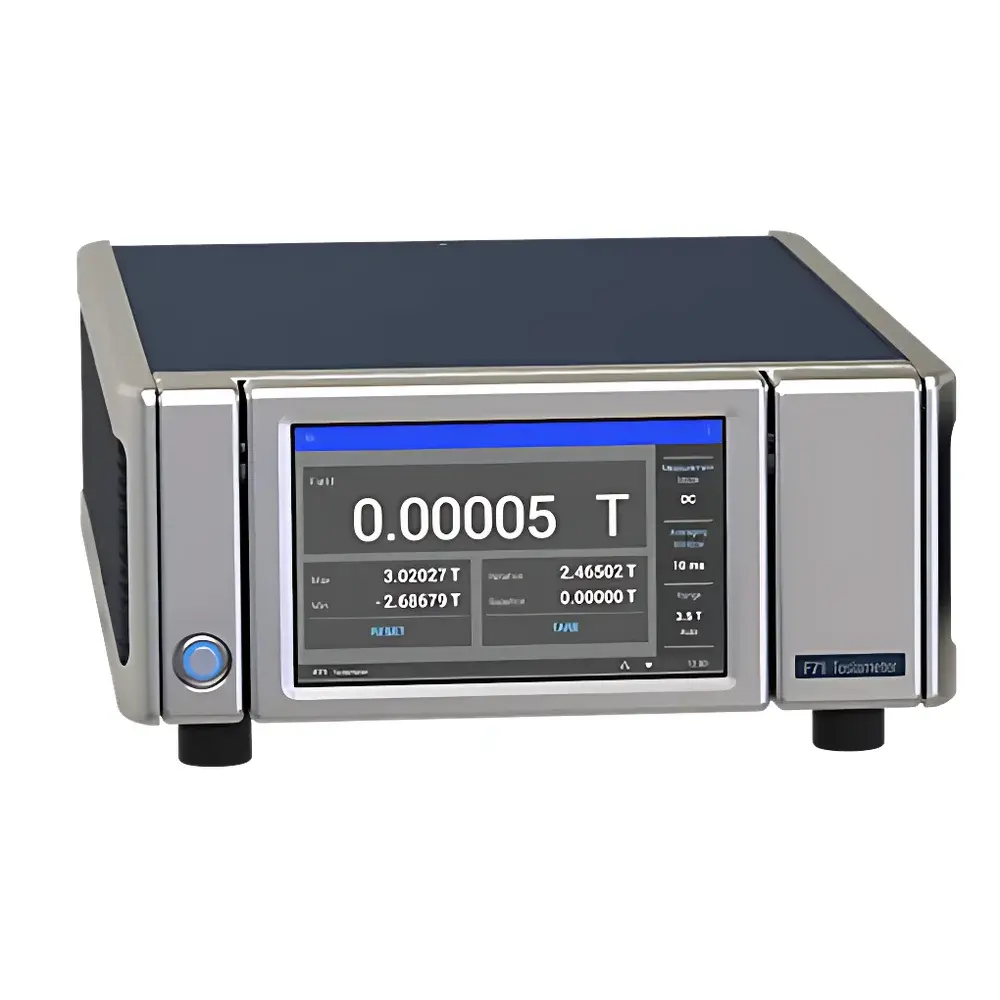
Lake Shore F71 and F41 Digital Gaussmeters / Magnetometers
| Brand | Lake Shore |
|---|---|
| Origin | USA |
| Model | F71 (3-axis), F41 (1-axis) |
| Measurement Range | 35 mT to 35 T |
| DC Accuracy | ±0.15% of reading (standard probe, 350 mT–3.5 T range) |
| AC Bandwidth | 550 Hz (–3 dB), HF Mode: 20 Hz–7 kHz (–0.2%) |
| Resolution | < 0.1 µT |
| Probe Compatibility | FP-Series Hall Probes only |
| Compliance | Designed for GLP/GMP environments with audit-ready data logging capability |
Overview
The Lake Shore F71 and F41 digital gaussmeters are precision magnetic field measurement instruments engineered for laboratory, industrial, and research applications requiring high stability, traceable accuracy, and operational robustness across wide dynamic ranges. Both models operate on the Hall effect principle—measuring the transverse voltage generated in a semiconductor (2Dex™ Hall sensor) under orthogonal magnetic flux—and deliver calibrated field values in tesla (T) or gauss (G). The F71 supports true vectorial 3-axis measurement with orthogonally aligned sensor elements housed within a single FP-series probe tip; the F41 provides high-fidelity single-axis (X-axis) measurement optimized for directional field mapping and integration into automated test stations. Unlike conventional Hall-based magnetometers, these instruments eliminate reliance on external zero-Gauss chambers through proprietary TruZero™ technology—a real-time offset correction methodology that continuously compensates for thermoelectric drift, geometric misalignment voltages, and flicker noise without interrupting measurement continuity. This architecture enables uninterrupted DC and AC field monitoring in variable thermal environments—from cryogenic dewars to ambient benchtop setups—while maintaining metrological integrity over extended acquisition periods.
Key Features
- TruZero™ auto-nulling technology: Eliminates manual zeroing by dynamically correcting for thermal EMF, contact asymmetry, and low-frequency noise via on-board algorithms and spinning-current excitation.
- FP-series Hall probes: Feature sub-0.1 mm² active sensing area, integrated Pt100 temperature sensors, and factory-characterized B–T compensation curves for <±0.2% full-scale accuracy across –40 °C to +85 °C operating range.
- TiltView™ capacitive touchscreen: 4.3-inch diagonal display with smartphone-grade gesture navigation, adjustable tilt mechanism (0°–90°), and icon-driven interface compliant with IEC 61000-4-2 ESD immunity standards.
- Multi-range DC/AC/HF operation: Three distinct measurement modes—DC (0 Hz), AC (up to 550 Hz), and High-Frequency (20 Hz–7 kHz)—each with dedicated signal conditioning, analog output scaling, and RMS/peak detection logic.
- Low-drift electronics: Temperature-coefficient-compensated front-end amplifiers and 24-bit delta-sigma ADCs ensure <10 ppm/°C gain drift and <15-minute warm-up to specified accuracy.
- Modular probe ecosystem: Supports interchangeable FP-NS series probes—including handheld transverse (FP-NS-180-TSXX), fixed-mount 3-axis (FP-NS-180-ZSXXM), and cryogenic variants—with mechanical alignment tolerances <0.2° between orthogonal axes.
Sample Compatibility & Compliance
The F71 and F41 are compatible exclusively with Lake Shore’s FP-series Hall probes—designed to meet ISO/IEC 17025 calibration traceability requirements when used with NIST-traceable reference fields. These instruments do not support legacy 400-series probes or bare semiconductor sensors (e.g., InAs, GaAs wafers). All FP probes undergo individual characterization at multiple temperatures and field strengths, with coefficients stored in EEPROM for real-time linearization and thermal compensation. For regulated environments, the systems support optional firmware upgrades enabling 21 CFR Part 11-compliant electronic signatures, audit trails, and role-based access control. Data export formats include CSV, HDF5, and IEEE 488.2 SCPI command sets—facilitating integration into LabVIEW, Python (PyVISA), or MATLAB automation frameworks. Mechanical design complies with IEC 61010-1 safety standards for measurement equipment; EMC performance meets EN 61326-1 Class A emission limits.
Software & Data Management
Lake Shore’s MMS (Magnetometer Management Software) provides full instrument control, real-time waveform visualization, statistical analysis (min/max/avg/std dev), and configurable alarm thresholds. Raw analog outputs (±10 V, 0–10 V, or 4–20 mA) support direct oscilloscope or DAQ system interfacing with user-defined scaling (e.g., 20 V/T for pulse diagnostics). Internal memory logs up to 1 million timestamped readings at programmable intervals (10 ms–1 h); USB-C and Ethernet interfaces enable remote scripting and synchronized multi-instrument deployments. For GxP workflows, optional software modules generate PDF reports with embedded calibration certificates, operator ID, environmental metadata (temperature/humidity), and digital signatures—fully auditable per ALCOA+ principles. Firmware updates are delivered via signed binary packages validated using SHA-256 hash verification.
Applications
These gaussmeters serve critical roles in magnet characterization (permanent magnets, electromagnets, superconducting coils), materials science (magnetic susceptibility screening, domain imaging support), accelerator physics (beamline field mapping), and quality assurance (motor stator field uniformity, MRI shimming validation). The F71’s vector mode enables spatial field gradient estimation in undulating geometries—essential for magnetic shielding validation and magnetic resonance coil homogeneity testing. The F41’s compact form factor and fast analog output make it ideal for closed-loop feedback in pulsed-field magnetizers and eddy-current brake monitoring. Both models have been deployed in national metrology institutes for inter-laboratory comparison studies referenced to primary standards such as NMR teslameters and SQUID-based reference systems.
FAQ
What is the difference between TruZero™ and traditional zeroing procedures?
TruZero™ eliminates the need for physical placement in a zero-field chamber by applying real-time mathematical correction to Hall voltage offsets—using continuous sensor excitation reversal and weighted averaging—to suppress thermoelectric and geometric error sources inherent in all semiconductor-based probes.
Can the F71 measure true vector magnitude without rotating the probe?
Yes—the three orthogonal Hall elements are physically aligned to <0.2° tolerance and digitally fused using root-sum-square (RSS) computation; no mechanical reorientation is required for total field magnitude determination.
Are FP-series probes compatible with older Lake Shore gaussmeters?
No—FP probes use a proprietary 26-pin mini-D-sub interface and embedded EEPROM communication protocol; they are only supported by F41/F71 and newer platforms (e.g., Model 475 upgrade kits require hardware modification).
Does the instrument support cryogenic operation below 77 K?
The base F41/F71 electronics are rated for –20 °C to +60 °C ambient; however, optional FP-series low-temperature probes (e.g., FP-LT-180) are qualified down to 1.8 K and communicate calibrated field values directly—without requiring external cold-stage temperature input.
How is measurement uncertainty determined for compliance reporting?
Total uncertainty combines Type A (statistical repeatability, typically <0.05% of reading) and Type B components (calibration certificate uncertainty, temperature compensation residual, linearity deviation), reported per GUM (JCGM 100:2008) with coverage factor k=2 (95% confidence).



