
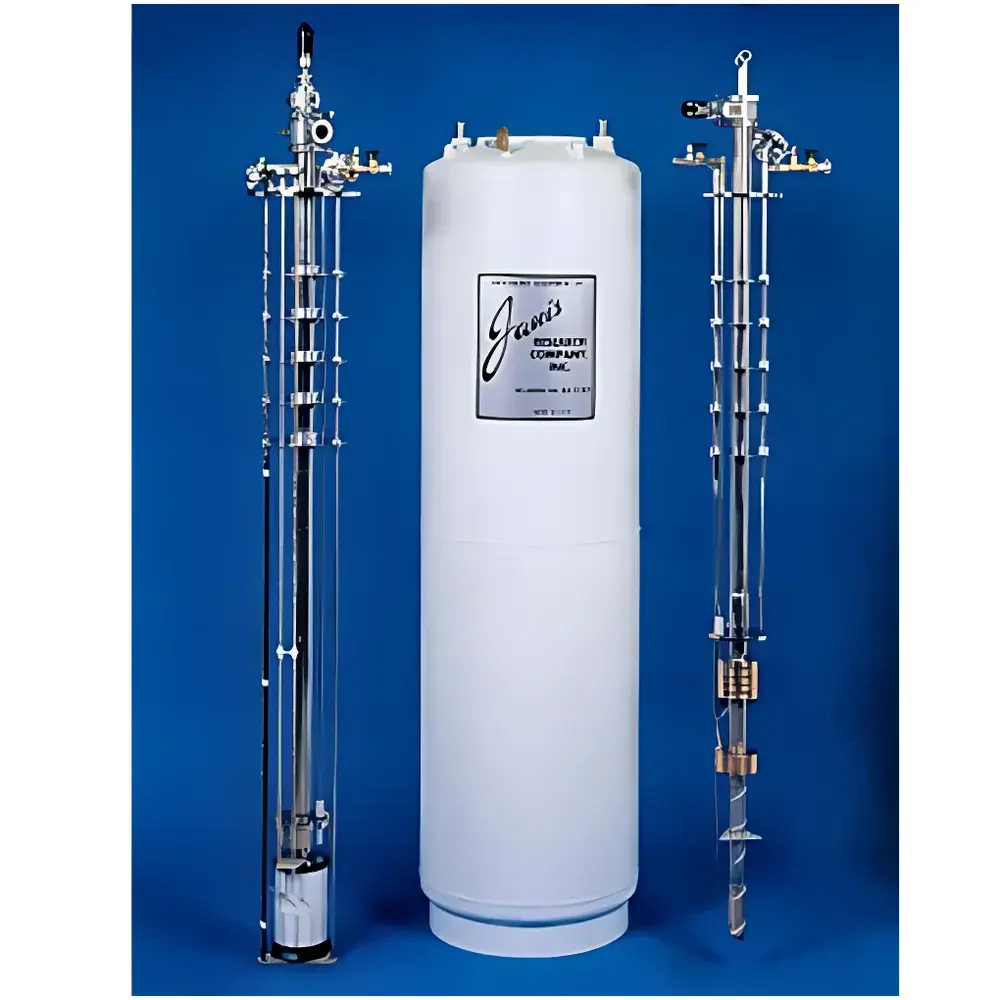
Lake Shore SuperVariMag Wet Superconducting Magnet System
| Brand | Lake Shore |
|---|---|
| Origin | USA |
| Manufacturer Status | Authorized Distributor |
| Product Origin | Imported |
| Model | SuperVariMag |
| Pricing | Upon Request |
Overview
The Lake Shore SuperVariMag Wet Superconducting Magnet System is a cryogenically cooled, liquid-helium-based platform engineered for high-field, low-temperature magnetic characterization of condensed matter. Operating on the principle of persistent-mode superconducting magnetism, the system utilizes NbTi (6–9 T) or Nb3Sn (10–14 T) coil technology to generate stable, highly homogeneous DC magnetic fields. Designed for integration into advanced physical property laboratories, the SuperVariMag supports variable-temperature operation from 1.5 K to 325 K (with 400 K optional via resistive heater upgrade), enabling comprehensive thermomagnetic mapping of electronic, magnetic, and transport phenomena. Its open-bath (wet) architecture—featuring a 20 L capacity liquid helium dewar with vapor-cooled thermal shield—ensures extended hold times and mechanical stability under high-field conditions. Unlike dry (cryocooler-based) systems, the wet configuration delivers superior field homogeneity, thermal uniformity, and long-term field stability—critical for quantum oscillation studies, critical field mapping, and precision Hall effect measurements.
Key Features
- Field range: 6–9 T (NbTi) or 10–14 T (Nb3Sn), with homogeneity options from ±0.5% to ±0.01% over 1 cm DSV (diameter spherical volume)
- Sample space: 1.0–2.5 inch (25–63 mm) internal bore diameter; configurable for vertical, transverse, or vector field geometries using dual- or triple-coil arrangements
- Temperature control: 1.5 K base temperature (via pumped He-4), extendable to 325 K standard or 400 K optional; compatible with Lambda-point refrigeration for sub-2.2 K operation
- Cryogenic architecture: Open-bath liquid helium dewar with vapor-shielded insulation; ultra-low boil-off variants available for >100-hour hold time at 4.2 K
- Sample environment: Continuous-flow vapor or high-vacuum sample space; compatible with liquid, powder, bulk, and irregularly shaped specimens without optical access constraints
- Modular insert compatibility: Rotating sample probes, ultra-high vacuum (UHV) inserts, 3He refrigerator inserts, and custom electrical feedthrough configurations
Sample Compatibility & Compliance
The SuperVariMag accommodates diverse sample forms—including single crystals, thin films, polycrystalline powders, nanowires, and heterostructures—within its thermally anchored, vibration-isolated sample space. Its atmosphere-controlled sample chamber enables controlled cooling in inert gas, vacuum, or liquid cryogen environments, ensuring reproducible thermal contact and minimal thermal gradients across heterogeneous samples. The system complies with standard laboratory safety protocols for cryogenic handling (ANSI/ASHRAE 15), electromagnetic field exposure limits (ICNIRP 2010), and integrates seamlessly with ISO/IEC 17025-accredited test workflows. When equipped with Lake Shore’s M81-SSM and M91 FastHall modules, the platform supports GLP-compliant data acquisition, including full audit trails, user authentication, and electronic signatures per FDA 21 CFR Part 11 requirements.
Software & Data Management
The SuperVariMag is fully interoperable with Lake Shore’s MeasureLINK™ software suite—a Windows-based, instrument-agnostic platform supporting synchronized control of magnetic field, temperature, current sourcing, and voltage measurement. MeasureLINK enables automated sweep routines (e.g., B-sweeps at fixed T, T-sweeps at fixed B), real-time plotting, and export to HDF5, CSV, or MATLAB-native formats. With optional M81-SSM Synchronized Source-Measure capability, users achieve sub-millisecond timing alignment between excitation and readout—essential for AC susceptibility, low-noise resistivity, and quantum transport studies. All measurement metadata—including calibration coefficients, sensor IDs, timestamped environmental logs, and instrument configuration snapshots—is embedded directly into data files to ensure traceability and regulatory compliance.
Applications
- Quantum transport characterization: Shubnikov–de Haas oscillations, quantum Hall effect, and Landau level spectroscopy
- Magnetic phase diagram mapping: Critical field determination (Hc1, Hc2), metamagnetic transitions, and spin reorientation
- Superconductor research: Upper critical field (Hc2) analysis, vortex lattice imaging (via scanning probe integration), and flux pinning behavior
- Spintronics & multiferroics: Anisotropic magnetoresistance (AMR), giant magnetoresistance (GMR), and exchange bias quantification
- Low-dimensional materials: Graphene, TMDCs, topological insulators, and skyrmion-hosting chiral magnets under tunable field-temperature trajectories
- Calorimetric coupling: Integration with PPMS-style heat capacity modules for magnetic specific heat analysis
FAQ
What cryogen consumption rate can be expected for continuous operation at 4.2 K?
Typical boil-off rates range from 0.8–1.2 L/h for standard vapor-shielded dewars, and as low as 0.3–0.5 L/h for HiEff configurations—dependent on ambient conditions and thermal loading.
Is remote operation supported for unattended overnight measurements?
Yes—MeasureLINK supports secure LAN/WAN connectivity, scheduled task execution, email alerting on completion or error, and TLS-encrypted data streaming to network storage.
Can the system be upgraded from NbTi to Nb3Sn coil later?
No—coil type is determined at manufacturing; however, field strength and homogeneity options are selected during initial configuration and documented in the system’s calibration certificate.
Are there restrictions on electrical feedthrough count or current rating?
Standard configurations include 12 low-thermal-conductance copper-nickel feedthroughs rated to 3 A DC; custom high-current (10 A) or RF-grade (up to 18 GHz) options are available upon request.
Does Lake Shore provide NIST-traceable calibration documentation?
Yes—each system ships with factory calibration reports for field homogeneity, temperature sensor linearity (Cernox™, RuO2, carbon glass), and magnetic field vs. current response, all traceable to NIST standards.



