
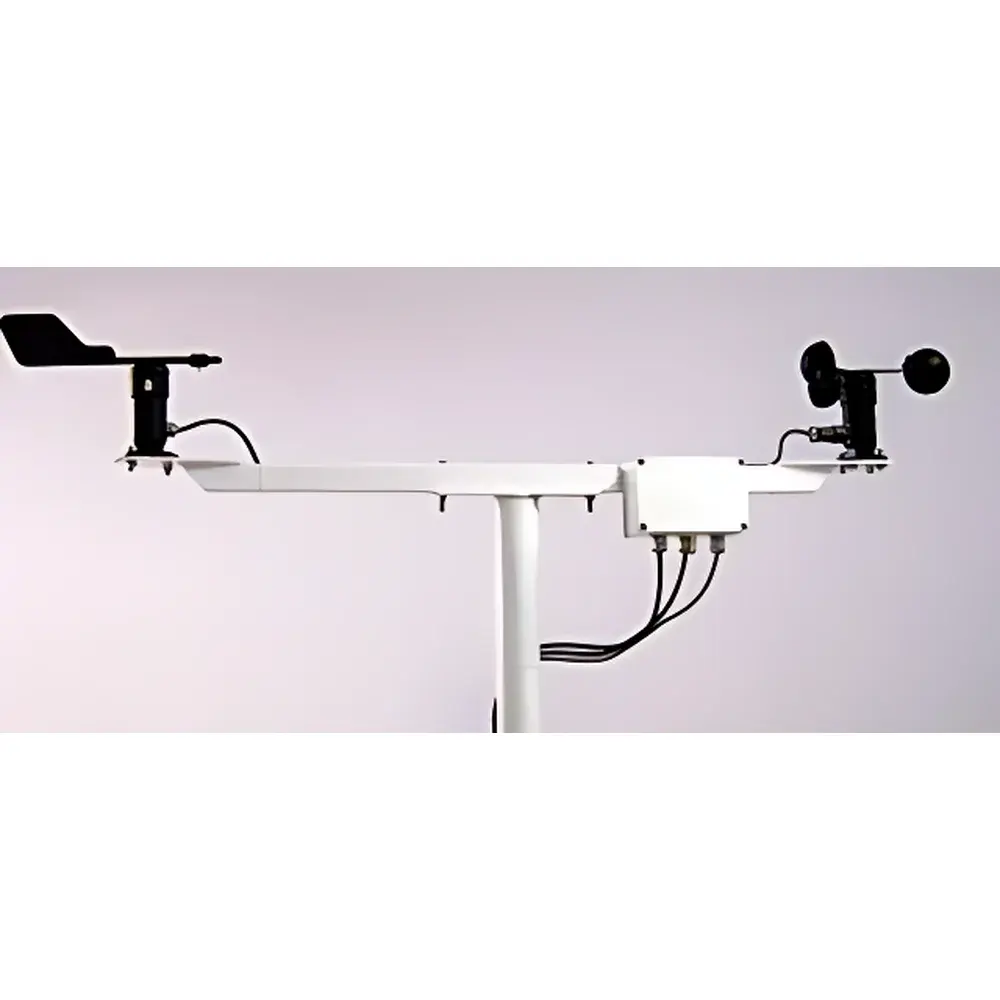
Lambrecht 578 Ultrasonic Wind Speed and Direction Monitoring Station
| Brand | Lambrecht |
|---|---|
| Model | 578 |
| Origin | Germany |
| Sensor Type | Ultrasonic Anemometer |
| Operating Temperature | -40 to +65 °C |
| Storage Temperature | -45 to +70 °C |
| Power Consumption | Avg. 0.14 mA, Peak 30 mA (external supply) |
| Battery | 3 V Lithium Cell |
| Battery Life | 8 months (no solar), 2 years (with 0.5 W solar panel) |
| Compliance | CE, RoHS, IP65 enclosure rating |
| Data Logging | Internal SD card storage with timestamped binary/CSV export |
| Communication | RS-485 (Modbus RTU), optional USB or Bluetooth interface |
Overview
The Lambrecht 578 Ultrasonic Wind Speed and Direction Monitoring Station is a fully integrated, maintenance-free environmental monitoring system engineered for long-term, unattended operation in demanding outdoor conditions. Unlike mechanical cup-and-vane anemometers subject to bearing wear and inertia-induced lag, the 578 employs time-of-flight ultrasonic transit-time measurement across three orthogonal acoustic paths. This solid-state architecture eliminates moving parts, delivering high reproducibility of wind vector measurements—both speed (0.01–60 m/s) and direction (0–360°)—with no mechanical hysteresis or zero drift over seasonal temperature cycles. Designed for deployment in meteorological networks, air quality monitoring stations, renewable energy site assessments, and industrial stack emission compliance tracking, the system meets the foundational requirements of ISO 16452:2021 (Wind measurement — Performance requirements for ultrasonic anemometers) and supports traceable calibration protocols aligned with WMO Guide to Meteorological Instruments and Methods of Observation (CIMO Guide, Chapter 12).
Key Features
- Ultrasonic wind sensing with no moving parts—ensures >10-year operational reliability and immunity to icing, dust accumulation, or mechanical fatigue
- Integrated dual-axis tilt compensation and built-in temperature/pressure sensors for real-time atmospheric density correction
- IP65-rated aluminum housing with marine-grade anodized finish, rated for continuous exposure to salt spray, UV radiation, and thermal cycling
- Low-power embedded controller optimized for extended battery life: average current draw of 0.14 mA enables 8-month autonomy on a single 3 V lithium cell
- 0.5 W monocrystalline solar panel with charge management circuitry extends field service interval to 24 months under typical European insolation profiles
- Onboard microSD card (pre-installed, up to 32 GB) stores second-resolution wind vectors with UTC timestamps; data export via FAT32-compatible CSV or binary format
Sample Compatibility & Compliance
The Lambrecht 578 is validated for continuous monitoring of ambient atmospheric wind in open terrain, rooftop installations, coastal zones, and industrial perimeters. It complies with EN 61326-1:2013 (EMC for measurement equipment), EN 61000-6-2:2019 (immunity), and EN 61000-6-3:2019 (emissions). Its measurement uncertainty profile—±0.15 m/s (speed) and ±2° (direction) at 10 m/s under laminar flow conditions—meets Class 2 specifications per IEC 61000-4-30 Annex B for environmental monitoring instrumentation. The system supports GLP-compliant audit trails when interfaced with certified data acquisition platforms and satisfies data integrity prerequisites for regulatory submissions under EU Directive 2008/50/EC (Ambient Air Quality Directive) and US EPA 40 CFR Part 58 Appendix E.
Software & Data Management
Data retrieval is performed via standard USB-Mass Storage mode or RS-485 Modbus RTU (function codes 03/04) for integration into SCADA, IoT edge gateways, or custom telemetry systems. The included Lambrecht WindLog Suite (v4.2+) provides configuration, firmware update, and post-processing capabilities—including turbulence intensity (TI), wind shear exponent (α), and sector-wise wind rose generation. All logged files include embedded metadata (sensor ID, firmware version, GPS coordinates if externally supplied, and sensor health flags), ensuring full traceability. Exported datasets conform to CF Standard Names v1.8 and are compatible with Python (pandas/xarray), MATLAB, and R statistical environments. Audit logs record all configuration changes, firmware updates, and manual data clear events—supporting 21 CFR Part 11-compliant environments when deployed with validated IT infrastructure.
Applications
- Long-term climatological monitoring for national meteorological services and research institutions
- Pre-construction wind resource assessment for onshore and near-shore wind farm development (IEC 61400-12-1 compliant data collection)
- Real-time ventilation control in tunnel and underground infrastructure
- Emission dispersion modeling input for industrial stack monitoring (EPA AP-42, AERMOD-ready)
- Boundary layer studies in atmospheric science field campaigns (e.g., BLLAST, HyMeX)
- Calibration reference for lower-cost rotating anemometer arrays in distributed sensor networks
FAQ
Does the Lambrecht 578 require periodic mechanical recalibration?
No. The ultrasonic transducers are factory-calibrated using NIST-traceable wind tunnel procedures; only annual verification against a reference standard is recommended per ISO/IEC 17025.
Can the system operate without solar charging in polar winter conditions?
Yes. With pre-conditioned lithium cells and low-temperature firmware, it maintains functionality down to –40 °C; battery life reduces to ~4 months under continuous darkness at –25 °C.
Is Modbus TCP supported natively?
No—only Modbus RTU over RS-485 is embedded. Modbus TCP requires an external protocol converter or gateway device.
What is the maximum sampling frequency for raw ultrasonic transit-time data?
The internal processing engine captures 20 Hz transit-time samples; final wind vectors are output at user-selectable intervals from 1 s to 1 h.
How is sensor fouling mitigated in high-dust or coastal environments?
The transducer faces incorporate hydrophobic nano-coating and self-cleaning acoustic pulsing sequences activated during low-wind periods.
Related Products







