
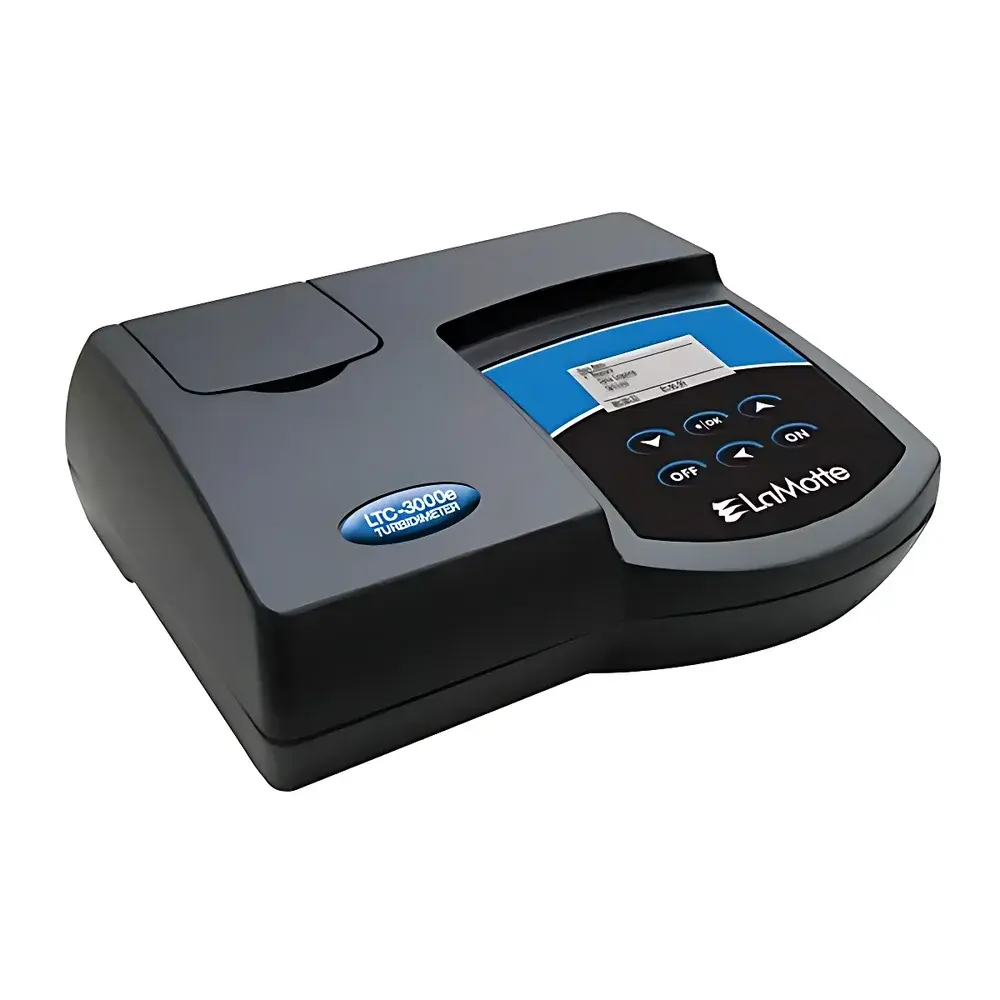
Lamotte LTC-3000WE Portable Turbidimeter
| Origin | USA |
|---|---|
| Manufacturer Type | Authorized Distributor |
| Origin Category | Imported |
| Model | 1901-CD |
| Product Type | Portable |
| Measurement Range | 0–4000 NTU (with extended low-range precision down to 0.05 NTU) |
| Resolution | 0.01 NTU (0.00–10.99), 0.1 NTU (11.00–109.9), 1 NTU (110–4000) |
| Operating Temperature | 0–50 °C |
| Accuracy | ±0.05 NTU (0–2.5 NTU), ±2% (2.5–100 NTU), ±3% (>100 NTU) |
| Detection Limit | 0.05 NTU/FNU |
| Repeatability | ±0.02 NTU or ±1% |
| Light Source | Tungsten lamp (525 nm), 428 nm LED, and 525 nm LED |
| Detector | Silicon photodiode |
| Sample Volume | 10 mL |
| Cell Diameter | 25 mm |
| Response Time | <2 s |
| Data Storage | 4000 measurements with timestamp |
| Interface | RS232 and USB |
| Power Supply | 100–240 V AC adapter |
| Dimensions (L×W×H) | 22 × 8 × 20 cm |
| Compliance | US EPA Method 180.1 & 330.5, ISO 7027, ASTM D6508 |
Overview
The Lamotte LTC-3000WE Portable Turbidimeter is an EPA-compliant, microprocessor-controlled optical instrument engineered for high-precision turbidity measurement across drinking water, wastewater, environmental monitoring, and field-based applications. It operates on the principle of nephelometric detection—measuring scattered light intensity at 90° relative to the incident beam—per US EPA Method 180.1 and ISO 7027 standards. Its patented multi-detector optical chamber minimizes stray light and color interference, while the dual-wavelength LED system (428 nm and 525 nm) enables robust compensation for sample chromaticity and particle size distribution effects. The instrument features a tungsten lamp for broad-spectrum reference and integrated temperature-stabilized photodiodes to ensure signal consistency under variable ambient conditions. Designed for operational rigor in both laboratory and uncontrolled outdoor environments, the LTC-3000WE delivers stable, reproducible readings within two seconds—critical for time-sensitive compliance sampling and rapid process verification.
Key Features
- Patented focused optical design optimized for low-turbidity accuracy (detection limit: 0.05 NTU/FNU)
- Multi-wavelength illumination (428 nm LED, 525 nm LED, and tungsten lamp) with automatic wavelength selection based on measurement range and matrix type
- MSP430 microcontroller platform enabling advanced calibration algorithms, real-time drift correction, and adaptive averaging (2/5/10 s integration)
- Fixed-position sample cell holder ensuring repeatable optical alignment and eliminating operator-induced positioning error
- Large backlit LCD with intuitive menu navigation and seven-language support (English, Spanish, French, Japanese, Italian, Portuguese, Chinese)
- Onboard storage for up to 4,000 timestamped measurements with export capability via RS232 or USB to compliant LIMS or spreadsheet environments
- Configurable auto-power-off (5/10/30 min) and adjustable signal averaging to balance speed and statistical confidence
- Integrated support for multiple turbidity units (NTU, FNU, AU, FAU, ASBC, EBC) and parallel residual chlorine quantification (free/total Cl₂) using DPD colorimetry
Sample Compatibility & Compliance
The LTC-3000WE accepts standard 25-mm-diameter glass or disposable plastic cuvettes (10 mL volume), accommodating both clear potable water and highly turbid surface or industrial effluent samples. Its optical architecture maintains linearity and repeatability across the full 0–4000 NTU range, with enhanced sensitivity in the critical 0–10 NTU zone required for regulatory compliance with WHO, US EPA, and EU Drinking Water Directive limits. The instrument meets US EPA Methods 180.1 (nephelometric turbidity) and 330.5 (chlorine residual), and conforms to ISO 7027 for formazin-based calibration traceability. Its firmware supports GLP/GMP audit trails—including user ID logging, calibration history, and data modification timestamps—making it suitable for regulated environments subject to FDA 21 CFR Part 11 requirements when paired with validated data transfer protocols.
Software & Data Management
Data acquisition and reporting are streamlined through bidirectional communication via RS232 or USB. Raw measurement logs—including date/time stamp, unit selection, calibration status, and operator ID—are stored in non-volatile memory with cyclic overwrite protection. Exported files follow CSV format compatible with Microsoft Excel, LabArchives, and industry-standard LIMS platforms. Firmware updates are delivered via secure Lamotte-provided utilities, preserving configuration integrity during version upgrades. No proprietary software installation is required for basic data retrieval; however, Lamotte’s optional TurbView™ desktop application provides advanced trend analysis, calibration curve visualization, and automated report generation aligned with ISO/IEC 17025 documentation frameworks.
Applications
- Drinking water treatment: Finished water quality verification per EPA 180.1, filter performance monitoring, and distribution system integrity assessment
- Environmental field work: Stream, lake, and reservoir turbidity profiling with GPS-synced metadata capture (via external integration)
- Wastewater operations: Effluent discharge compliance, clarifier optimization, and sludge blanket depth estimation
- Pharmaceutical manufacturing: Purified water and water-for-injection (WFI) clarity validation per USP and EP 2.2.1
- Educational laboratories: Teaching core principles of light scattering, Beer-Lambert law limitations, and nephelometric vs. absorptiometric measurement distinctions
- Food & beverage QC: Cider, beer (ASBC/EBC), and juice clarity control with direct unit conversion and method-specific calibration options
FAQ
Does the LTC-3000WE require annual recalibration by an accredited lab?
No—field recalibration using NIST-traceable formazin or AMCO AEPA standards is supported via the onboard calibration routine. However, annual verification against primary standards is recommended for ISO/IEC 17025-accredited labs.
Can it measure turbidity in colored samples without interference?
Yes—the dual-wavelength LED system and proprietary scatter-compensation algorithm significantly reduce chromatic bias, particularly in yellow-hued natural waters or treated effluents.
Is the instrument compatible with GLP audit requirements?
Yes—when configured with user authentication and enabled audit trail logging, it meets core GLP data integrity criteria for traceability, change control, and electronic signature readiness.
What is the battery life in portable operation mode?
The LTC-3000WE operates exclusively via AC power (100–240 V); it does not include internal batteries. For true field portability, Lamotte offers the optional LTC-3000WE-BP battery pack accessory.
How does the instrument handle large particulates that cause signal fluctuation?
Its rapid <2-second response time combined with selectable averaging (2/5/10 s) suppresses transient spikes from settling aggregates, delivering statistically stable results even in heterogeneous suspensions.




