
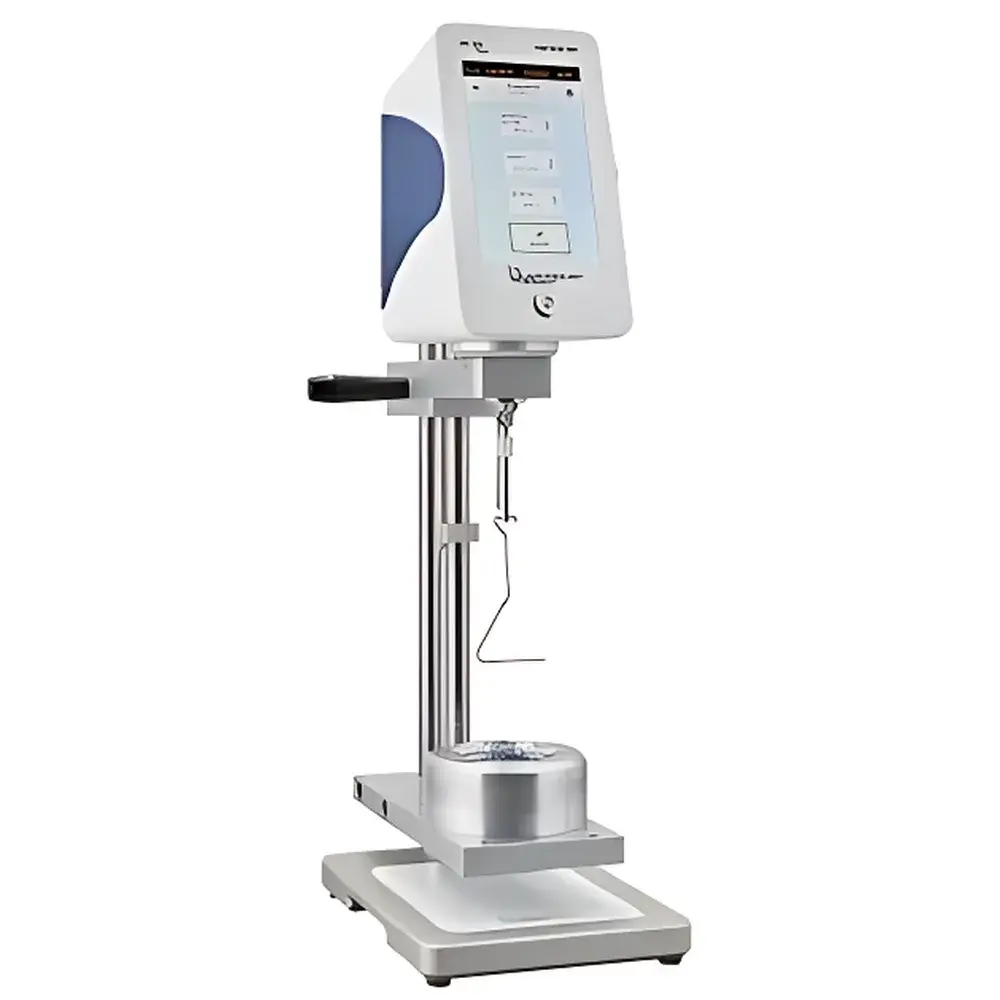
Lamy RM100 TOUCH Gel Rotational Viscometer
| Brand | Lamy Rheology |
|---|---|
| Origin | France |
| Model | RM100 TOUCH |
| Instrument Type | Portable Rotational Viscometer |
| Viscosity Range | 100–5,000,000,000 mPa·s |
| Rotational Speed | 0.3–1500 rpm |
| Torque Range | 0.05–40 mN·m |
| Temperature Range | −50 °C to 300 °C (with optional RT-1 furnace) |
| Accuracy | ±1% of full scale |
| Repeatability | ±0.2% |
| Display | 7″ capacitive touchscreen |
| Interface | RS232, USB, 4–20 mA analog output |
| Temperature Sensor | Integrated Pt100 |
| Power Supply | 90–240 VAC, 50/60 Hz |
| Dimensions (main unit) | 180 × 135 × 250 mm |
| Weight | 15 kg |
| Compliance | ASTM D2196, ISO 2555, ISO 3219, DIN 53019 |
Overview
The Lamy RM100 TOUCH is a high-precision, portable rotational viscometer engineered for rigorous rheological characterization of gels, crosslinked polymers, resins, and highly structured fluids. Operating on the principle of controlled shear stress or shear rate via coaxial cylinder (Couette) or cone-and-plate geometry—depending on the selected measurement system—the instrument delivers reproducible viscosity data under defined mechanical and thermal conditions. Its core design eliminates mechanical hysteresis by replacing traditional spring-based torque sensing with a direct-drive electromagnetic motor and digital torque transduction. This architecture ensures stable rotational speed across the full viscosity range—from low-viscosity solvents to ultra-high-viscosity gels exceeding 5 × 10⁹ mPa·s—without speed droop or calibration drift. The integrated Pt100 temperature sensor enables real-time thermal monitoring during gelation kinetics studies, making the RM100 TOUCH particularly suited for gel time determination, cure monitoring, and quality control of thermosetting systems in R&D and production environments.
Key Features
- Electromagnetic direct-drive motor with no springs, eliminating annual recalibration and mechanical wear;
- 7-inch high-resolution capacitive touchscreen interface supporting multilingual UI, on-device method programming, and local data backup;
- Full torque range of 0.05–40 mN·m with ±0.2% repeatability and ±1% full-scale accuracy;
- Wide operational speed range: 0.3–1500 rpm with continuous variable resolution—no fixed speed steps;
- Integrated temperature measurement (−50 °C to 300 °C) using calibrated Pt100 sensor; compatible with optional RT-1 high-temperature furnace (±0.2 °C stability at 300 °C);
- User authentication via username/password (4-digit PIN), ensuring traceable access control in regulated labs;
- Dual communication interfaces: RS232 and USB for instrument control, data export, and integration with LIMS or SCADA systems;
- 4–20 mA analog output configurable for torque or viscosity signal transmission to PLCs or process controllers;
- No leveling requirement—robust mechanical base and self-compensating sensor alignment ensure operational stability on standard lab benches.
Sample Compatibility & Compliance
The RM100 TOUCH supports both reusable geometries (e.g., DIN spindles, MS-DIN series) and single-use disposable sample cups (MS-C), minimizing cross-contamination and eliminating cleaning validation burdens—critical for pharmaceutical, cosmetic, and food applications. It is validated against internationally recognized standards including ASTM D2196 (viscosity of paints, varnishes, and related products), ISO 2555 (determination of apparent viscosity of plastics in the molten state), ISO 3219 (rheology of polymer melts and solutions), and DIN 53019 (rotational viscometry). When paired with the RT-1 furnace and MS-DIN geometry, it meets GLP-compliant thermal ramping requirements for accelerated stability testing. All firmware and data handling protocols support audit trail generation per FDA 21 CFR Part 11 when used with compliant PC software.
Software & Data Management
While the RM100 TOUCH operates autonomously via its embedded OS, optional LamyVisco PC software provides advanced method scripting, real-time graphing (viscosity vs. time, shear rate, or temperature), statistical analysis (mean, SD, CV%), and export to CSV, PDF, or XML formats. Data files include metadata such as operator ID, timestamp, environmental temperature, rotor ID, and calibration certificate reference. All measurements are time-stamped with millisecond precision and stored with immutable file attributes. The USB port supports direct printing to compatible label or thermal printers for GMP-aligned record keeping. Firmware updates are delivered via signed binary packages, preserving cryptographic integrity and version traceability.
Applications
- Gelation Kinetics: Real-time monitoring of sol-gel transitions in silicone rubbers, epoxy resins, and hydrogels;
- QC/QA in Food Manufacturing: Consistency testing of jams, pectin gels, dairy desserts, and plant-based alternatives;
- Coatings & Inks: Viscosity profiling across shear rates to predict sprayability, leveling, and sag resistance;
- Pharmaceutical Formulations: Rheological assessment of topical gels, mucoadhesive polymers, and injectable depots;
- Academic Research: Structure-property relationships in associative polymers, colloidal gels, and yield-stress fluids;
- Chemical Process Development: In-line viscosity estimation via analog output integration into pilot-scale reactors.
FAQ
Does the RM100 TOUCH require periodic spring replacement or annual recalibration?
No. Its spring-free electromagnetic torque transduction system eliminates mechanical fatigue and maintains metrological stability without scheduled hardware maintenance.
Can the instrument measure gel time automatically?
Yes. By programming a time-sweep viscosity profile at fixed shear rate and temperature, the onset of rapid viscosity increase (gel point) is identified algorithmically using first-derivative threshold detection.
Is the RT-1 high-temperature furnace included with the base RM100 TOUCH unit?
No. The RT-1 is an optional accessory. When installed, it extends temperature capability to 300 °C with ±0.2 °C uniformity and integrates seamlessly via the same touchscreen interface.
What sample volumes are supported with disposable cups?
Standard MS-C cups hold 12–15 mL depending on geometry; low-volume variants accommodate as little as 2.5 mL for precious or hazardous samples.
How is data integrity ensured in regulated environments?
The instrument logs all user actions, measurement events, and configuration changes with timestamps and operator IDs. When used with validated LamyVisco software, full 21 CFR Part 11 compliance—including electronic signatures and audit trails—is achievable.



