
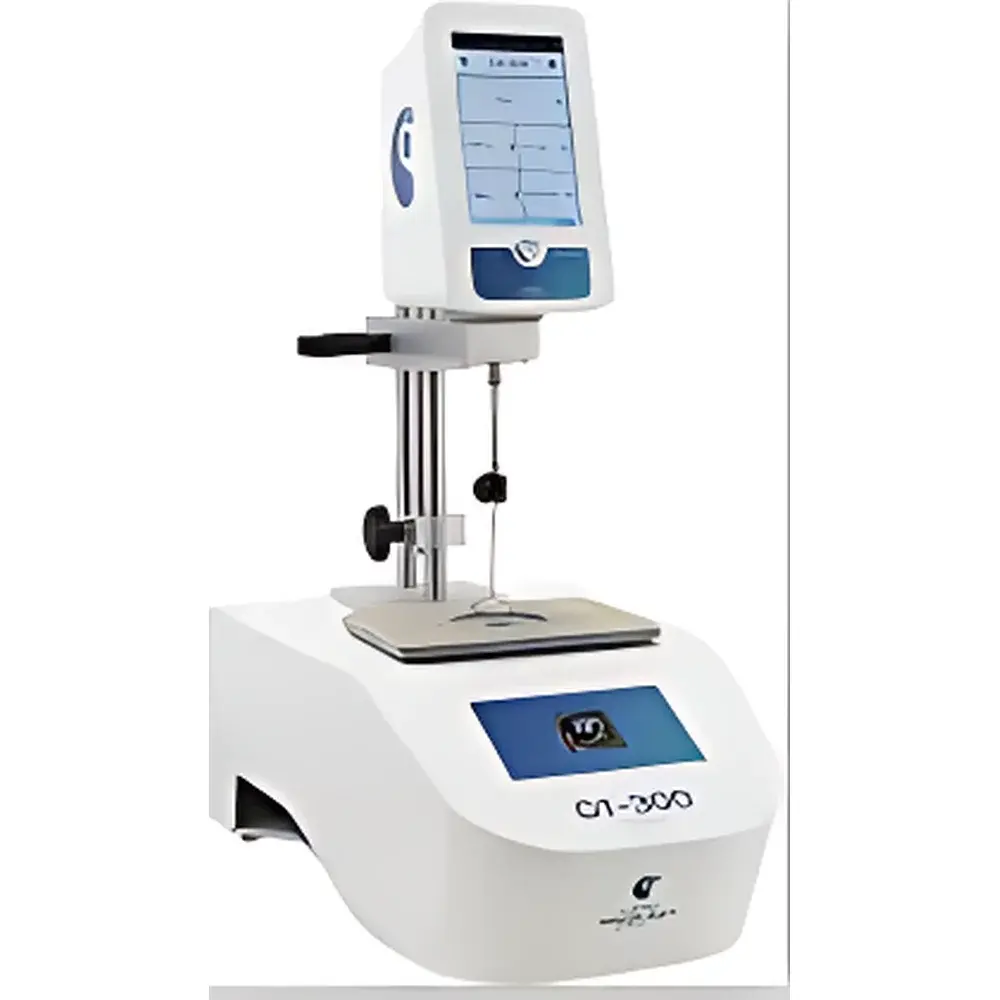
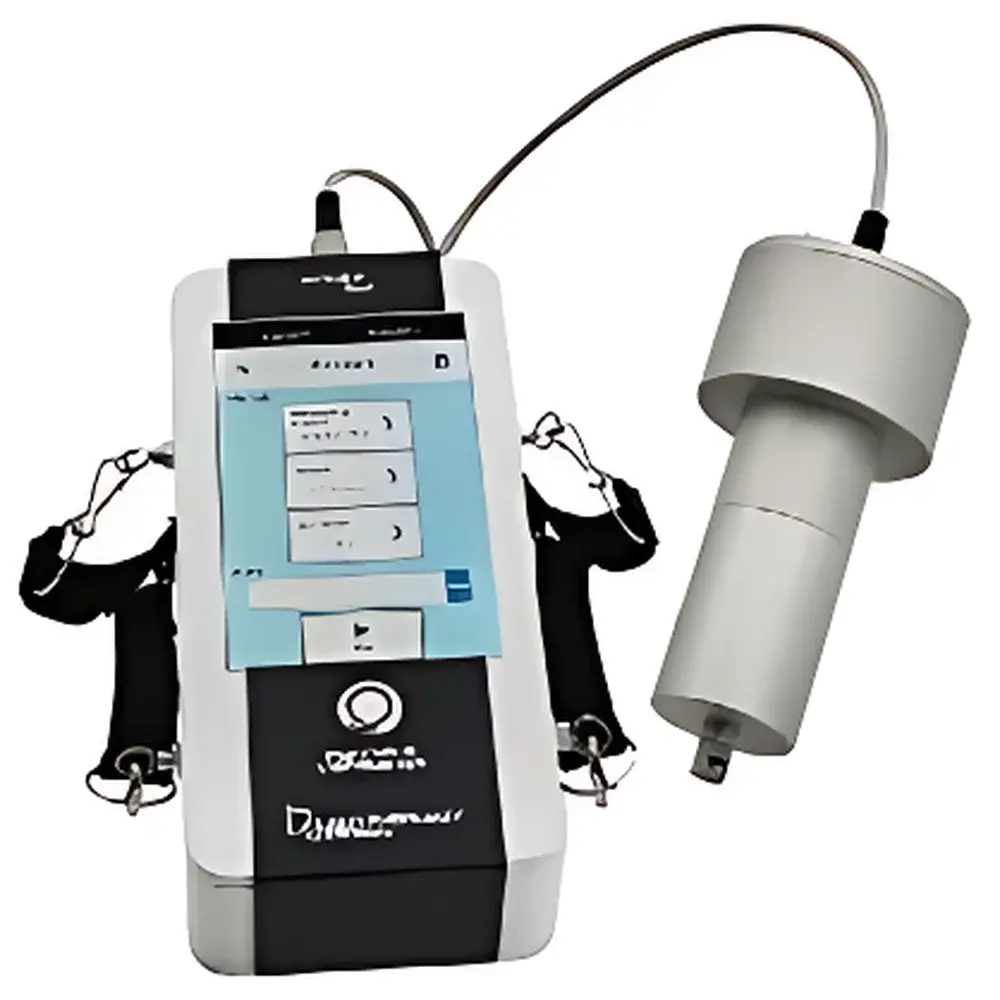
Lamyrheology GT300 PLUS Gel Timer Rotational Viscometer
| Brand | Lamyrheology |
|---|---|
| Origin | France |
| Model | GT300 PLUS |
| Instrument Type | Online Rotational Viscometer |
| Viscosity Range | 100–5×10⁹ mPa·s |
| Speed Range | 0.3–1500 rpm |
| Torque Range | 0.05–30 mN·m |
| Temperature Range | 15–300 °C |
| Accuracy | ±1% of full scale |
| Repeatability | ±0.2% |
| Display | 7" capacitive touchscreen |
| Interface | RS232, USB, 4–20 mA analog output |
| Power Supply | 90–240 VAC, 50/60 Hz |
| Dimensions (main unit) | 180 × 135 × 250 mm |
| Weight | 15 kg |
Overview
The Lamyrheology GT300 PLUS Gel Timer Rotational Viscometer is an advanced, online-capable rheological instrument engineered for real-time monitoring of viscosity evolution and gelation kinetics in thermosetting resins, coatings, adhesives, and food formulations. Unlike conventional rotational viscometers relying on mechanical spring-based torque sensing, the GT300 PLUS employs a direct-drive electromagnetic motor with digital torque transduction—eliminating hysteresis, drift, and calibration dependency associated with torsion springs. Its measurement principle is grounded in controlled shear rate application under isothermal or programmed temperature conditions, enabling precise determination of gel point (tgel) via time-dependent viscosity inflection analysis per ASTM D4287 and ISO 2555. The system operates on Couette flow geometry using interchangeable spindles (rotors) and sample cups, supporting both standard and single-use disposable configurations to prevent cross-contamination and ensure measurement integrity across batch-critical QC environments.
Key Features
- Electromagnetic direct-drive motor delivering consistent torque output up to 30 mN·m—maintains set rotational speed even at ultra-high viscosities (>10⁸ mPa·s), avoiding slip or deceleration common in gear-driven or stepper-motor systems.
- Integrated Pt100 Class A temperature sensor with active thermal regulation (±0.2 °C stability) across the full 15–300 °C range, enabling accurate gel-time profiling under industrially relevant cure schedules.
- 7-inch high-resolution capacitive touchscreen interface supporting multilingual operation (English, French, Spanish, Russian) and intuitive method programming—including multi-step ramp-hold protocols, automatic endpoint detection, and real-time viscosity vs. time curve overlay.
- No mechanical leveling required; self-compensating optical leveling algorithm ensures consistent gap control between rotor and cup—critical for reproducible shear rate definition in non-Newtonian systems.
- Full data traceability architecture: timestamped measurements with operator ID lock (4-digit PIN), audit-ready export via USB or RS232, and optional GLP-compliant software integration supporting FDA 21 CFR Part 11 electronic signature and audit trail requirements.
- Modular connectivity: configurable 4–20 mA analog output for PLC integration, USB host port for printer or flash storage, and native support for Lamyrheology’s PC-based RheoLab Suite for advanced curve fitting, Arrhenius modeling, and report generation.
Sample Compatibility & Compliance
The GT300 PLUS accommodates a broad spectrum of sample formats—from low-viscosity liquids (≥100 mPa·s) to highly filled pastes and reactive oligomers approaching solidification. Its design supports both reusable stainless-steel rotors and certified single-use polypropylene sample cups, minimizing cleaning validation burden in regulated pharmaceutical or food-grade facilities. The instrument complies with IEC 61000-6-3 (EMC emission standards) and IEC 61010-1 (safety for laboratory equipment). When operated with validated methods and calibrated transducers, it meets data integrity expectations outlined in ISO/IEC 17025 for testing laboratories and supports GMP-aligned process validation per ICH Q5E and USP .
Software & Data Management
RheoLab Suite (v4.2+) provides comprehensive instrument control, automated gel-point calculation (via tangent-intersection or derivative threshold algorithms), and export to CSV, PDF, or XML formats compatible with LIMS and MES platforms. All raw data—including torque, angular velocity, temperature, and elapsed time—is stored with metadata (operator ID, method name, calibration certificate ID, environmental log). Built-in backup functionality enables encrypted local archiving on USB drives or network shares. Optional cloud synchronization allows remote access to historical runs for cross-site comparison and trend analysis—particularly valuable for multi-plant quality harmonization initiatives.
Applications
- Chemical manufacturing: Real-time monitoring of epoxy, phenolic, and polyurethane resin cure profiles during R&D and production release testing.
- Coatings & inks: Quantifying pot life, open time, and film formation kinetics under variable humidity and temperature conditions.
- Food science: Characterizing starch gelatinization, pectin setting, and protein network development in dairy analogs and plant-based matrices.
- Academic research: Investigating thixotropic recovery, yield stress onset, and structural regeneration in soft matter systems using time-sweep and oscillatory extension protocols (when paired with optional oscillatory module).
- Quality control labs: Enforcing specification limits on gel time (e.g., ≤120 s @ 150 °C per ASTM D2471) with automated pass/fail flagging and SPC charting.
FAQ
Does the GT300 PLUS require annual spring replacement or recalibration?
No. The absence of mechanical torsion springs eliminates scheduled maintenance related to spring fatigue or hysteresis drift. Torque transduction is performed digitally via Hall-effect sensors, requiring only periodic verification against NIST-traceable reference fluids per ISO 17025 internal audit schedule.
Can the instrument be integrated into a continuous production line?
Yes. With its 4–20 mA analog output, IP54-rated enclosure (optional), and programmable trigger logic, the GT300 PLUS supports inline viscosity feedback control loops when coupled with compatible process controllers or DCS systems.
Is temperature control accurate enough for kinetic modeling?
Yes. The Peltier-assisted heating/cooling block achieves ±0.2 °C thermal stability over 30-minute holds, sufficient for reliable Arrhenius activation energy calculations (Ea) from multi-temperature gel-time datasets.
What sample volume is required for a valid measurement?
Standard protocols use 15–25 mL in the supplied cup geometry. For low-volume screening, micro-cup adapters (sold separately) reduce minimum volume to 3 mL while preserving shear rate fidelity.
How does the system handle highly thixotropic or yield-stress materials?
Pre-shear conditioning routines and customizable rest periods prior to measurement initiation allow structural recovery assessment. Time-sweep mode captures full structural breakdown/rebuild cycles at user-defined intervals, supporting Herschel-Bulkley parameter extraction.



