
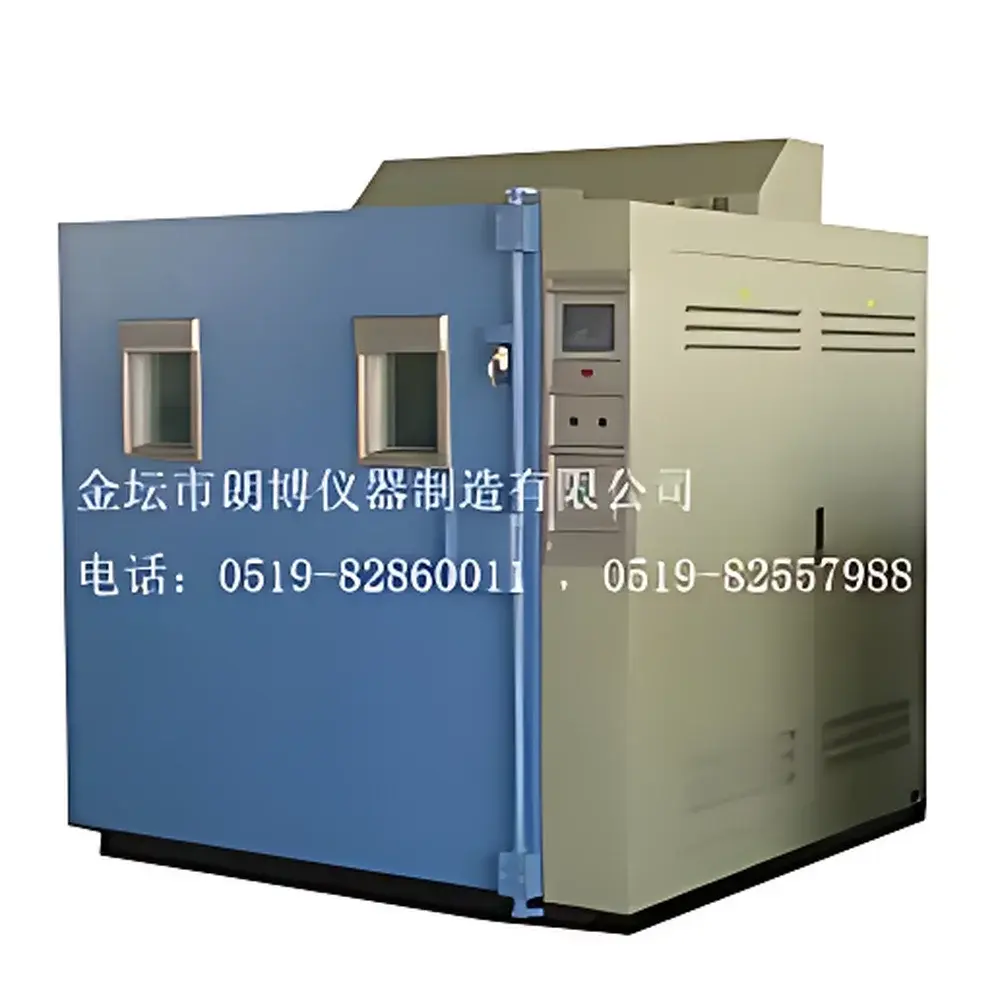
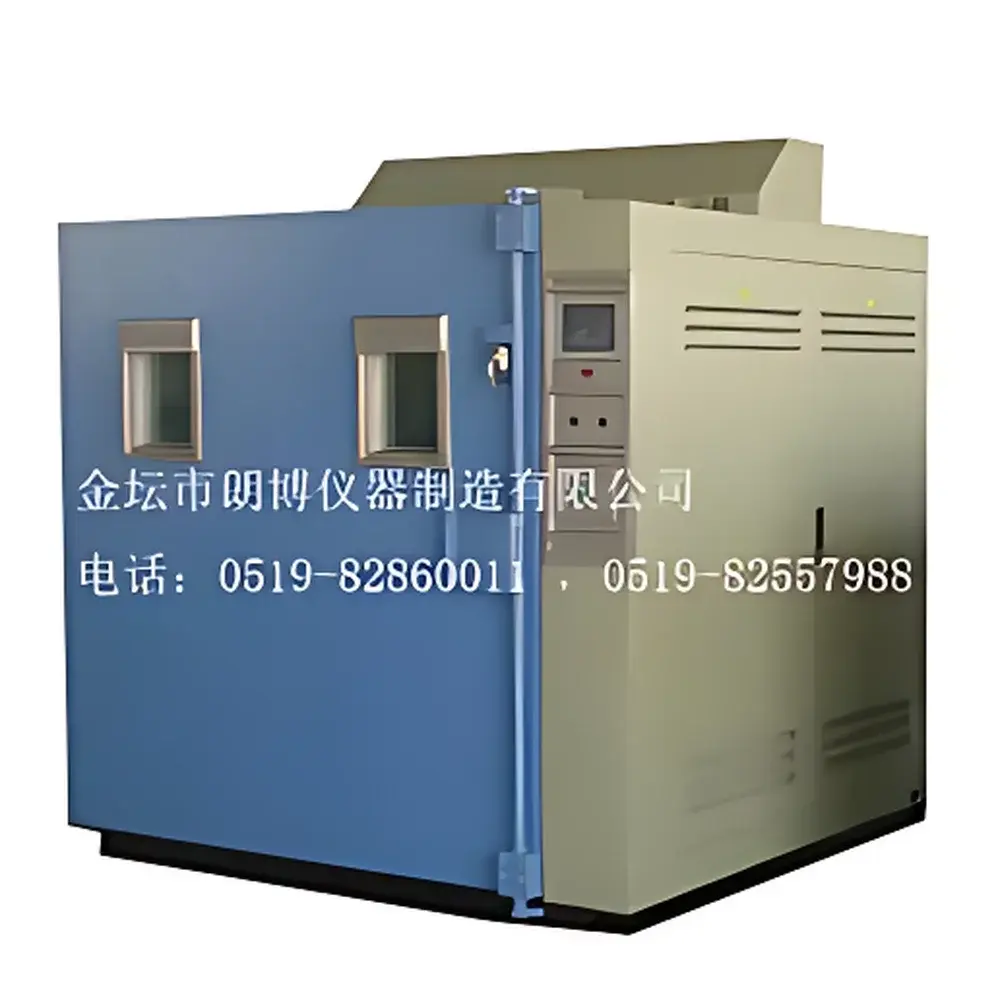
Langbo GFGDJS-1500 Photovoltaic Module Environmental Test Chamber
| Brand | Langbo |
|---|---|
| Origin | Jiangsu, China |
| Model | GFGDJS-1500 |
| Internal Dimensions (W×D×H) | 1000 × 1000 × 1500 mm |
| Temperature Range | −40 °C to +100 °C |
| Temperature Cycling Range | −40 °C to +100 °C |
| Humidity Range | 30–98% RH (at 40–90 °C) |
| Humidity Cycling Range | 75–95% RH (at 25–85 °C) |
| Temperature Uniformity | ±2 °C |
| Temperature Fluctuation | ±0.5 °C |
| Humidity Deviation | +2 / −3% RH |
| Heating/Cooling Rate | 1.0–2.0 °C/min (linearly adjustable) |
| Timer Range | 0–9999 h |
| Power Supply | AC 380 V, 50 Hz |
| Total Power Consumption | 32 kW |
| Refrigerant | R23 / R404A |
| Control Resolution | 0.1 °C |
| Display | 5.7″ LED touchscreen interface |
| Compliance | GB/T 19394–2003, GB/T 9535–1998, GB/T 6492–1986, IEC 61215:2005, IEC 61646, IEC 61345:1998 |
Overview
The Langbo GFGDJS-1500 Photovoltaic Module Environmental Test Chamber is a precision-engineered climatic chamber designed specifically for accelerated reliability testing of photovoltaic (PV) modules under controlled temperature and humidity stress conditions. It operates on the principle of forced-air convection with dual-stage refrigeration and steam-based humidification to replicate real-world environmental extremes—including thermal cycling, damp heat, and freeze-thaw sequences—as defined in international PV qualification standards. Its robust architecture supports continuous operation across wide-ranging test profiles while maintaining high reproducibility in both temperature and relative humidity control. The chamber is not intended for general-purpose environmental simulation but rather for compliance-driven validation per IEC 61215, IEC 61646, and corresponding national standards such as GB/T 9535 and GB/T 19394.
Key Features
- Large internal workspace (1000 × 1000 × 1500 mm) accommodating full-size PV modules up to 1.6 m², with optimized airflow distribution via stainless-steel multi-wing impeller and long-shaft circulation fan.
- Dual-stage cascade refrigeration system utilizing R23 and R404A refrigerants, paired with imported compressors (Copeland or Danfoss equivalents), enabling stable operation from −40 °C to +100 °C without cross-contamination between heating and cooling circuits.
- Steam-generation humidification system with external boiler design, integrated water-level auto-compensation and dry-run protection, ensuring consistent RH delivery across the operational range (30–98% RH at 40–90 °C).
- Independent high-speed infrared heating elements (3 kW) and auxiliary humidifier heaters (0.75 kW), decoupled from the refrigeration loop to prevent thermal interference during combined temperature-humidity cycling.
- Intuitive 5.7-inch LED touchscreen controller with PID + SSR coordinated regulation for simultaneous temperature and humidity setpoint management, offering programmable ramp-soak cycles and data logging capability.
- Structural integrity ensured by 1.2 mm cold-rolled A3 steel outer casing with electrostatic powder coating and 100 mm thick high-density fiberglass insulation—meeting thermal performance requirements specified in GB/T 10586–1989 and GB/T 10592–1989.
Sample Compatibility & Compliance
The GFGDJS-1500 accommodates standard crystalline silicon, thin-film, and bifacial PV modules—including frames, junction boxes, and backsheet assemblies—without requiring disassembly. Its chamber geometry and airflow dynamics are validated to meet uniformity criteria outlined in IEC 61215:2005 Annex A (temperature deviation ≤ ±2 °C; humidity deviation +2/−3% RH). It supports all mandatory sequential tests: thermal cycling (−40 °C ↔ +85 °C, ≥2 m/s air velocity), damp heat (85 °C / 85% RH, 1000 h), and humidity freeze (−40 °C after 10 cycles at 25–85 °C / 75–95% RH). All control algorithms and hardware configurations comply with GLP-aligned documentation practices, supporting audit-ready test record generation where required.
Software & Data Management
The embedded controller provides local real-time monitoring, cycle programming, and event-triggered alarm logging (e.g., compressor fault, low-water cutoff, door-open detection). While no proprietary PC software is bundled, the unit outputs timestamped CSV-formatted data via RS485 or optional Ethernet interface, compatible with third-party SCADA systems and LIMS platforms. Data integrity meets basic traceability needs for internal QA reporting; for FDA 21 CFR Part 11 or ISO/IEC 17025 compliance, integration with validated external data acquisition software is recommended. Firmware updates are performed via USB port with version-controlled release notes available upon request.
Applications
- Pre-certification screening of new PV module designs against IEC 61215 Ed. 3 qualification requirements.
- Root-cause analysis of encapsulant delamination, solder bond fatigue, and potential-induced degradation (PID) under cyclic thermal-moisture stress.
- Accelerated aging studies correlating chamber exposure data with field performance metrics (e.g., power loss rate, leakage current drift).
- Supplier qualification audits where repeatable environmental stress profiles are mandated by Tier-1 OEMs or utility-scale EPC contractors.
- Research into moisture ingress pathways through edge seals and frame interfaces using gravimetric and electroluminescence (EL) post-test evaluation.
FAQ
What PV-specific test standards does this chamber support?
It fully satisfies the environmental conditioning requirements of IEC 61215:2005, IEC 61646:2008, GB/T 9535–1998, GB/T 19394–2003, and related damp-heat, thermal-cycle, and humidity-freeze protocols.
Is remote monitoring or network connectivity available?
Standard configuration includes RS485 Modbus RTU output; optional Ethernet module enables TCP/IP communication for integration into facility-wide monitoring networks.
Can the chamber perform simultaneous temperature and humidity ramps?
Yes—the PID + SSR coordinated control system allows independent yet synchronized ramping of both parameters within defined operational boundaries.
What maintenance intervals are recommended for long-term reliability?
Compressor oil inspection every 2,000 operating hours; refrigerant leak check annually; steam generator descaling every 3 months under continuous use; filter replacement every 6 months.
Does the unit include calibration certificates or NIST-traceable verification?
Factory calibration is performed prior to shipment using reference-grade sensors; full NIST-traceable certification is available as an add-on service with documented uncertainty budgets.



