
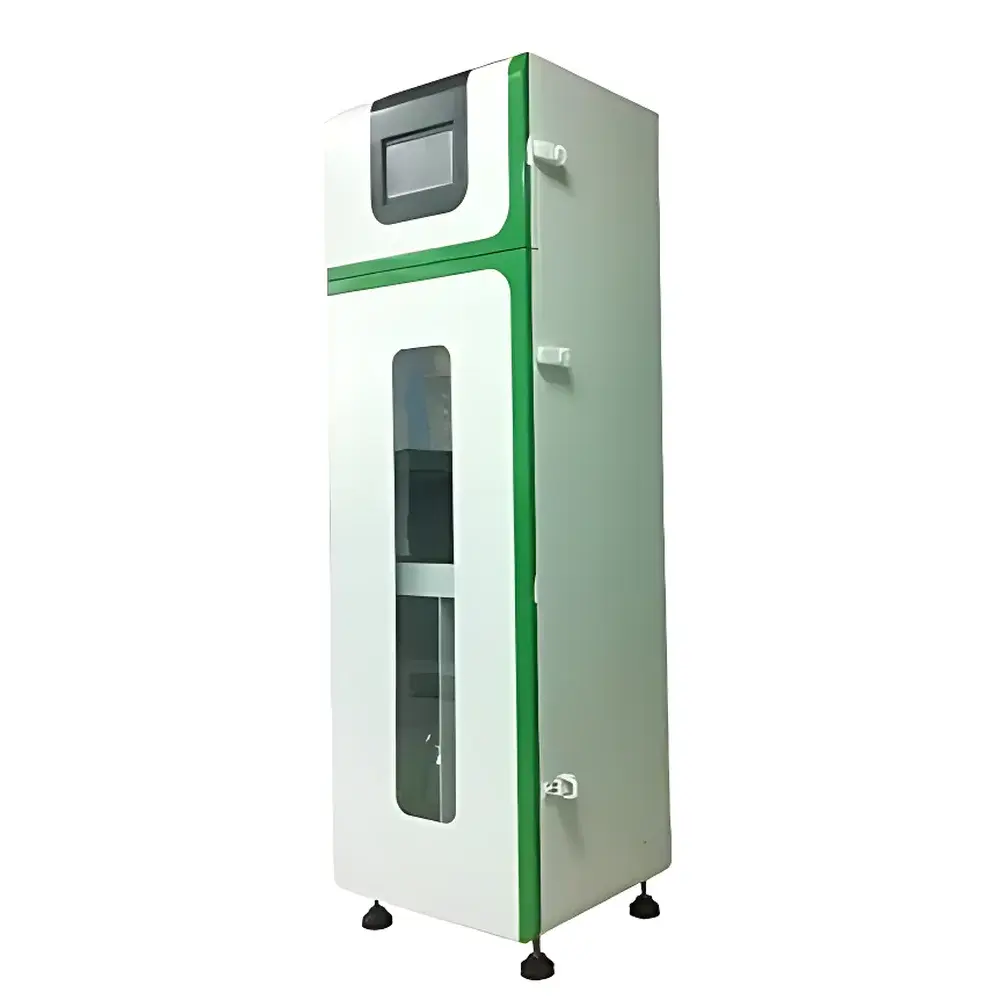
Langcheng LC-SPA Series Single-Parameter Online Water Chemistry Analyzer
| Origin | Guangdong, China |
|---|---|
| Manufacturer Type | Authorized Distributor |
| Origin Category | Domestic (China) |
| Model | LC-SPA Single-Parameter Fully Automated Online Water Chemistry Analyzer |
| Price Range | USD 7,000 – 14,000 |
| Instrument Type | Online Water Quality Monitoring Analyzer |
| Measured Parameters | Total Nitrogen (TN), Total Phosphorus (TP), Total Iron (Fe), Total Zinc (Zn), Total Copper (Cu), Total Manganese (Mn), Total Chromium (Cr), Total Lead (Pb), Total Nickel (Ni), Total Silver (Ag), Total Aluminum (Al), Sulfide (S²⁻), Sulfate (SO₄²⁻), Ammonia-Nitrogen (NH₃-N), Nitrate (NO₃⁻), Nitrite (NO₂⁻), Orthophosphate (PO₄³⁻), Silicate (SiO₃²⁻), Chloride (Cl⁻), Hexavalent Chromium (Cr⁶⁺), Fluoride (F⁻), Chemical Oxygen Demand (COD), Total Organic Carbon (TOC) |
Overview
The Langcheng LC-SPA Series Single-Parameter Online Water Chemistry Analyzer is a fully automated, benchtop-integrated wet-chemistry analyzer engineered for continuous, unattended monitoring of individual water quality parameters in real time. Based on standardized colorimetric, spectrophotometric, and digestion-coupled analytical methodologies—aligned with ISO 15681 (phosphorus), ISO 11908 (nitrogen), ISO 6595 (ammonia), and EPA Method 353.2 (nitrate/nitrite)—the LC-SPA delivers laboratory-grade accuracy in field-deployable instrumentation. It operates via discrete sample segmentation, precise reagent dosing, controlled thermal digestion (where required), and high-stability optical detection using dual-beam photometry with real-time background subtraction. Designed for deployment in diverse aquatic matrices—including surface water, groundwater, municipal and industrial wastewater, and estuarine tidal zones—the system maintains measurement integrity across salinity gradients up to 35 g/L through its adaptive optical signal processing architecture.
Key Features
- Dual-source, dual-beam digital photometer with automatic background correction—enabling robust performance in turbid or saline samples without manual calibration drift.
- FLA (Flow-Loop Assisted) reflux reaction module with integrated degassing mechanism—eliminates air bubble interference in chemical reaction pathways and ensures reproducible reaction kinetics.
- IP67-rated sealed instrument enclosure; independent, physically isolated reagent and deionized water reservoirs—minimizing cross-contamination risk and extending operational uptime between maintenance cycles.
- High-precision peristaltic pumping system with wear-compensated rotor design—guaranteeing ±1.5% volumetric accuracy over >10,000 actuation cycles and supporting extended calibration stability.
- Intelligent reagent diagnostics: real-time level sensing, flow-path integrity verification, and consumables life tracking—triggering configurable alerts (relay output / Modbus TCP) upon low-reagent or blockage conditions.
- Auto-restart functionality with state-resume logic: restores pre-interruption analysis sequence after power recovery—no manual intervention or data loss.
Sample Compatibility & Compliance
The LC-SPA accepts raw water samples with suspended solids ≤50 mg/L (pre-filtered via optional 50-µm inline sieve) and pH range 4–10. It complies with EN 14181 (QAL1/QAL2 requirements for automated analyzers), supports GLP/GMP-aligned audit trails (via optional firmware upgrade), and meets essential electromagnetic compatibility (EMC) and safety standards per IEC 61326-1 and IEC 61010-1. All wetted components are constructed from PTFE, PFA, and borosilicate glass—ensuring chemical resistance against strong oxidants (e.g., persulfate digestions), acids (H₂SO₄, HNO₃), and chelating agents used in heavy metal analysis.
Software & Data Management
The embedded Linux-based controller runs Langcheng’s LCA-OS v4.x firmware, offering local web interface (HTTPS), Modbus RTU/TCP, and optional OPC UA integration. Data logging includes raw absorbance values, temperature-compensated results, diagnostic timestamps, and QC flagging (e.g., “digestion incomplete”, “reagent expired”). Export formats include CSV and XML; historical datasets support trend visualization and statistical process control (SPC) charting. For regulated environments, the optional 21 CFR Part 11-compliant software package provides electronic signatures, role-based access control, and immutable audit logs—fully traceable to ALCOA+ principles.
Applications
The LC-SPA serves as a dedicated, regulatory-grade node in distributed water quality networks—ideal for compliance monitoring at wastewater treatment plant effluent points, drinking water intake stations, river basin observatories, and industrial discharge outfalls. Its single-parameter architecture eliminates cross-reactivity artifacts common in multi-analyte platforms, making it particularly suited for critical parameters requiring method-specific validation (e.g., Cr⁶⁺ by diphenylcarbazide, COD by closed-reflux titrimetry). Field deployments demonstrate >90-day mean time between unscheduled interventions under continuous 24/7 operation.
FAQ
What sample pretreatment is required before analysis?
Raw samples must be filtered through a 50-µm stainless-steel sieve to prevent particulate clogging; no centrifugation or acid preservation is needed for most parameters.
Can the LC-SPA be integrated into an existing SCADA system?
Yes—native Modbus TCP and optional OPC UA enable seamless interoperability with Siemens Desigo, Honeywell Experion, and ABB 800xA platforms.
Is method validation documentation available for regulatory submissions?
Full method validation reports—including LOD/LOQ, precision (RSD ≤3.2%), spike recovery (89–104%), and inter-laboratory comparison data—are provided per parameter upon request.
How often must reagents be replaced?
Reagent consumption varies by parameter and frequency; typical replacement intervals range from 30 days (for high-frequency TN/TP) to 90 days (for low-turnover Cr⁶⁺ or F⁻), tracked automatically by onboard sensors.
Does the analyzer support remote firmware updates?
Yes—secure OTA (Over-The-Air) updates are supported via authenticated HTTPS connection, with rollback capability and versioned changelogs.







