
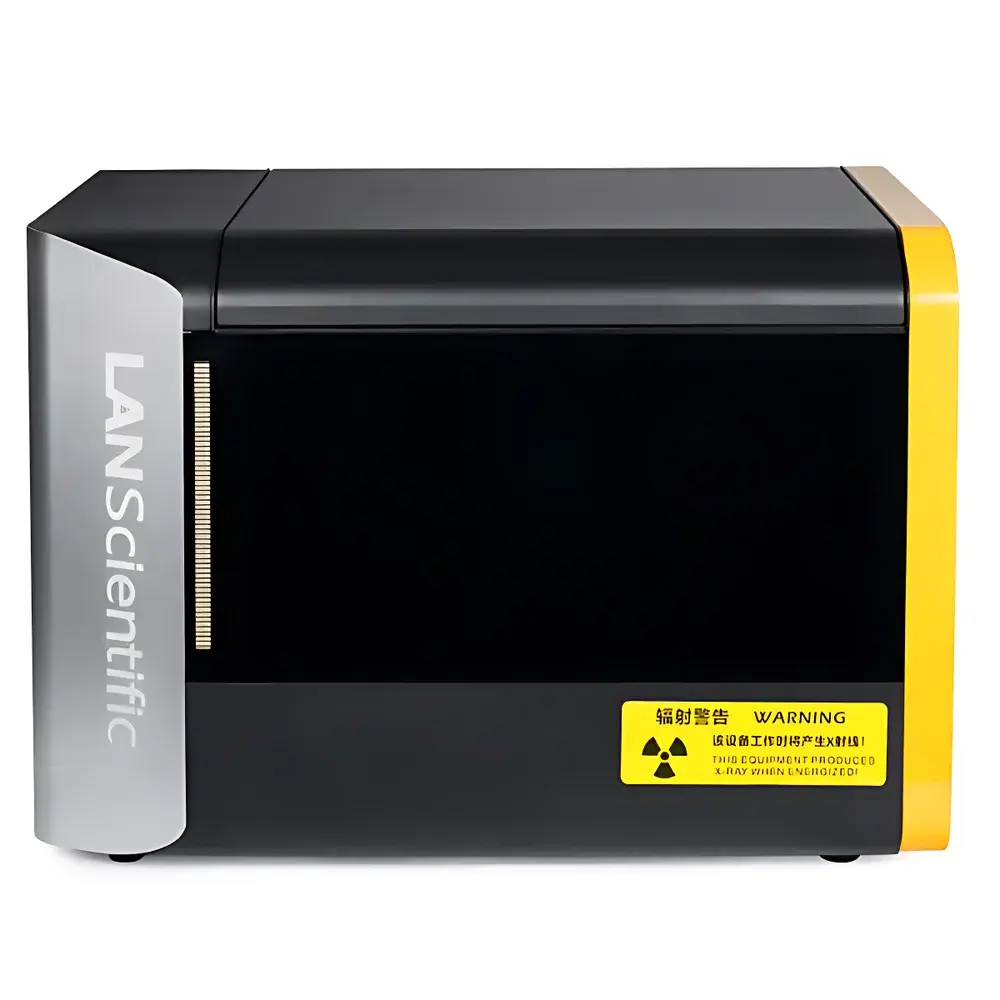
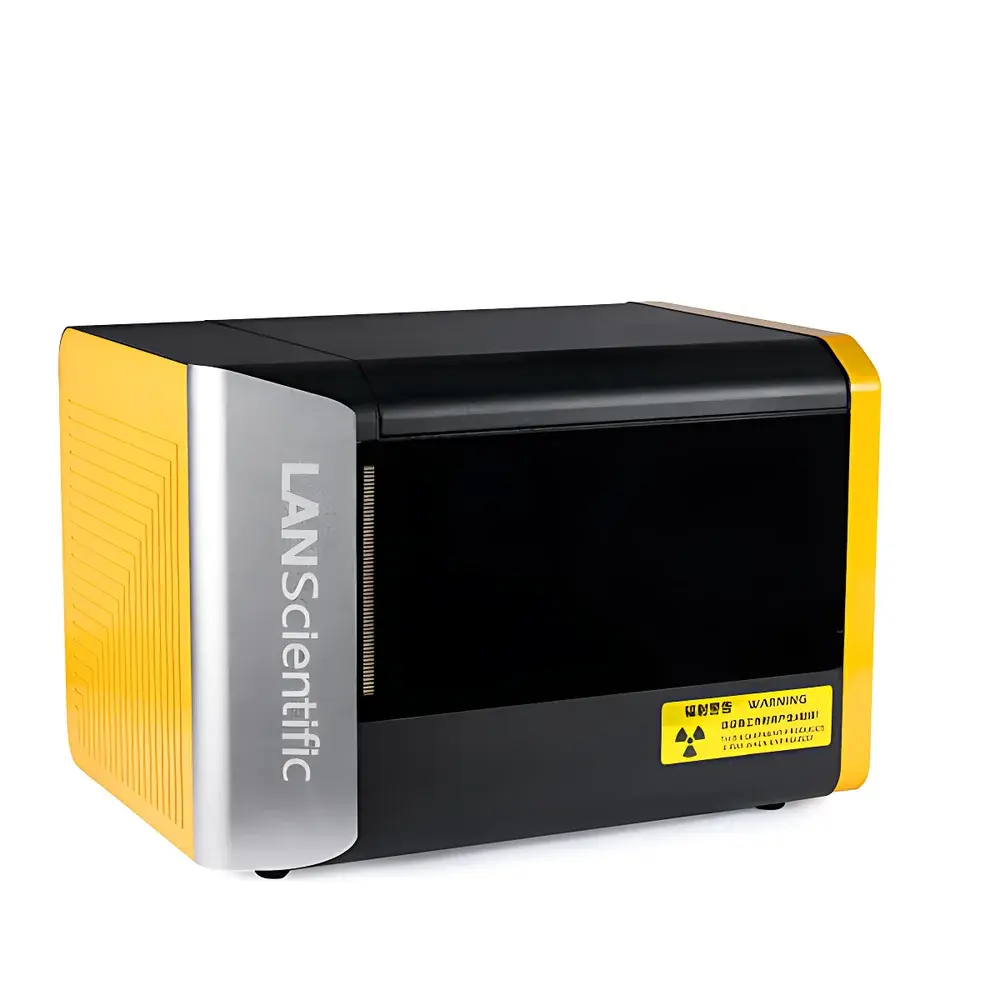
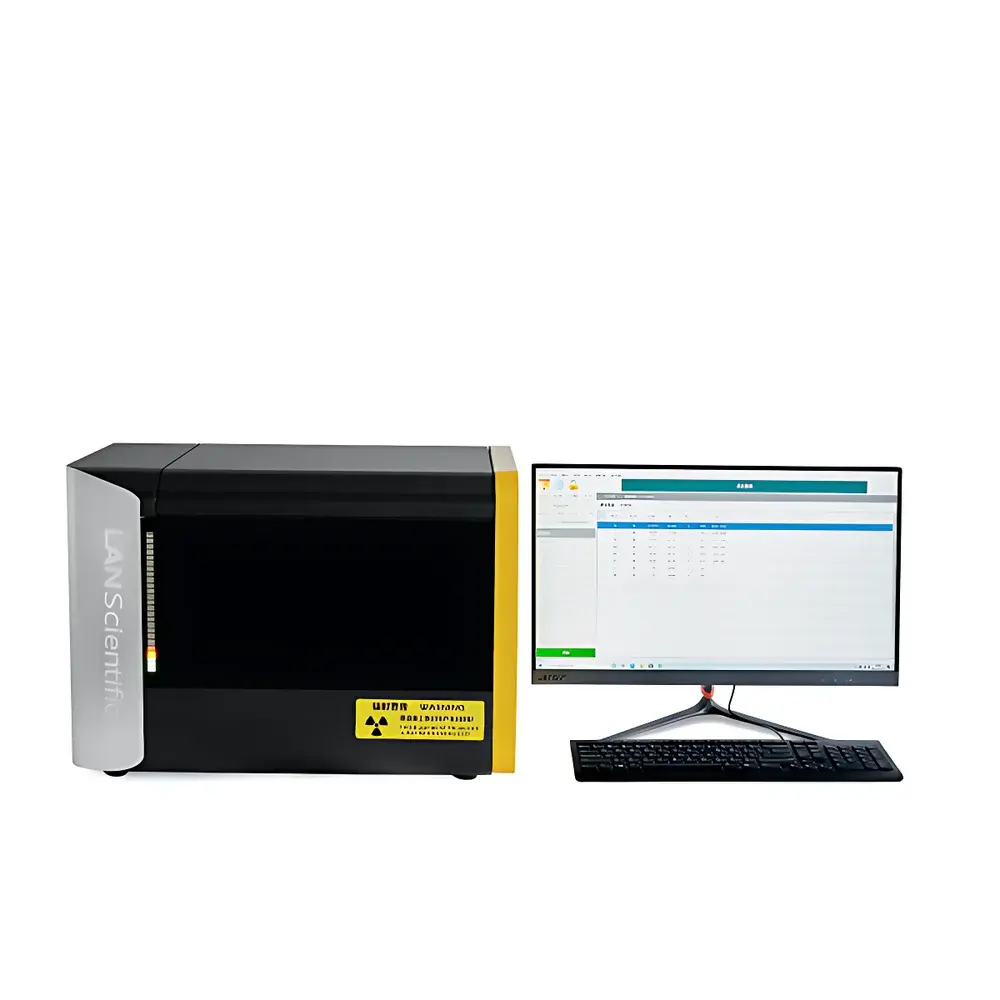
LANScientific ScopeX Desktop Energy Dispersive X-Ray Fluorescence Spectrometer for Refractory Materials Analysis
| Brand | LANScientific |
|---|---|
| Origin | Jiangsu, China |
| Manufacturer Type | Direct Manufacturer |
| Regional Classification | Domestic (China) |
| Model | ScopeX Refractory Materials Analyzer |
| Form Factor | Benchtop |
| Instrument Type | Conventional ED-XRF |
| Industry-Specific Application | Non-Ferrous Metals & Refractories |
| Elemental Range | Na (11) – U (92) |
| Detection Limit | down to ppm level |
| Light Element Capability | Enhanced Si, P, S, Al, Mg via low-energy X-ray excitation + intelligent vacuum system |
| Collimators | 5 mm, 3 mm, 1 mm, 0.5 mm (motorized auto-switching) |
| Filters | Multiple filter sets (software-selectable) |
| Detector | Peltier-cooled silicon drift detector (SDD) |
| Sample Chamber | Large-volume, multi-geometry compatible (solid, powder, liquid, thin film, irregular shapes) |
| Data Interface | USB 3.0, Wi-Fi 802.11ac, Bluetooth 5.0 |
| Report Output | Customizable Excel/PDF reports with logo, spectral overlays, and sample metadata |
| Safety Compliance | Fully shielded metal enclosure with interlocked safety door |
Overview
The LANScientific ScopeX Desktop Energy Dispersive X-Ray Fluorescence (ED-XRF) Spectrometer is an industrial-grade benchtop analyzer engineered for precise, non-destructive elemental quantification in refractory materials, high-temperature ceramics, metallurgical slags, foundry sands, and non-ferrous alloys. Operating on the fundamental principle of X-ray fluorescence—where primary X-rays eject inner-shell electrons from sample atoms, triggering characteristic secondary X-ray emission—the ScopeX delivers trace-to-major element analysis across the full range from sodium (Na, Z=11) to uranium (U, Z=92). Its optimized low-energy X-ray tube, combined with an intelligent vacuum environment, ensures robust excitation and detection of light elements including Mg, Al, Si, P, and S—critical for assessing alumina-silica ratios, impurity levels (e.g., Fe, Ca, Ti), and phase-stabilizing additives (e.g., Cr, Ni, Mo) in refractory formulations. Designed for routine QC labs and production environments, the instrument integrates mechanical stability, thermal management, and electromagnetic shielding to maintain measurement reproducibility under continuous operation.
Key Features
- Large-capacity sample chamber accommodating irregular geometries: blocks up to 300 × 300 × 100 mm, powders in standard cups, liquids in sealed cells, and thin films on holders—enabling direct analysis without pelletization or fusion.
- Motorized collimator turret with four apertures (5 mm, 3 mm, 1 mm, 0.5 mm) and programmable filter selection—dynamically optimizing beam footprint and spectral background for each sample matrix and target element.
- Peltier-cooled silicon drift detector (SDD) with 100 kcps) and excellent peak-to-background ratio without cryogenic maintenance.
- Integrated vacuum system with automatic pressure regulation (1–10 Pa range)—enhancing sensitivity for elements below calcium while preserving long-term tube stability and detector integrity.
- Multi-modal connectivity: native support for USB 3.0 bulk transfer, enterprise-grade Wi-Fi (WPA3-secured), and Bluetooth 5.0 for remote status monitoring and firmware updates.
- Full hardware interlock architecture: mechanically coupled safety door switch, real-time radiation monitoring circuit, and software-enforced exposure timeout—ensuring compliance with national radiation safety standards (GB18871-2002, GBZ115-2002).
Sample Compatibility & Compliance
The ScopeX accepts heterogeneous samples without destructive preparation: sintered refractory bricks, crushed chamotte aggregates, molten slag quenched into glassy flakes, coated crucible linings, and even hydrated binder systems. It supports ASTM C602 (aggregate analysis), ISO 21068 (refractory raw material testing), and internal specifications aligned with ISO/IEC 17025-accredited laboratories. All measurement protocols are traceable to NIST SRM reference materials (e.g., SRM 278, SRM 2710a). The system’s software enforces GLP-compliant audit trails—including user login, method version, calibration history, and raw spectrum archiving—with optional 21 CFR Part 11 readiness via digital signature module.
Software & Data Management
The proprietary QuantLab™ software provides quantitative analysis using fundamental parameter (FP) algorithms with matrix correction libraries for common refractory matrices (alumina, magnesia, silica, zirconia, chromite). Users define custom calibrations using certified reference materials or empirical standards. Spectral deconvolution employs iterative least-squares fitting with peak-shape modeling (Gaussian-Lorentzian hybrid). Reports export natively to Excel (.xlsx) and PDF formats, embedding full spectra, calibration curves, uncertainty estimates (k=2), and configurable headers (logo, lab ID, analyst signature). Raw data files (.spc, .csv) are stored in hierarchical directories with timestamped metadata, supporting LIMS integration via ODBC or REST API.
Applications
- Quality control of raw materials: quantification of Al₂O₃, SiO₂, Fe₂O₃, CaO, MgO, and trace contaminants (V, Pb, As) in bauxite, kaolin, and magnesite.
- Process validation: real-time monitoring of slag composition during steelmaking or non-ferrous smelting—tracking Cr/Ni ratios in stainless steel ladle linings.
- Fatigue assessment: detection of alkali-induced degradation (Na, K ingress) in ceramic fiber insulation after thermal cycling.
- Regulatory compliance: screening for RoHS-restricted elements (Pb, Cd, Hg, Cr⁶⁺ surrogate) in refractory binders and casting molds.
- R&D support: mapping elemental distribution across cross-sections via sequential point analysis—correlating microstructure with compositional gradients.
FAQ
Does the ScopeX require liquid nitrogen cooling?
No. It utilizes a thermoelectric Peltier cooler integrated with active heat dissipation, eliminating cryogen dependency and enabling unattended 8-hour shifts.
Can it analyze powdered samples without pressing pellets?
Yes—provided particle size is <100 µm and homogeneity is verified; loose powders may be analyzed directly using the supplied cup holder and Mylar film seal.
Is vacuum required for all measurements?
Vacuum is automatically engaged only when analyzing elements below calcium (Z<20); atmospheric mode is used for heavier elements to maximize throughput.
How is calibration maintained across instrument lifetime?
Calibration stability is tracked via daily check standards (e.g., Cu foil, Fe₂O₃ disk); software logs drift corrections and triggers recalibration alerts based on statistical control limits (±2σ deviation).
Can the system be integrated into a factory MES or SAP environment?
Yes—via OPC UA server interface or custom CSV/XML data push; full schema documentation and test certificates are provided upon request.






