
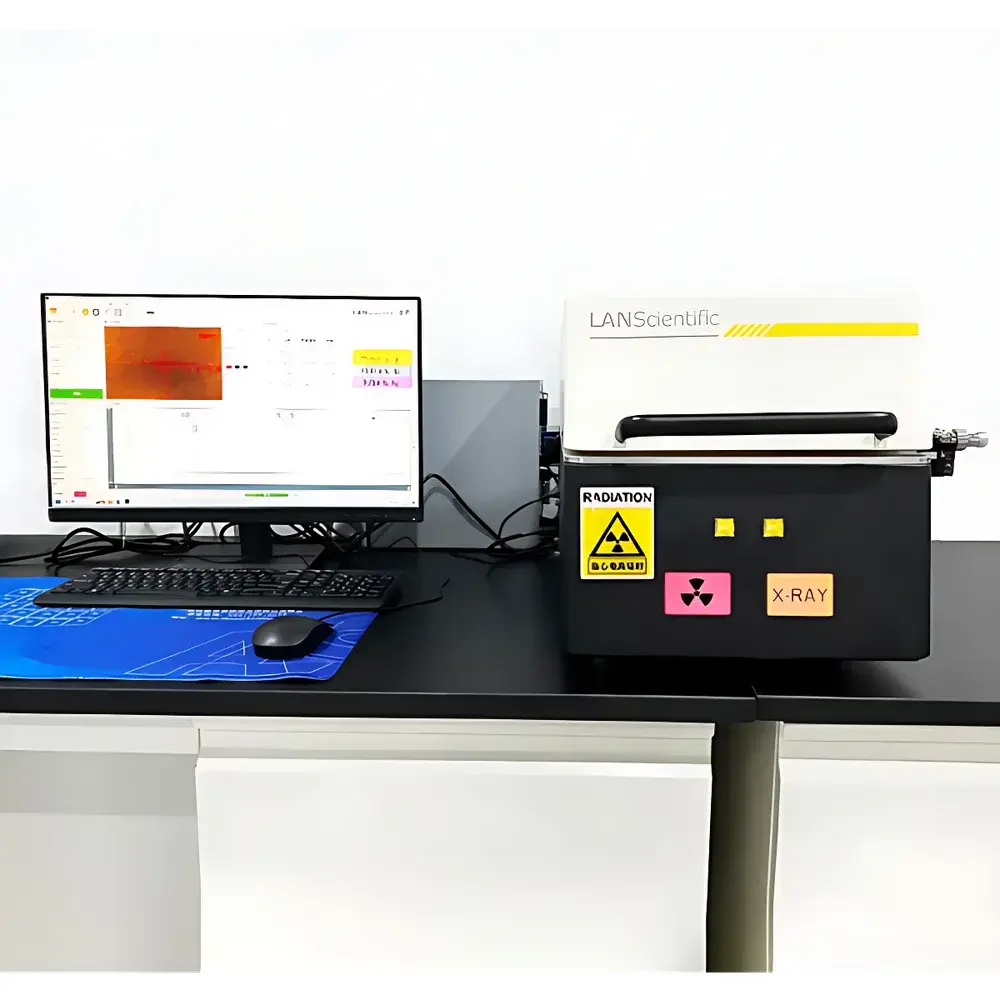
LANScientific ScopeX PG7 Desktop Energy Dispersive X-Ray Fluorescence Spectrometer
| Brand | LANScientific |
|---|---|
| Origin | Jiangsu, China |
| Manufacturer Type | Manufacturer |
| Regional Category | Domestic |
| Model | ScopeX PG7 |
| Price Range | USD 14,000 – 42,500 (FOB) |
| Form Factor | Benchtop |
| Instrument Type | Conventional ED-XRF |
| Industry-Specific Application | Non-Ferrous Metals |
| Elemental Range | Al (13) to U (92) |
| Detection Limit | Sub-ppm to % level (matrix-dependent) |
| Safety Compliance | IEC 62495, GB/Z 25488–2010, EN 61000-6-3 |
| Software | ScopeX Suite v3.2 (with audit trail, user-level permissions, CFR Part 11 ready) |
Overview
The LANScientific ScopeX PG7 is a benchtop energy dispersive X-ray fluorescence (ED-XRF) spectrometer engineered for precise, non-destructive elemental analysis of precious metals and alloys. Based on the fundamental principle of X-ray fluorescence—where primary X-rays excite inner-shell electrons in sample atoms, resulting in characteristic secondary (fluorescent) X-ray emission—the ScopeX PG7 delivers quantitative and qualitative compositional data across the full detectable range from aluminum (Z = 13) to uranium (Z = 92). Its optimized X-ray tube (Rh anode, 50 kV/1.0 mA), large-area silicon drift detector (SDD, 25 mm² active area, <125 eV Mn Kα resolution), and vacuum-compatible sample chamber enable high-count-rate acquisition with excellent peak separation and low background noise. Designed specifically for jewelry manufacturing, bullion refining, assay laboratories, and regulatory testing centers, the instrument meets the operational demands of routine QC/QA workflows where speed, repeatability, and regulatory traceability are critical.
Key Features
- Integrated industrial-grade PC with pre-installed ScopeX Suite software—no external computer required
- Large-volume sample chamber (300 × 300 × 120 mm) accommodating irregular, oversized, or multi-component items (e.g., clasps, settings, bezels, mounted stones)
- Manually adjustable high-precision X-Y stage (±0.1 mm resolution) enabling targeted micro-analysis of small features without sample repositioning
- Dual-mode operation: air mode for heavy elements (Z ≥ 20) and vacuum mode for light element enhancement (Al–Cl), improving detection sensitivity for alloying elements such as Ag, Cu, Ni, Zn, and Sn
- Comprehensive radiation safety architecture: interlocked high-voltage cutoff, hardware-based lid sensor, electromagnetic shutter, fully shielded metal enclosure meeting IEC 62495 Class II requirements
- Bluetooth-enabled thermal printer for immediate report generation—no cables, no driver installation, compliant with ISO/IEC 17025 documentation requirements
Sample Compatibility & Compliance
The ScopeX PG7 accepts solid, non-powdered samples up to 5 kg and 30 cm in maximum dimension. It supports direct analysis of coins, bars, ingots, finished jewelry, scrap lots, electroplated substrates, and solder joints—without dissolution, acid digestion, or surface polishing. Its measurement protocol aligns with ASTM E1621 (Standard Guide for XRF Analysis of Metals), ISO 3497 (Metallic Coatings — XRF Measurement of Coating Thickness and Composition), and USP / (Elemental Impurities in Pharmaceutical Products) for reference material validation. All calibration curves are traceable to NIST SRM standards (e.g., NIST 482, 1144, 1275), and system performance verification follows daily drift correction using internal check standards. The instrument’s firmware and software support GLP/GMP-compliant environments through configurable user roles, electronic signatures, and immutable audit trails per FDA 21 CFR Part 11.
Software & Data Management
ScopeX Suite v3.2 provides a validated, intuitive interface for method development, spectral acquisition, quantification, and reporting. It includes matrix-matched standardless quantification (Fundamental Parameters algorithm), empirical calibration with up to 20 reference standards, and optional PLS regression for complex alloy systems. Data export supports CSV, PDF, XML, and LIMS-integrated formats (via ASTM E1382-compliant ODBC drivers). All raw spectra, processing parameters, operator ID, timestamp, and environmental metadata (chamber pressure, tube current/voltage, live time) are stored in encrypted SQLite databases with automatic backup scheduling. Remote diagnostics and firmware updates are supported via secure HTTPS connection—no third-party cloud storage involved.
Applications
- Routine purity verification of gold (Au), silver (Ag), platinum (Pt), palladium (Pd), and rhodium (Rh) alloys in jewelry production lines
- Identification of plating thickness and base-layer composition in gilded or rhodium-plated articles
- Authentication of hallmark compliance (e.g., 375, 585, 750, 916, 999) per ISO 9202 and national marking regulations
- Quantitative screening for prohibited or regulated elements (e.g., Cd, Pb, Ni, As) in consumer-facing precious metal products
- Scrap sorting and valuation in precious metal recycling facilities—enabling rapid lot classification prior to smelting
- Forensic analysis of counterfeit coins or altered bullion, including detection of tungsten-core gold bars via density-correlated Z-profile anomalies
FAQ
Does the ScopeX PG7 require external cooling or compressed air?
No. The SDD detector is thermoelectrically cooled; no liquid nitrogen or chiller unit is needed.
Can it measure gold purity below 99.9% with certified accuracy?
Yes—when calibrated against certified reference materials and operated under vacuum for light-element interference correction, typical relative standard deviation (RSD) for Au in 999.9 gold is ≤0.15% at 100 s counting time.
Is method transfer possible between different ScopeX PG7 units?
Yes—calibration files, spectral libraries, and measurement protocols are fully portable across instruments of the same model and firmware revision.
What maintenance intervals are recommended?
Annual preventive maintenance (PM) is advised, including X-ray tube output verification, detector resolution check, and mechanical alignment validation per manufacturer SOP.
How is data integrity ensured during power interruption?
All acquisitions are auto-saved at 5-second intervals; interrupted runs resume from last checkpoint upon reboot without data loss.




