
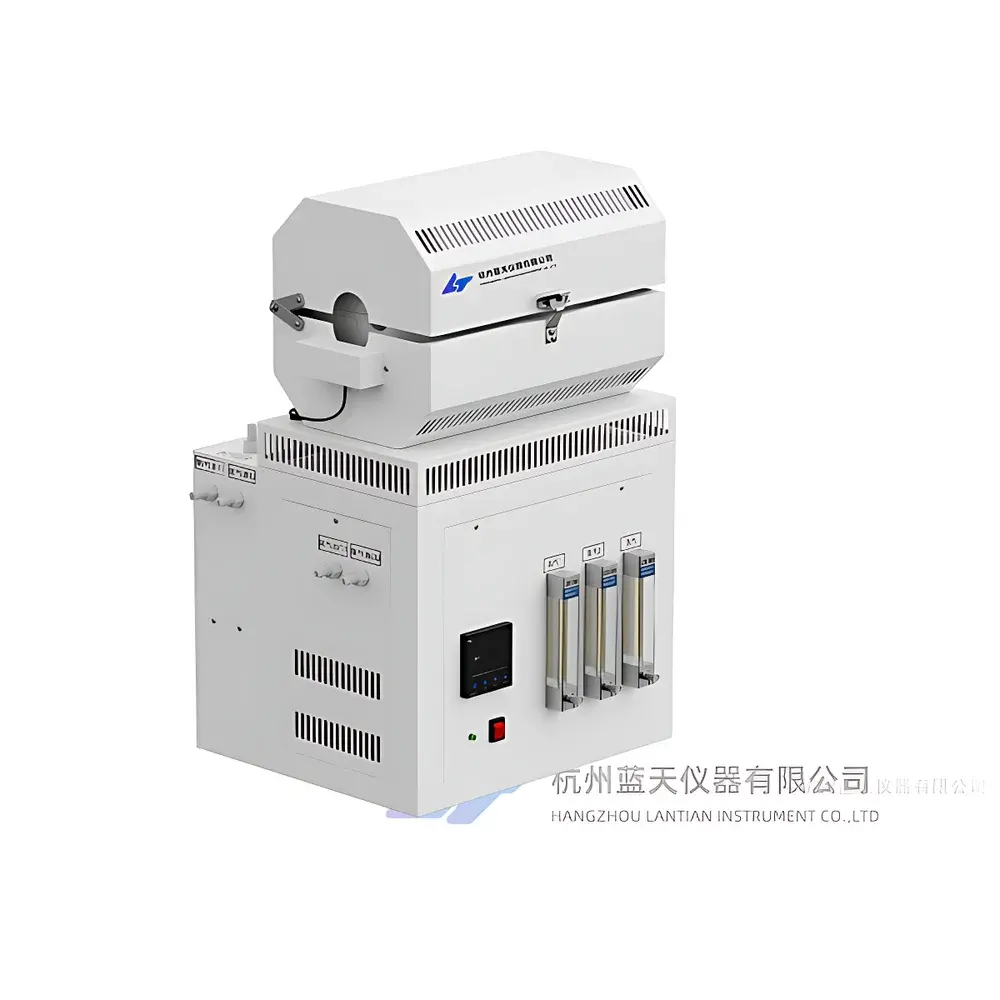
LANTIAN AOX-C Adsorbable Organic Halogens (AOX) Analyzer
| Brand | LANTIAN |
|---|---|
| Model | AOX-C |
| Detection Principle | High-Temperature Combustion Coupled with Ion Chromatography |
| Compliance | HJ/T 83–2001, ISO 9562:1989, GB/T 15959–1995 |
| Combustion Temperature | Up to 1150 °C |
| Sample Introduction | Nitrogen-Pressurized Column Adsorption |
| Sample Mass Range | 5–1000 mg |
| Detection Range | 0.8–1000 µg/L (as Cl⁻ equivalent) |
| Analysis Time (instrumental) | 3–10 min per sample |
| Carrier Gas | O₂ ≥99.6% (recommended ≥99.999%) |
| Accessories Included | Integrated combustion furnace, quartz combustion tube, dual sample boats, quartz push rod, rubber end caps, adsorption column assembly (×2), 1.27 m silicone tubing (OD 15 mm), 5 scrubbing bottles, 2 absorption bottles, 2 absorption tubes, mounting fixtures,纱布,胶布,扎线 |
| Software Option | Real-time instrument control and quantitative data processing module (optional) |
Overview
The LANTIAN AOX-C Adsorbable Organic Halogens (AOX) Analyzer is a dedicated benchtop system engineered for the accurate, standardized quantification of adsorbable organic halogen compounds—including AOCI (adsorbable organic chlorine), AOF (fluorine), and AOBr (bromine)—in aqueous and semi-solid environmental matrices. It operates on the internationally recognized high-temperature combustion–ion chromatography (IC) principle: organic halogen species are first concentrated onto activated carbon under controlled nitrogen pressure; the loaded carbon is then combusted at up to 1150 °C in an oxygen-rich atmosphere, converting covalently bound halogens into volatile hydrogen halides (e.g., HCl, HBr, HF); these acidic gases are subsequently absorbed quantitatively into alkaline aqueous solution and resolved via ion chromatography with suppressed conductivity detection. This methodology ensures trace-level sensitivity, matrix robustness, and full compliance with regulatory frameworks governing disinfection by-product monitoring, pulp & paper effluent assessment, and industrial wastewater characterization.
Key Features
- Integrated combustion furnace with precise temperature control (ambient to 1150 °C) and ceramic insulation for stable thermal profiles and extended service life.
- Dual-sample-boat design with direct-injection capability—enabling rapid loading of solid or slurry samples without pre-drying or solvent transfer.
- Nitrogen-pressurized adsorption module with calibrated flow regulation, ensuring reproducible breakthrough volumes and consistent adsorption efficiency across variable water matrices (including saline, turbid, or humic-rich samples).
- Modular gas conditioning train: five-stage scrubbing system removes SO₂, NOₓ, CO₂, and particulates prior to halide absorption, minimizing interferences in IC analysis.
- Quartz-lined combustion tube and high-purity alumina sample holder minimize memory effects and catalytic side reactions during high-temperature oxidation.
- Pre-assembled, field-ready configuration—including all critical consumables (silicone tubing, rubber seals, absorption vessels) and mechanical fixtures—reduces commissioning time and operator dependency.
Sample Compatibility & Compliance
The AOX-C accommodates a broad range of environmental and industrial sample types: drinking water, surface water, groundwater, municipal and industrial wastewater, landfill leachate, pulp mill effluents, saline process waters, soil/sediment extracts, and sludge digests. Its operational protocol adheres strictly to HJ/T 83–2001 (China’s national standard for AOX determination by ion chromatography), ISO 9562:1989 (Water quality — Determination of adsorbable organic halogens (AOX) — Method using activated carbon adsorption and microcoulometric detection), and GB/T 15959–1995 (equivalent to the microcoulometric variant). While the system is optimized for IC-based quantification, its combustion architecture is fully compatible with microcoulometric detection modules when configured per GB/T 15959 requirements. All hardware components meet GLP-aligned construction standards, and the optional software package supports 21 CFR Part 11-compliant audit trails, electronic signatures, and raw data archiving for regulated laboratories.
Software & Data Management
An optional PC-based control and data acquisition software suite provides real-time monitoring of furnace temperature, gas flow rates, and combustion cycle status. It enables method-driven sequence programming, automatic peak integration using calibrated halide standards (Cl⁻, Br⁻, F⁻), and generation of AOX concentration reports expressed as µg/L Cl⁻-equivalent. The software exports ASCII and CSV files compatible with LIMS environments and supports user-defined reporting templates aligned with local discharge permits (e.g., GB 8978–1996, GB 3544–2008). Audit logs record all parameter modifications, calibration events, and result approvals—meeting minimum documentation requirements for ISO/IEC 17025-accredited testing laboratories.
Applications
- Regulatory compliance testing for AOX in wastewater discharges from chlorinated pulp mills, textile dyeing facilities, and pharmaceutical manufacturing plants.
- Monitoring formation of halogenated disinfection by-products (DBPs) in drinking water treatment systems following chlorine, chloramine, or ozone application.
- Environmental impact assessment of landfill leachate and contaminated groundwater plumes containing persistent organohalogens (e.g., PCBs, chlorinated pesticides, brominated flame retardants).
- Process optimization in electroplating and metal finishing industries where halogenated solvents or additives may contribute to effluent AOX load.
- Research applications in environmental chemistry, including speciation studies of adsorbed vs. dissolved AOX fractions and kinetic evaluation of halogen release during thermal degradation.
FAQ
What sample volume or mass is required for reliable AOX quantification?
For liquid samples, typical adsorption volumes range from 100 mL to 1 L depending on expected AOX concentration; solid samples (soils, sediments) are extracted and diluted to ensure 5–1000 mg of total suspended solids or dissolved organic carbon is delivered to the adsorption column.
Can the AOX-C be used for fluorine- or bromine-specific analysis?
Yes—the ion chromatographic detection module resolves F⁻, Cl⁻, and Br⁻ independently; results are reported as AOF, AOCI, and AOBr based on respective calibration curves and stoichiometric conversion factors.
Is oxygen purity critical for combustion performance?
Oxygen purity directly affects combustion completeness and halogen recovery efficiency; ≥99.999% grade O₂ is strongly recommended to avoid incomplete oxidation and low bias, particularly for recalcitrant compounds such as polyhalogenated aromatics.
How often must the combustion tube and sample boat be replaced?
Under routine use (≤10 samples/day), quartz combustion tubes exhibit service lifetimes exceeding 500 analyses; sample boats are inspected after each run and replaced when visible carbon residue or deformation occurs—typically every 50–100 runs.
Does the system support unattended batch operation?
The base AOX-C requires manual sample loading and absorption vial replacement between runs; however, integration with an autosampler and robotic absorption vessel handler is feasible via third-party OEM interfaces—consult technical support for compatibility documentation.
Related Products







