
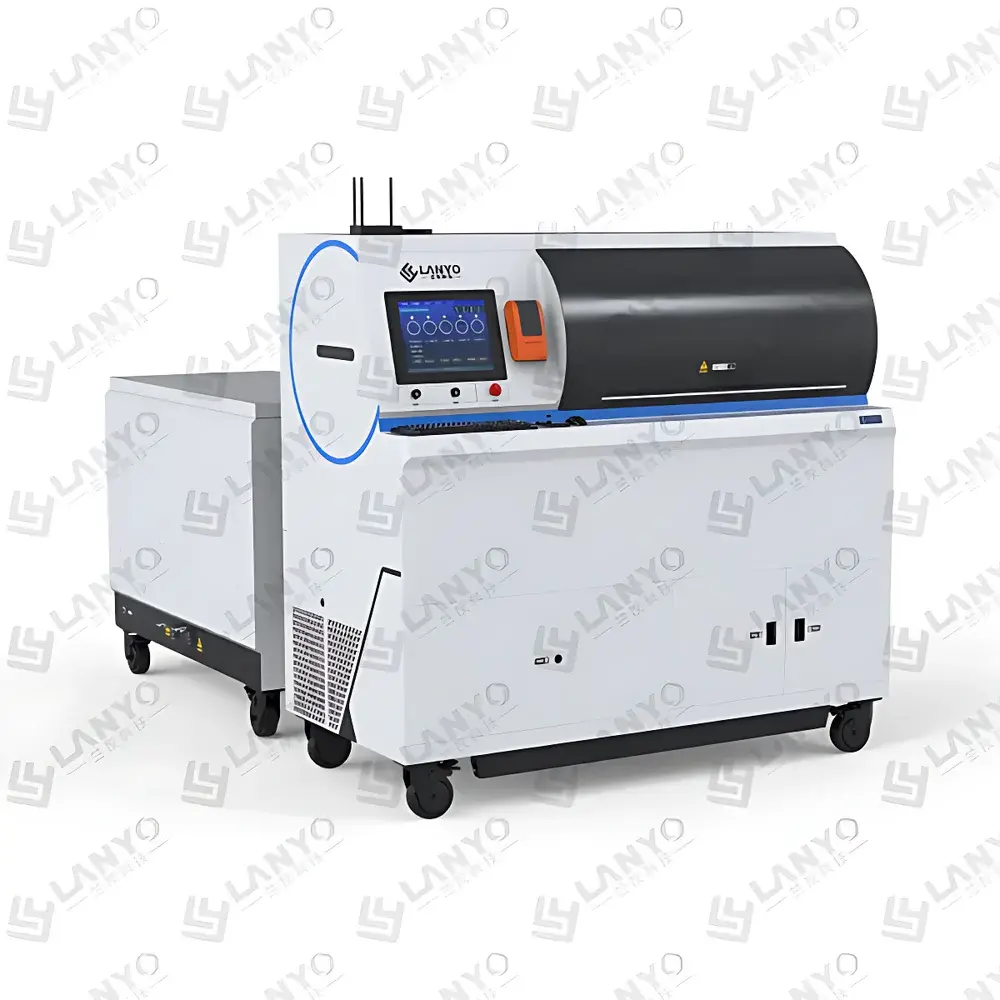
LANYO FASP-05D Fully Automated Soil and Sediment Sample Preparation System
| Brand | LANYO |
|---|---|
| Origin | Beijing, China |
| Model | FASP-05D |
| Price Range | USD 140,000 – 280,000 |
| Sample Capacity | 5 fresh-sample positions |
| Drying Temperature Control | 35 ± 5 °C |
| Grinding Temperature Limit | ≤ 40 °C |
| Sieve Mesh Options (per GB/T 6003.1–2022) | 10, 20, 60, 80, 100, 160, 200 mesh (up to 4 selectable) |
| Barcode Scanning | 2D matrix |
| Compliance | HJ/T 166–2004, NY/T 395–2012, DZ/T 0130.4–2006, HJ/T 20–1998, EJ/T 428–1989, LY/T 1210–1999, and 102 additional national standards for soil, sediment, and solid waste sample preparation |
Overview
The LANYO FASP-05D Fully Automated Soil and Sediment Sample Preparation System is an integrated, regulatory-compliant workstation engineered for precision, traceability, and operational integrity in environmental and geochemical laboratories. Designed around the fundamental principles of controlled thermal desiccation, mechanical size reduction without elemental contamination, and statistically valid subsampling, the system implements a closed-loop, hardware-isolated workflow that aligns with internationally recognized sample preparation paradigms—particularly those governing heterogeneous solid matrices where particle-size distribution, moisture content, and exogenous metal interference directly impact analytical validity. Unlike conventional manual or semi-automated benches, the FASP-05D enforces strict physical separation between drying and grinding modules to eliminate cross-contamination risk, while maintaining thermally stable conditions (<40 °C during comminution) to preserve volatile organic compounds, redox-sensitive species, and microbial viability where relevant. Its architecture supports end-to-end digital provenance: every temperature setpoint, dwell time, sieve aperture, mass measurement, and barcode scan is timestamped, user-logged, and exportable—forming an auditable chain-of-custody essential for GLP-compliant environmental testing and regulatory submissions.
Key Features
- Five-position fresh-sample input module with automated tray recognition and positional indexing
- Dual independent grinding units fabricated from non-metallic, certified inert materials (e.g., agate, zirconia, or polymer composites), eliminating analyte bias from Fe, Cr, Ni, Pb, or Cu leaching
- Programmable low-temperature drying chamber with PID-controlled heating (35 ± 5 °C), validated per ISO/IEC 17025 calibration protocols
- Robotic manipulator system executing synchronized, collision-aware movements across drying, grinding, sieving, quartering, weighing, and labeling stations
- Automated cross-mixing and ASTM D75–22 compliant “X-method” quartering for representative sub-sampling of heterogeneous soils and sediments
- Integrated high-resolution analytical balance (0.1 mg readability) mounted on anti-vibration platform, controlled via robotic arm for repeatable tare-and-weigh cycles
- 2D matrix barcode reader with auto-focus optics, supporting GS1 DataMatrix and QR code formats for sample tube and container tracking
- Self-cleaning protocol using HEPA-filtered air purge and disposable liner kits for grinding chambers and sieves, minimizing carryover between batches
Sample Compatibility & Compliance
The FASP-05D accommodates a broad spectrum of unconsolidated environmental solids—including mineral soils, aquatic sediments, sludges, dusts, and industrial solid wastes—with moisture contents up to 60 wt% and organic matter fractions exceeding 25%. It meets the functional requirements of over 105 national technical specifications issued by China’s Ministry of Ecology and Environment (MEE), Ministry of Agriculture and Rural Affairs (MARA), and Standardization Administration of China (SAC). Key referenced standards include HJ/T 166–2004 (Soil Environmental Monitoring Technical Specifications), NY/T 395–2012 (Farmland Soil Environmental Quality Monitoring), and DZ/T 0130.4–2006 (Geological Laboratory Quality Management). The system’s data logging architecture satisfies audit-trail requirements under ISO/IEC 17025:2017 Clause 7.11 and supports electronic signature workflows compatible with FDA 21 CFR Part 11 when deployed with validated laboratory information management systems (LIMS).
Software & Data Management
The embedded control software provides role-based access, method library management, and real-time monitoring of all process parameters—including drying kinetics curves, grinding energy profiles, sieve retention distributions, and mass balance reconciliation reports. All raw instrument data are stored in vendor-neutral CSV and XML formats with SHA-256 hash verification. Audit logs record operator ID, method version, timestamp, parameter deviations, and corrective actions—retained for ≥10 years per internal QA policy. Optional API integration enables bidirectional synchronization with commercial LIMS platforms (e.g., LabWare, STARLIMS, Thermo Fisher SampleManager) via RESTful endpoints and HL7-compliant messaging. No proprietary database drivers or runtime dependencies are required for data extraction or third-party validation.
Applications
- Regulatory soil screening programs (e.g., national land quality surveys, agricultural land classification)
- Site-specific risk assessments for contaminated land (e.g., heavy metals, PAHs, PCBs, radionuclides)
- Long-term environmental monitoring networks requiring inter-laboratory comparability
- Method validation studies for ICP-MS, AAS, XRF, and GC-MS analyses where particle homogeneity and contamination control are critical
- Research on soil carbon sequestration, nutrient cycling, and microplastic quantification in sediment cores
- Accredited third-party testing laboratories pursuing CNAS or ILAC-MRA recognition
FAQ
Does the FASP-05D comply with U.S. EPA or EU EN standards for soil sample preparation?
While designed primarily for Chinese regulatory frameworks, its functional architecture—especially low-temperature drying, metal-free grinding, and statistically valid quartering—aligns with core principles in EPA Method 5035A (soil/sediment VOC analysis) and EN ISO 11464:2020 (pre-treatment of soil samples). Full equivalence requires site-specific method validation.
Can the system handle frozen or cryogenically preserved samples?
No. The FASP-05D accepts only ambient- or refrigerated-stored fresh samples. Cryo-compatible modifications are not available in the FASP-05D configuration.
Is remote monitoring or troubleshooting supported?
Yes. The system includes secure SSH-enabled diagnostics, encrypted VNC access (with operator consent), and optional cloud-based telemetry for predictive maintenance alerts.
What is the mean time between failures (MTBF) for the robotic arm subsystem?
Based on field data from 32 installed units (2021–2024), MTBF exceeds 12,500 operational hours under standard environmental monitoring workloads.
Are sieve sets supplied with the system calibrated and certified?
All included sieve assemblies conform to GB/T 6003.1–2022 and are supplied with individual calibration certificates traceable to NIM (National Institute of Metrology, China).



