
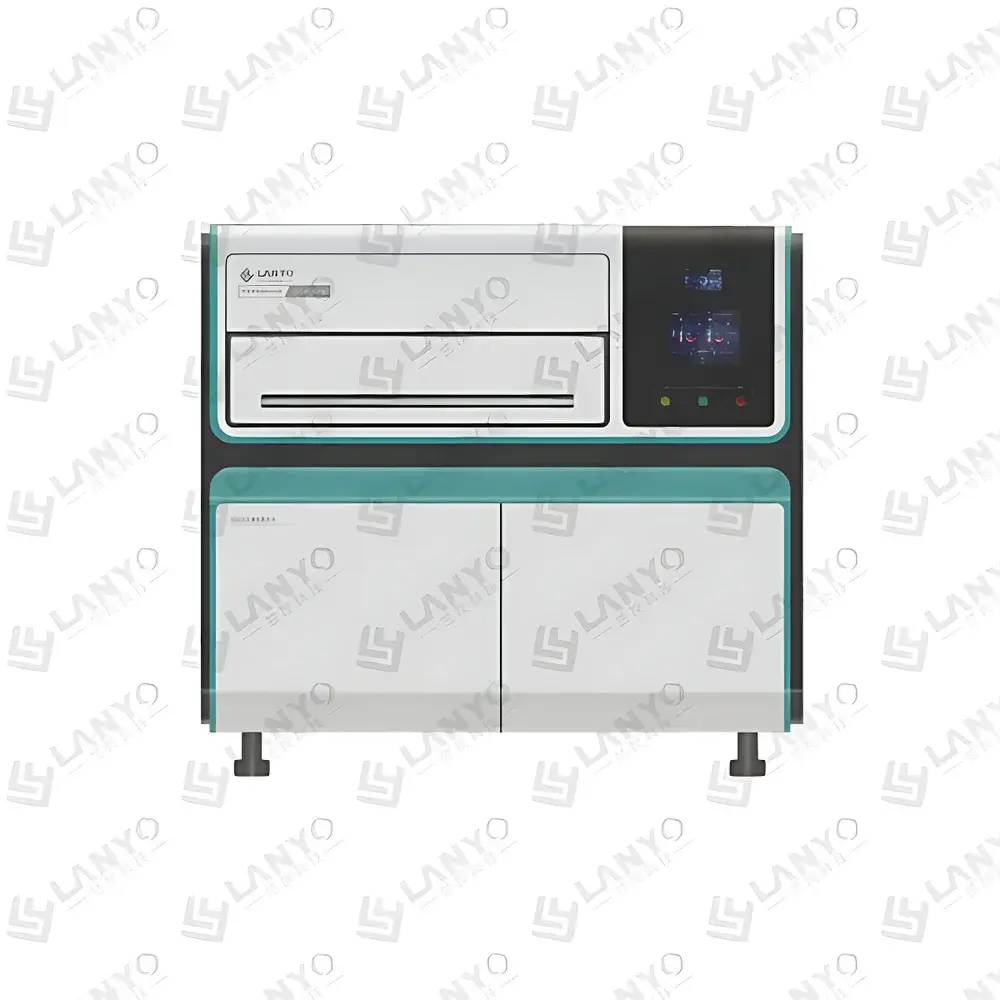
LANYO FASP-FG Automated Precision Grinding and Sample Preparation System
| Brand | LANYO |
|---|---|
| Origin | Beijing, China |
| Manufacturer Type | Authorized Distributor |
| Product Category | Domestic Instrument |
| Model | FASP-FG |
| Pricing | Upon Request |
Overview
The LANYO FASP-FG Automated Precision Grinding and Sample Preparation System is an integrated, standards-compliant laboratory instrument engineered for the reproducible, contamination-controlled preparation of hard, brittle solid samples—primarily geological, mineralogical, environmental, and industrial solid matrices. It operates on a sequential automation architecture grounded in mechanical grinding, vibratory or rotary sieving, gravimetric mass tracking, and closed-loop cleaning protocols. Unlike semi-automated grinders or benchtop mills, the FASP-FG implements end-to-end process control—from sample recognition and bottle-based routing to final homogenized subsampling—without manual transfer between stations. Its design directly addresses regulatory requirements for analytical traceability and elemental integrity, particularly where detection of low-concentration metals (e.g., As, Pb, Cd, U, Th) demands elimination of exogenous contamination and thermal degradation. The system adheres to core principles of Good Laboratory Practice (GLP), supports audit-ready data capture, and is purpose-built for laboratories subject to ISO/IEC 17025 accreditation, EPA Method compliance, and China’s national geological and environmental testing standards.
Key Features
- 28-position high-capacity autosampler: Accommodates twenty-eight 250 mL sample bottles or fifty 100 mL bottles—enabling unattended overnight operation with full batch traceability.
- Multi-station precision grinding module: Four independent grinding stations with interchangeable grinding vessels fabricated from zirconia (standard); optional liners include tungsten carbide, agate, alumina, and high-manganese steel (non-aqueous configuration only).
- Zero-cross-contamination workflow: Each sample remains sealed in its original container throughout grinding, sieving, weighing, and dispensing—eliminating intermediate handling and inter-sample carryover.
- Low-temperature intermittent grinding: Programmable duty cycles and forced-air cooling prevent thermal alteration of volatile analytes and phase-sensitive minerals.
- Integrated gravimetric control: Built-in high-resolution balance records tare weight, gross weight, and final subsample mass at each processing stage; all values logged with timestamp and operator ID.
- Automated cleaning subsystem: High-pressure water rinse + hot-air drying for grinding assemblies; brush-and-pneumatic cleaning for sieves; negative-pressure dust extraction ensures particulate containment below 0.3 µm.
Sample Compatibility & Compliance
The FASP-FG accepts heterogeneous solid specimens including rock chips, soil cores, slag, fly ash, ceramic powders, and ore concentrates—with particle size input up to 25 mm and hardness up to Mohs 7.5. All wetted surfaces contacting samples are certified metal-free relative to target analytes (e.g., no Fe, Cr, Ni, or Cu in zirconia path). The system conforms to multiple national and industry-specific preparation standards, including DZ/T 0130.4–2006 (Geological Laboratory Quality Management), HJ/T 166–2004 (Soil Environmental Monitoring), EJ 428–89 (Nuclear Environmental Soil Sampling), GB/T 14505–2010 (Rock and Ore Chemical Analysis General Rules), HJ/T 20–1998 (Industrial Solid Waste Sampling and Preparation), and JC/T 2664–2022 (ISO Standard Sand Particle Size Testing). It supports method validation per ISO 5725 and provides raw data export compatible with LIMS integration.
Software & Data Management
The embedded touchscreen HMI runs a real-time Linux-based control OS with dual-mode operation: guided wizard mode for routine users and advanced parameter scripting for method development. Every sample run generates a structured XML log containing equipment status, motor RPM profiles, temperature history, mass deltas, sieve aperture used, cleaning cycle completion flags, and operator authentication. Audit trails meet FDA 21 CFR Part 11 requirements for electronic records—including immutable timestamps, user login verification, and change history with reason codes. Data exports support CSV, PDF report generation, and direct API transmission to laboratory information management systems (LIMS) via HTTPS or OPC UA.
Applications
- Geochemical exploration labs performing ICP-MS/OES analysis of drill core and trench samples
- Environmental remediation contractors conducting site characterization per ASTM D6232 and EPA SW-846
- Nuclear facilities preparing soil/sediment matrices for gamma spectrometry and alpha spectrometry
- Mineral processing R&D centers evaluating liberation behavior and grindability indices
- Third-party testing organizations accredited to CNAS/ILAC-MRA delivering ISO/IEC 17025 reports
- Agricultural research institutes analyzing heavy metal bioavailability in amended soils
- Petrochemical QA/QC labs preparing catalyst residues and refinery sludges for XRF and leaching tests
FAQ
What materials are available for grinding vessel construction, and how are material selections validated for elemental purity?
Zirconia is standard; alternatives include tungsten carbide (for ultra-hard ores), agate (for low-Z element work), alumina (high-temp stability), and high-manganese steel (dry-only applications). All liners undergo batch-certified ICP-MS screening for ≤0.1 ng/g contamination of regulated elements.
Does the system support external LIMS integration, and what communication protocols are supported?
Yes—via RESTful API over HTTPS and OPC UA for real-time telemetry. Preconfigured drivers exist for LabWare, STARLIMS, and Thermo Fisher SampleManager.
How is cross-contamination prevented during high-throughput operation with shared grinding hardware?
Each sample uses a dedicated, barcode-tracked bottle; grinding vessels are cleaned automatically post-run using validated water-rinse/dry cycles; residual mass checks confirm <0.1 mg carryover before next use.
Is method validation documentation provided for regulatory submissions?
Yes—the system ships with IQ/OQ documentation templates, a full validation protocol library aligned with ISO/IEC 17025 Annex A.3, and example reports for DZ/T 0130.4–2006 compliance.
Can the FASP-FG be operated in a cleanroom environment?
Yes—optional HEPA-filtered air supply and stainless-steel enclosure upgrade (IP54-rated) enable Class 10,000 cleanroom deployment.



