
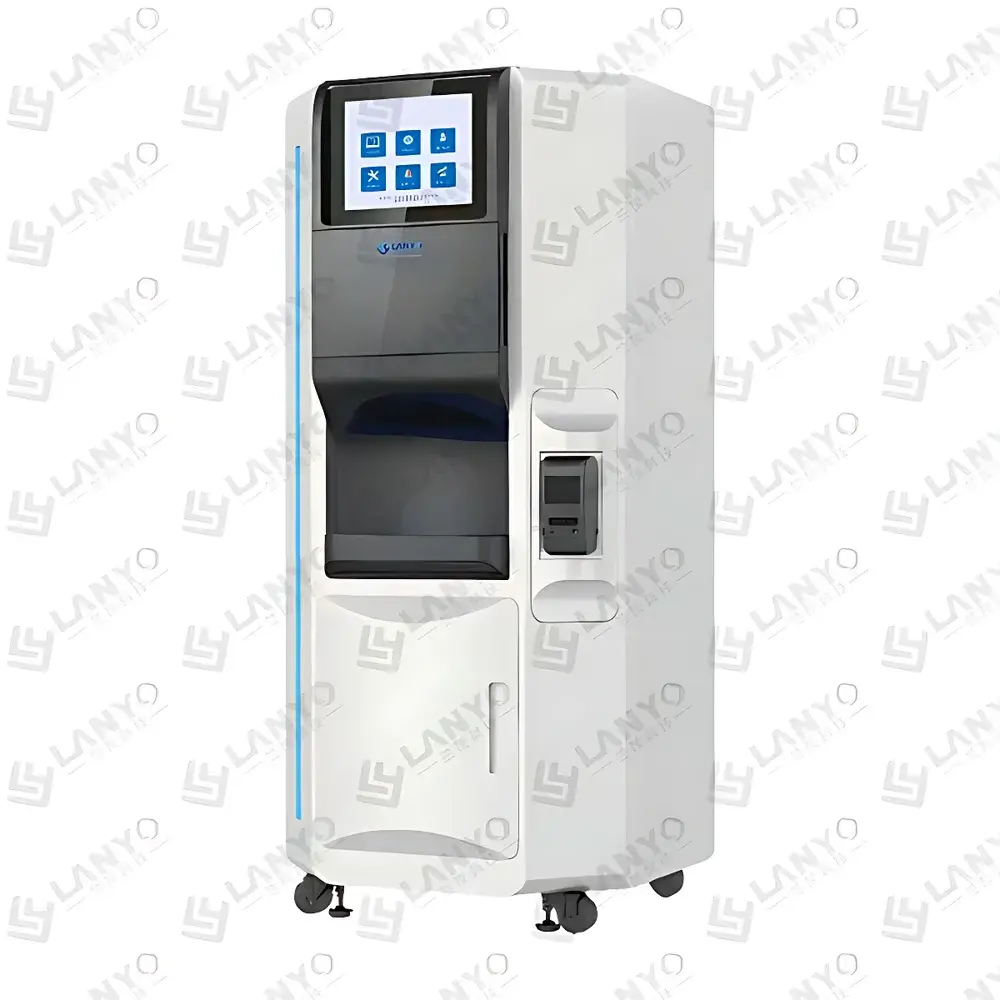
LANYO FASP-Geo Automated Rock & Soil Sample Preparation Workstation
| Brand | LANYO |
|---|---|
| Origin | Beijing, China |
| Model | FASP-Geo |
| Application Scope | Soil, sediment, solid waste, bedrock, and geological samples |
| Automation Level | Fully automated, unattended operation |
| Compliance | ASTM D6913, ISO 11277, USP <1058>, EPA Method 5035A, HJ/T 166–2004, NY/T 395–2012, DZ/T 0130.4–2006, HJ/T 20–1998, EJ/T 428–1989, LY/T 1210–1999 |
| Sample Throughput | Up to 30 samples per batch |
| Sieve Standards | GB/T 6003.1–2022 (10, 60, 100, 200 mesh) |
| Grinding Stages | Dual-stage — coarse jaw crushing + fine impact milling |
| Weighing Accuracy | ±0.01 g (integrated high-precision load cell) |
| Cleanliness Protocol | Brush + vacuum suction + acoustic dampening |
| Footprint | <2 m² |
| Modularity | Configurable inlet/outlet positions |
Overview
The LANYO FASP-Geo Automated Rock & Soil Sample Preparation Workstation is an engineered solution for standardized, contamination-free preparation of heterogeneous solid environmental and geological matrices. Designed specifically for integration into GLP-compliant, unattended laboratory environments—including “dark-light” (lights-out) facilities—the system implements a deterministic sequence of physical sample conditioning steps grounded in established regulatory frameworks for soil, sediment, mining waste, and bedrock analysis. Its operational architecture follows the fundamental principles of representative subsampling: mass reduction via geometric division (e.g., cross-quartering), particle size reduction under controlled mechanical energy input, homogenization through vibrational mixing, and size-class separation using certified sieve meshes traceable to GB/T 6003.1–2022 and ISO 3310-1. Unlike manual or semi-automated workflows, the FASP-Geo eliminates operator-dependent variability in grinding intensity, mixing duration, and fractionation geometry—critical factors influencing analytical reproducibility in elemental quantification (e.g., XRF, ICP-OES) and mineralogical characterization.
Key Features
- Fully Unattended Batch Processing: 30-position auto-loading carousel with programmable sample sequencing; integrated exit conveyor for post-processing sample retrieval—enabling 24/7 operation without human intervention.
- Dual-Stage Grinding Architecture: Coarse stage employs dual-jaw compression to preserve soil aggregate integrity and minimize lattice distortion; fine stage utilizes impact-based milling with interchangeable 60/100/200-mesh grinding modules for graded particle size distribution control.
- Regulatory-Aligned Subsampling: Motorized cross-quartering mechanism replicates manual ASTM D6913-compliant quartering; vibrational mixing ensures statistically homogeneous sub-aliquots prior to sieving and weighing.
- Zero-Cross-Contamination Design: All wetted surfaces are constructed from non-metallic, acid-resistant polymers and ceramic composites; no stainless steel or alloy components contact sample material—eliminating exogenous metal leaching risks during preparation.
- Integrated Metrology & Traceability: Built-in high-resolution load cell (±0.01 g) performs real-time mass verification before and after sieving; digital audit trail logs timestamped weight data, sieve selection, grinding cycle count, and cleaning event records.
- Modular Interfacing Capability: Standard RS-485 and Ethernet ports support bidirectional communication with LIMS, XRF analyzers, and robotic sample transport systems—facilitating closed-loop workflows in smart mine monitoring or mobile field labs.
Sample Compatibility & Compliance
The FASP-Geo is validated for use with air-dried, non-volatile solid matrices including but not limited to agricultural soils (per NY/T 395–2012), contaminated industrial sediments (per HJ/T 20–1998), uranium-bearing geological cores (per EJ/T 428–1989), forest floor litter (per LY/T 1210–1999), and metallurgical tailings (per DZ/T 0130.4–2006). All mechanical actions—grinding, sieving, mixing, and quartering—are calibrated against reference materials traceable to NIST SRM 2710a and GBW07401. The workstation meets functional requirements outlined in ISO/IEC 17025:2017 Clause 7.2.2 (method validation) and supports full compliance with FDA 21 CFR Part 11 when deployed with optional electronic signature and audit trail modules. Its non-metallic flow path satisfies USP and elemental impurity control criteria for environmental testing laboratories.
Software & Data Management
Controlled via LANYO LabOS v3.2—a deterministic, deterministic real-time operating system embedded on ARM Cortex-A53 hardware—the FASP-Geo provides role-based access control, method versioning, and encrypted local storage of all process metadata. Each sample run generates a machine-readable .CSV log containing: start/stop timestamps, sieve mesh used, cumulative grinding energy (kWh), final mass per fraction, deviation from target weight (±%), and cleaning cycle status. Exported logs are compatible with major LIMS platforms (e.g., Thermo Fisher SampleManager, LabWare LIMS) and support automated report generation aligned with ISO 17025 documentation requirements. Optional cloud synchronization enables remote monitoring and predictive maintenance alerts based on motor current profiling and vibration signature analysis.
Applications
- Centralized soil sample preparation hubs serving regional environmental monitoring networks
- On-site deployment at active mining operations for real-time geochemical feedstock assessment
- Mobile laboratories supporting rapid site characterization during brownfield redevelopment projects
- Reference material production facilities requiring certified homogeneity across >100 g batches
- Nuclear decommissioning programs where radiological sample integrity must be preserved without metallic contamination
- Academic geoscience departments conducting multi-element stable isotope ratio studies (e.g., Sr-Nd-Pb) demanding ultra-low procedural blanks
FAQ
Does the FASP-Geo comply with EPA Method 5035A for volatile organic analysis?
No—this workstation is designed exclusively for non-volatile, dry-solid matrices. Volatile or moisture-sensitive samples require dedicated low-temperature, inert-atmosphere preparation systems.
Can the sieve mesh configuration be modified beyond the standard 10/60/100/200 options?
Yes—custom sieve trays conforming to ISO 3310-1 specifications can be installed; users must validate new configurations per ISO 17025 Clause 7.2.2 prior to routine use.
Is third-party calibration certification available?
Yes—NIST-traceable calibration certificates for the integrated weighing module and sieve mesh certification reports are provided upon request, with annual recalibration services offered under service-level agreement.
What cybersecurity protocols are implemented in LabOS v3.2?
LabOS v3.2 complies with IEC 62443-3-3 SL2 requirements: TLS 1.2+ encryption for network communications, secure boot with signed firmware images, and write-protected system partitions preventing unauthorized code injection.



