
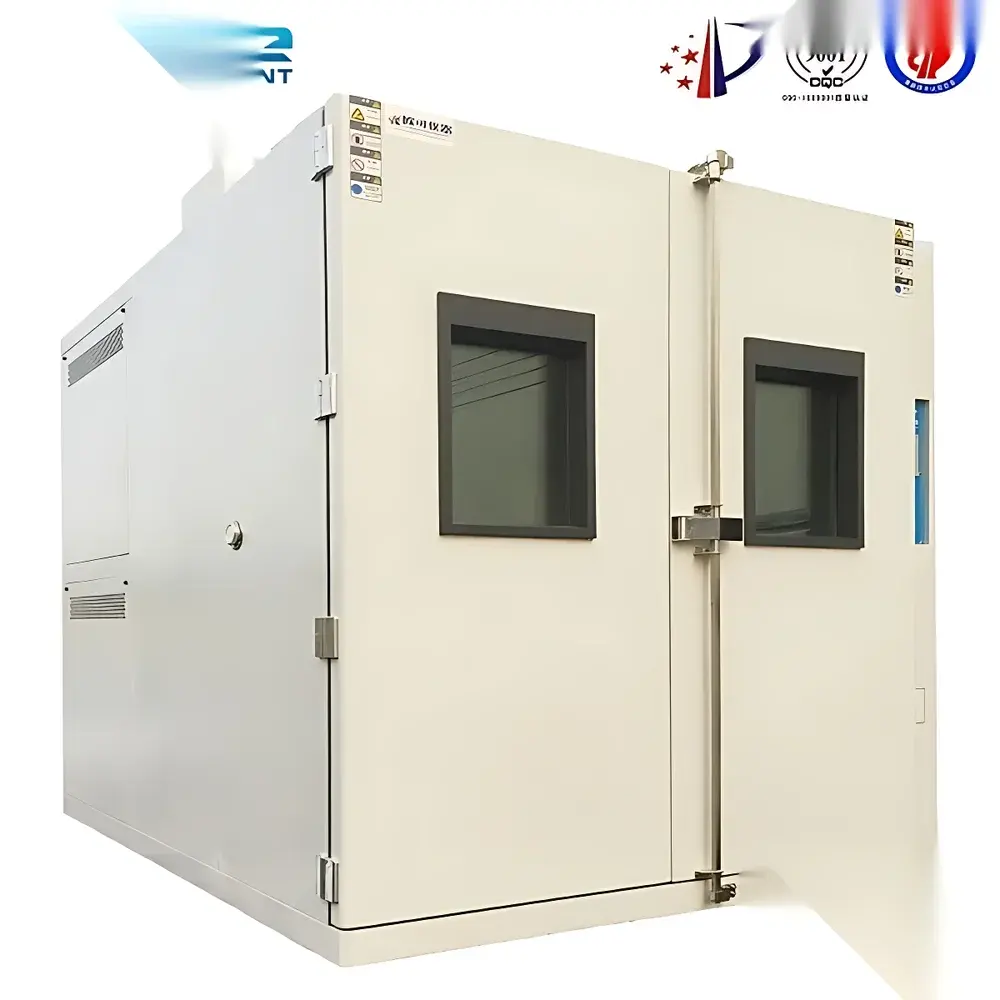
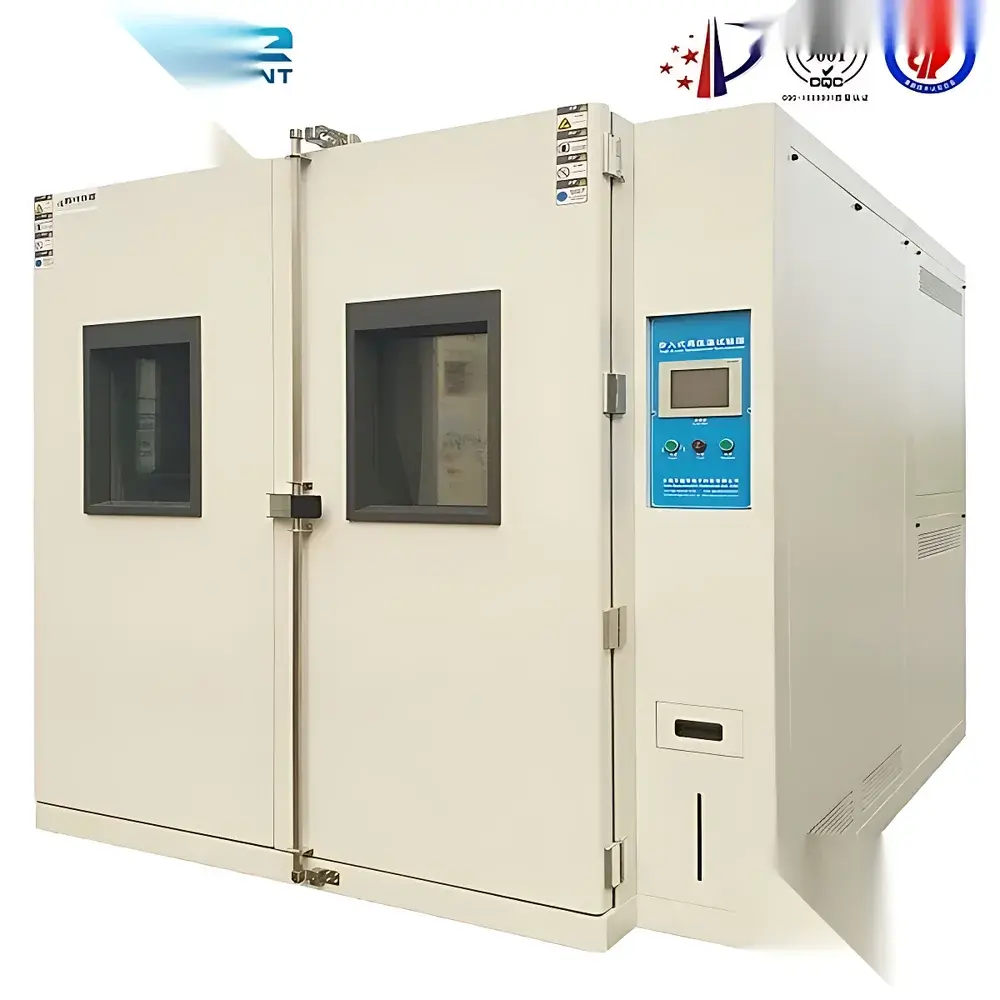
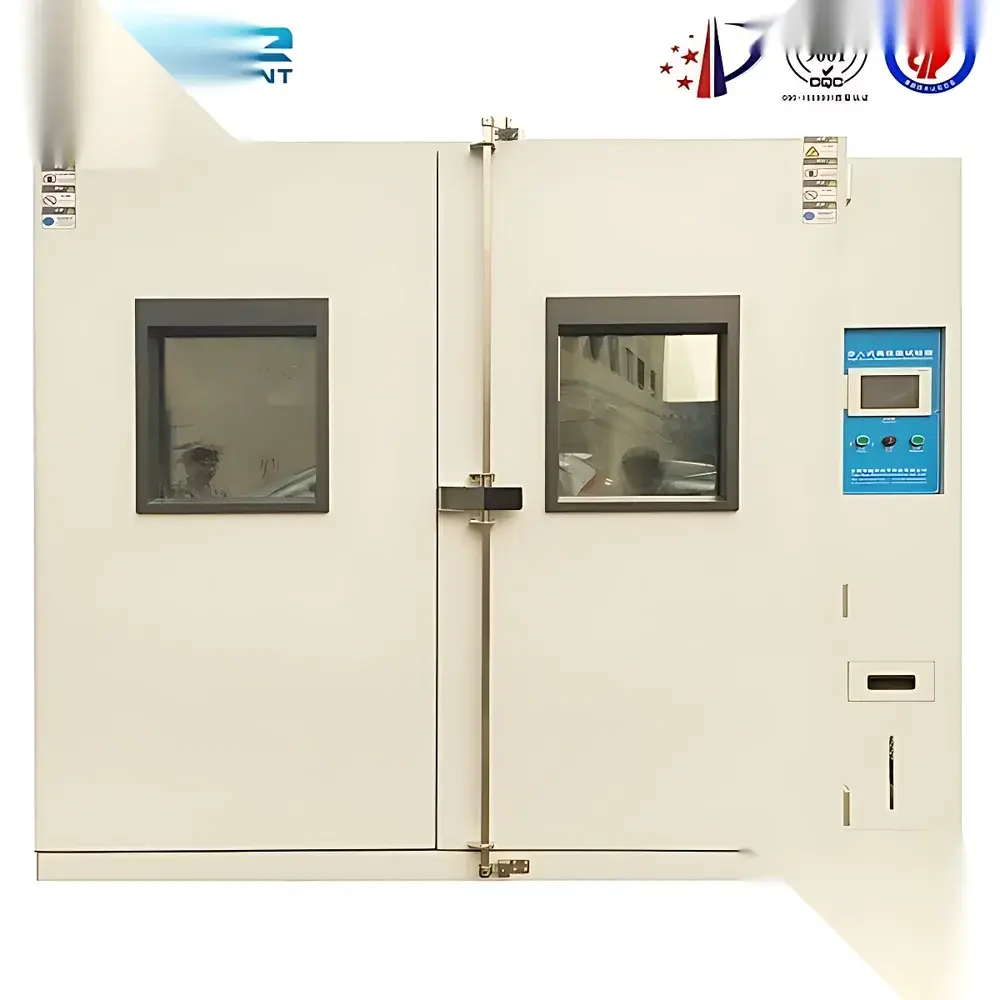
Large-Scale Temperature and Humidity Environmental Test Chamber
| Key Specifications | Temperature Range: -40°C to +130°C |
|---|---|
| Humidity Range | 20–98% RH |
| Temperature Uniformity | ±2°C |
| Humidity Uniformity | ±3.0% RH |
| Temperature Fluctuation | ±0.5°C |
| Humidity Fluctuation | ±2.5% RH |
| Heating Rate (air) | ~2.5°C/min (no-load, nonlinear) |
| Cooling Rate (air) | ~1.0°C/min (no-load, nonlinear) |
| Internal Chamber Dimensions (W×D×H) | 3000 × 1000 × 2000 mm |
| External Dimensions (W×D×H) | 3800 × 1300 × 2450 mm |
| Door Opening | 1000 × 1900 mm (outward-swinging) |
| Observation Windows | Front (300 × 450 mm), Left Side (500 × 450 mm) |
| Power Supply | 380 V ±10%, 50/60 Hz |
| Total Power Consumption | ~30 kVA |
| Refrigeration Method | Mechanical compression + water-cooled condenser |
| Humidification System | Stainless-steel steam generator with integrated deionized water purification |
| Dehumidification Method | Surface cooling via refrigerated coil |
| Air Circulation | Extended-shaft centrifugal blower with external motor drive |
| Heating System | Nickel-chromium alloy resistive heaters with PID + SSR control |
| Cooling System | High-efficiency plate-type air-to-refrigerant heat exchanger |
| Sensor Location | At air outlet of HVAC unit |
| Compliance | GB/T 5170.2 (temperature testing), GB/T 5170.5 (humidity testing) |
Overview
The Large-Scale Temperature and Humidity Environmental Test Chamber is an industrial-grade climatic simulation system engineered for rigorous validation of large-format products, assemblies, and materials under precisely controlled thermal and hygrothermal conditions. Designed for applications requiring volumetric stability across wide operational envelopes, this chamber employs a balanced air conditioning methodology—combining forced-air circulation, PID-regulated heating/cooling, and steam-based humidification—to achieve dynamic equilibrium between thermal input and environmental dissipation. Its core architecture adheres to the physical principles of convective heat transfer and psychrometric control, enabling reproducible exposure profiles compliant with international environmental testing standards. The chamber is intended for use in R&D laboratories, quality assurance departments, and certification facilities where full-scale environmental stress screening (ESS), accelerated life testing (ALT), and pre-compliance verification are routinely conducted.
Key Features
- Spacious internal workspace (3000 × 1000 × 2000 mm) accommodates oversized test specimens—including automotive components, aerospace subassemblies, medical equipment cabinets, and telecom infrastructure modules.
- Wide operational range: temperature from –40°C to +130°C and relative humidity from 20% to 98% RH—enabling combined stress testing per IEC 60068-2-30, MIL-STD-810H, and JEDEC JESD22-A110.
- Water-cooled mechanical refrigeration system ensures stable low-temperature performance even under ambient conditions up to +32°C, with cooling water inlet temperature maintained between +10°C and +30°C at 0.1–0.3 MPa pressure.
- Dual observation windows—front-mounted (300 × 450 mm) and left-side (500 × 450 mm)—fabricated from multi-layer laminated safety glass with anti-fog coating for unobstructed visual monitoring during extended test cycles.
- Stainless-steel steam humidifier integrated with on-board deionized water purification eliminates mineral deposition and ensures long-term reliability of humidity generation without manual descaling intervals.
- Extended-shaft centrifugal blower with externally mounted motor minimizes internal heat load and enhances maintenance accessibility while delivering uniform airflow distribution across the entire chamber volume.
- PID + SSR-controlled nickel-chromium heating elements provide fine-grained thermal regulation, supporting both steady-state and ramp-soak profiles with high repeatability.
Sample Compatibility & Compliance
This chamber supports testing of non-hazardous, non-explosive, and non-corrosive samples up to a maximum thermal load of 8.5 kW—equivalent to simulating the heat output of a large cabinet-style air conditioning unit. Internal mounting configurations accommodate custom fixtures, cable pass-throughs, and sensor feedthroughs (subject to user-provided sealing solutions). All performance specifications—including temperature/humidity uniformity (±2°C / ±3.0% RH), fluctuation (±0.5°C / ±2.5% RH), and ramp rates—are validated in accordance with GB/T 5170.2 (Electrical Equipment—Testing Methods for Temperature Characteristics) and GB/T 5170.5 (Testing Methods for Humidity Characteristics). While not certified to UL, CE, or UKCA out-of-the-box, the system’s design principles align with the functional safety expectations of ISO/IEC 17025-accredited laboratories performing environmental testing under GLP or GMP frameworks.
Software & Data Management
The chamber is equipped with a programmable logic controller (PLC)-based central management system featuring a 10.4-inch TFT touchscreen HMI. It supports up to 99 programmable test segments per profile, including ramp, soak, and cycling modes with adjustable dwell times and transition rates. Real-time data logging records temperature and humidity readings from the HVAC outlet sensor at user-defined intervals (1–60 seconds), storing up to 30 days of continuous history internally. Export options include USB flash drive (CSV format) and optional RS485/Ethernet communication for integration into enterprise LIMS or MES platforms. Audit trail functionality—compliant with FDA 21 CFR Part 11 requirements when paired with validated third-party software—is available through optional firmware upgrade packages that enforce electronic signatures, role-based access control, and immutable record retention.
Applications
- Environmental stress screening (ESS) of military-grade electronics enclosures and vehicle ECUs prior to field deployment.
- Thermal aging studies of polymer composites, adhesives, and battery module housings under cyclic humidity exposure.
- Validation of HVAC system performance under extreme ambient conditions using full-scale mock-ups.
- Pre-compliance testing for consumer appliances against IEC 60335-1 and EN 60335-1 requirements for operating environment robustness.
- Material compatibility assessment of packaging systems exposed to tropical or arctic storage conditions.
- Calibration support for reference sensors and metrology-grade hygrometers within accredited calibration labs.
FAQ
What is the recommended ambient installation environment for optimal chamber performance?
The chamber requires installation in a conditioned space with ambient temperature between +5°C and +32°C, relative humidity ≤85% RH, and adequate ventilation for the water-cooled condenser. Cooling water must be supplied at 10–30°C and 0.1–0.3 MPa pressure using clean, low-conductivity freshwater.
Can the chamber operate continuously at –40°C and 98% RH simultaneously?
No. Due to thermodynamic constraints, the achievable humidity range is pressure- and temperature-dependent. At –40°C, the maximum saturated RH is physically limited; operation at 98% RH is only feasible above approximately +10°C. The specified ranges reflect independent extremes—not simultaneous limits.
Is the internal sensor location configurable?
The primary temperature and humidity sensors are fixed at the HVAC air outlet per standard configuration to ensure representative measurement of conditioned supply air. Optional multi-point sensor kits (with calibrated NIST-traceable probes) can be installed at user-defined locations inside the workspace for spatial uniformity mapping.
Does the system include remote monitoring capability?
Standard configuration includes local HMI and USB data export. Remote access via Ethernet or Modbus TCP requires optional communication module installation and integration with site-specific SCADA or building management systems.
What maintenance intervals are recommended for sustained accuracy?
Monthly inspection of steam generator water level and drain valves; quarterly cleaning of refrigerated coil and air filter; annual recalibration of temperature/humidity sensors using traceable reference standards per ISO/IEC 17025 procedures.



