
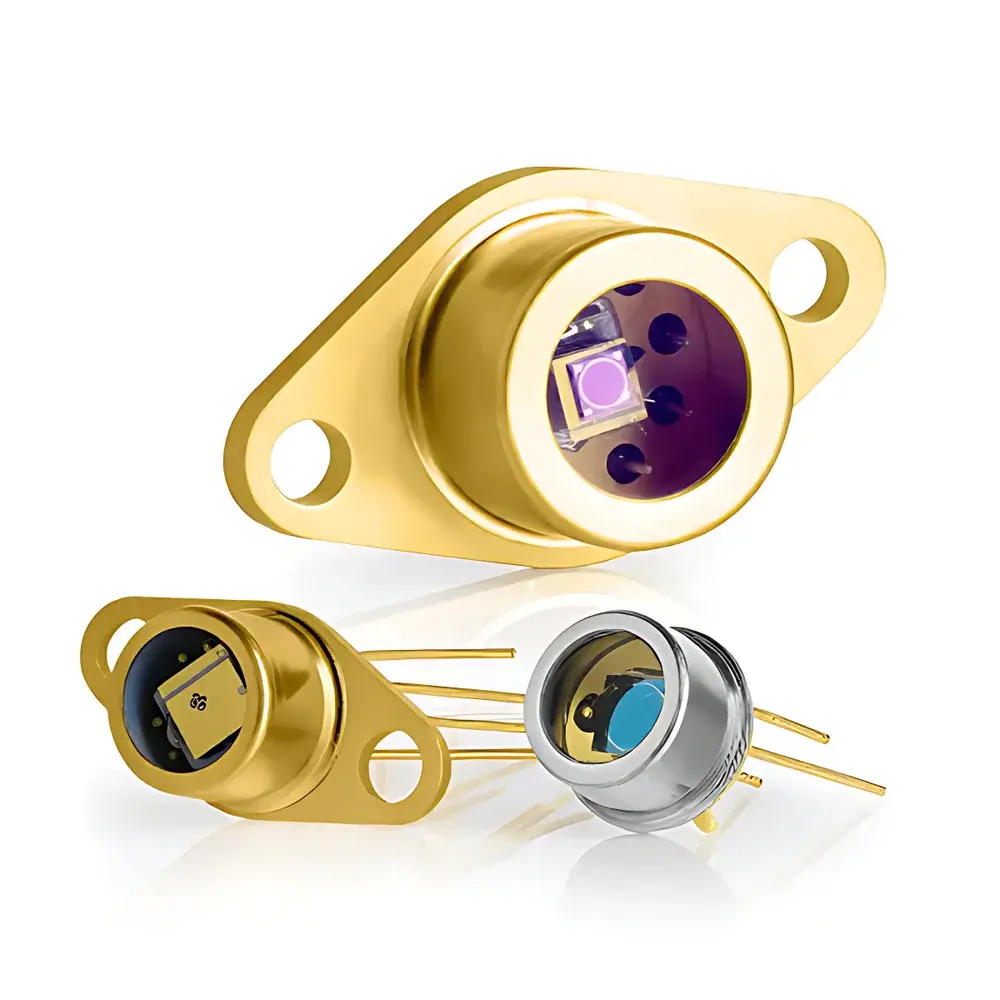
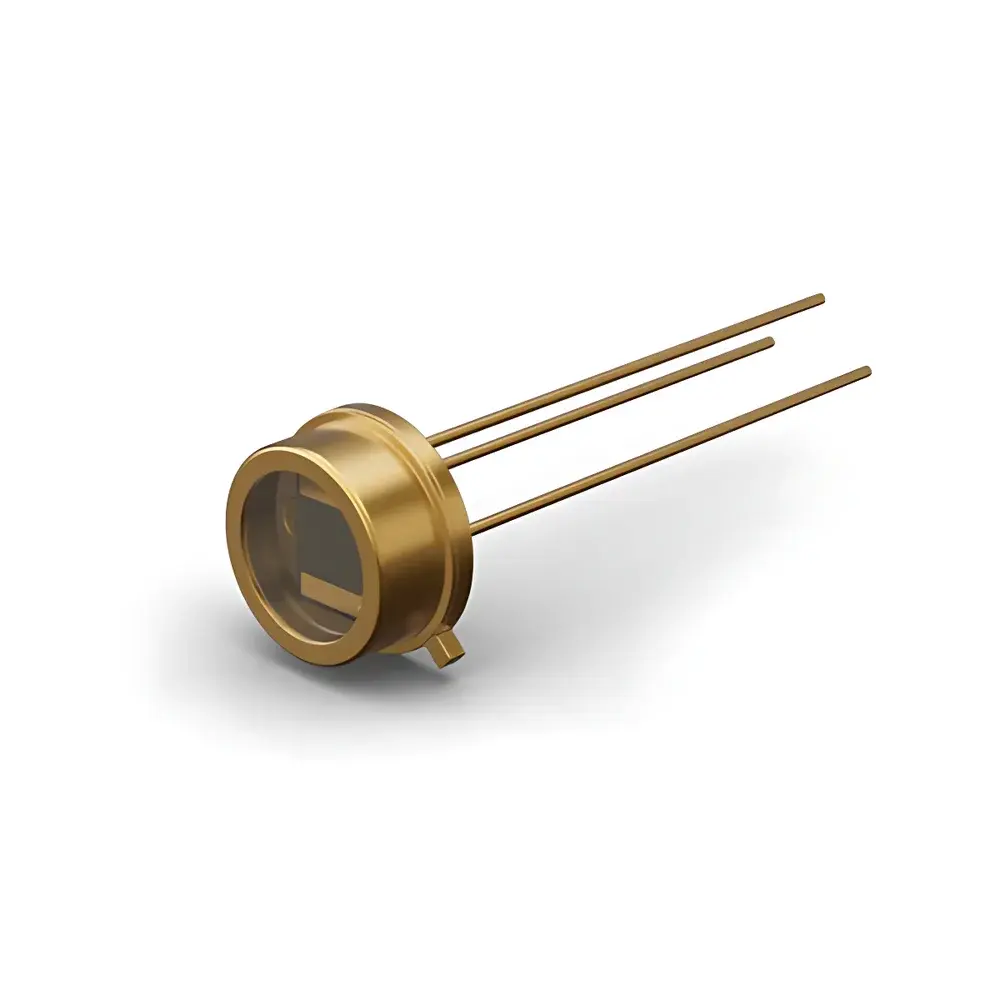
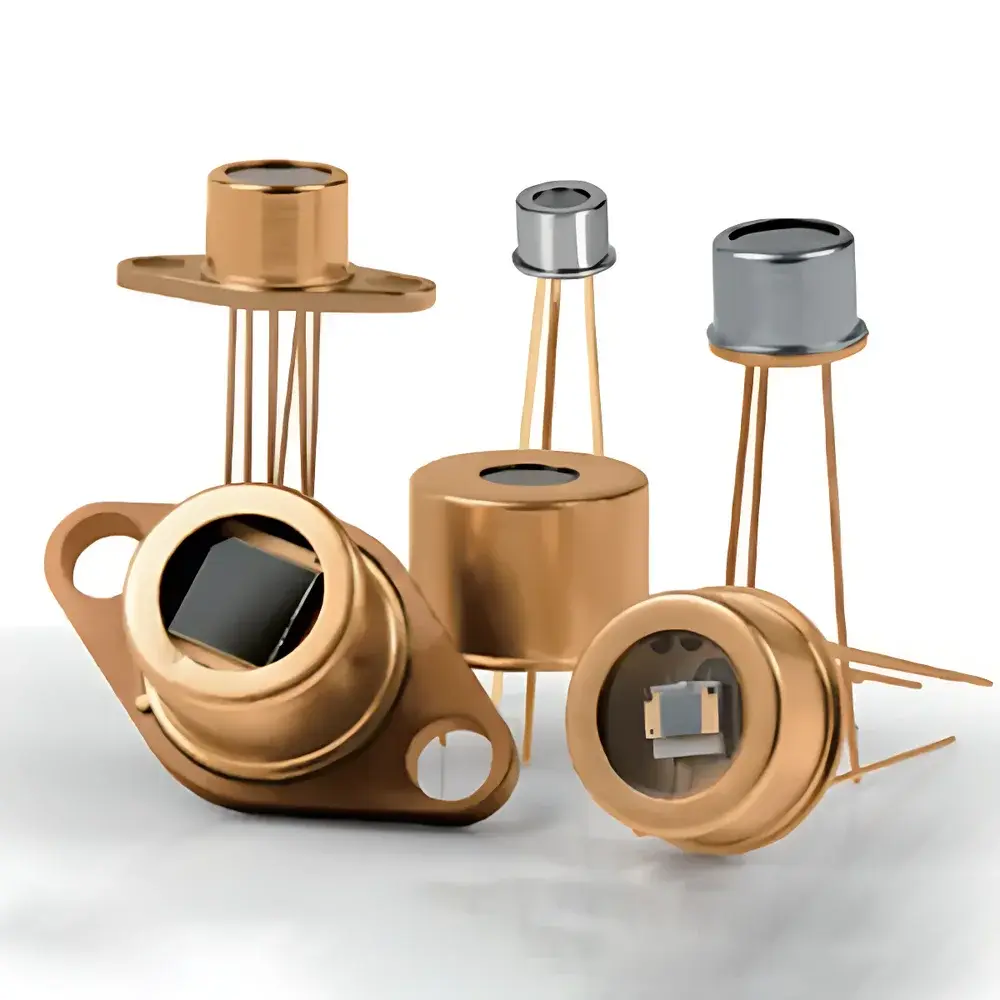
Laser Components PB2X Series Lead Sulfide (PbS) Infrared Photodetectors
| Brand | Laser Components |
|---|---|
| Origin | USA |
| Manufacturer Type | Authorized Distributor |
| Import Status | Imported |
| Model Series | PB2X |
| Component Category | Infrared Photodetector |
| Spectral Range | 1–3 µm (20% cutoff at 3.3 µm) |
| Available Cooling Options | Uncooled (PB25), Single-Stage TE-Cooled (PB27), Dual-Stage TE-Cooled (PB30) |
| Active Area Options | 1×1 mm² to 6×6 mm² |
| Typical Chip Size | 2×2 mm² (customizable) |
Overview
The Laser Components PB2X Series comprises high-sensitivity lead sulfide (PbS) infrared photodetectors engineered for broadband detection in the near-infrared (NIR) to short-wave infrared (SWIR) spectral region. Operating on the principle of photoconductive response, PbS detectors exhibit a measurable decrease in electrical resistance upon absorption of incident photons within their designated spectral band (1–3 µm), with a 20% transmission cutoff at approximately 3.3 µm. This intrinsic photoconductive mechanism delivers responsivity significantly exceeding that of comparable lead selenide (PbSe) devices—typically by more than one order of magnitude—making the PB2X series especially suitable for low-flux, medium-speed IR sensing applications where cost-effective large-area detection is required. Unlike InGaAs-based alternatives, PbS detectors offer scalable active areas (up to 6×6 mm²) at substantially lower unit cost, without compromising fundamental signal-to-noise performance in non-cryogenic configurations. The series includes three primary variants—PB25 (uncooled), PB27 (single-stage thermoelectric cooling), and PB30 (dual-stage TE cooling)—each optimized for distinct trade-offs between detectivity (D*), response time, and thermal stability.
Key Features
- High responsivity across 1–3 µm spectral band, with peak sensitivity near 2.4 µm
- 20% cutoff wavelength standardized at 3.3 µm, ensuring consistent spectral edge definition
- Three thermal management configurations: ambient operation (PB25), single-stage TE cooling (PB27), and dual-stage TE cooling (PB30) for enhanced D* and reduced dark current
- Customizable active area from 1×1 mm² up to 6×6 mm²; standard chip size is 2×2 mm²
- Robust hermetic TO-can or surface-mount package options compatible with automated PCB assembly
- Low 1/f noise characteristics suitable for DC-coupled and modulated detection architectures
- Compliance with RoHS 2.0 and REACH material restrictions
Sample Compatibility & Compliance
The PB2X detectors are designed for integration into optical systems requiring stable, repeatable NIR/SWIR response under ambient or controlled thermal conditions. They interface directly with transimpedance amplifiers, lock-in amplifiers, and OEM data acquisition modules. No sample preparation is required—the detector responds solely to incident irradiance intensity and spectral content. All PB2X variants comply with IEC 61000-4 electromagnetic immunity standards and meet MIL-STD-883H mechanical shock/vibration specifications when mounted per datasheet guidelines. For regulated environments—including pharmaceutical process monitoring and industrial safety systems—the detectors support traceable calibration protocols aligned with ISO/IEC 17025-accredited laboratories. While not intrinsically certified for hazardous locations, PB2X modules may be integrated into UL-listed enclosures meeting Class I, Division 2 requirements when deployed in fire detection or combustion monitoring systems.
Software & Data Management
PB2X detectors operate as analog sensor elements and do not include embedded firmware or digital interfaces. Integration into data acquisition ecosystems relies on external instrumentation—such as National Instruments DAQ cards, Keysight U1282A multimeters, or custom FPGA-based readout circuits. Laser Components provides comprehensive SPICE models and MATLAB-compatible responsivity curves (wavelength vs. Rv, D*, τ) for system-level simulation. Detector characterization reports include full spectral responsivity scans, NEP (noise-equivalent power) curves, and temperature-dependent dark resistance profiles—all traceable to NIST-calibrated reference sources. When used in GxP-regulated workflows (e.g., FT-NIR process analytical technology), the detectors support audit-ready documentation packages including calibration certificates, uncertainty budgets, and installation qualification (IQ) checklists compliant with FDA 21 CFR Part 11 electronic record requirements.
Applications
- Non-contact temperature measurement in paper drying and pulp processing lines
- Flame detection and combustion monitoring in industrial burners and gas turbines
- Fire alarm systems leveraging spectral discrimination between blackbody radiation and background clutter
- Moisture content analysis in agricultural products and hygroscopic materials via 1.9 µm and 2.7 µm water absorption bands
- Fourier-transform near-infrared (FT-NIR) spectrometers requiring large-area, cost-efficient detectors for benchtop and portable platforms
- Gas leak imaging using filtered IR illumination in methane (3.3 µm) and CO₂ (2.7 µm) absorption windows
- Quality control in polymer extrusion and film coating processes via real-time NIR reflectance feedback
FAQ
What is the typical response time of PB2X detectors?
Response time ranges from ~100 µs (PB25, uncooled) to ~200 µs (PB30, dual-stage cooled), depending on bias voltage, load resistance, and operating temperature.
Can PB2X detectors be used in vacuum environments?
Yes—hermetically sealed TO-46 and TO-5 packages are rated for operation under vacuum down to 10⁻⁶ mbar; consult datasheet for outgassing compliance data.
Is spectral calibration provided with each unit?
Spectral responsivity data is supplied per batch—not per unit—but NIST-traceable calibration services are available upon request through Laser Components’ certified metrology lab.
How does TE cooling affect detectivity (D*)?
Dual-stage cooling (PB30) improves D* by up to 3× over uncooled operation at room temperature, particularly above 2.5 µm, due to suppression of thermally generated carriers.
Are custom window materials available?
Yes—standard AR-coated fused silica windows can be substituted with BaF₂, CaF₂, or ZnSe for extended transmission beyond 3 µm; minimum order quantities apply.





