
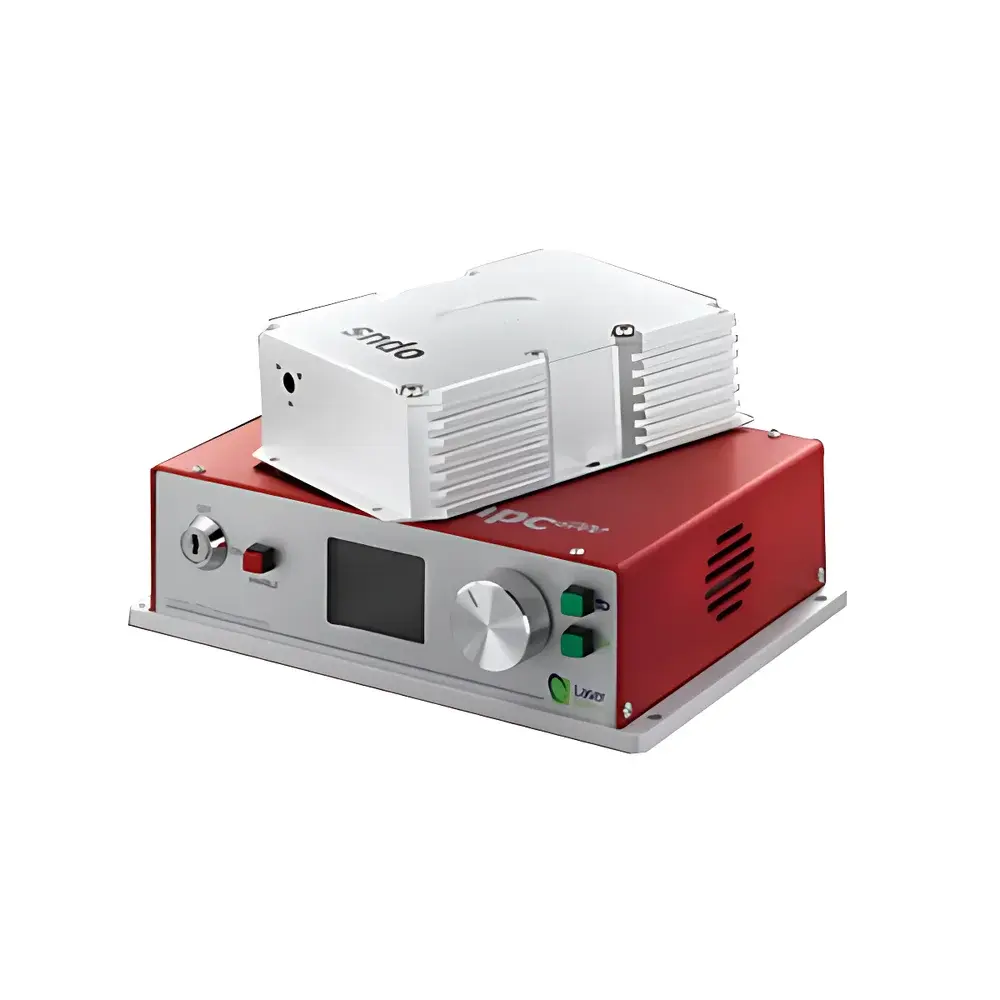
Laser Quantum Opus Series Scientific Laser Systems
| Brand | Laser Quantum |
|---|---|
| Origin | United Kingdom |
| Model | Opus532 / Opus660 / Opus1064 |
| Type | Solid-State Continuous-Wave (CW) Lasers |
| Wavelength | 532 nm / 660 nm / 1064 nm |
| Output Power | 2–6 W / 1–1.5 W / 4–10 W |
| Beam Diameter | 1.85±0.2 mm / 0.85±0.2 mm / 1.85±0.2 mm |
| Spatial Mode | TEM₀₀ |
| Beam Ellipticity | <1_1.15 / <1_1.2 / — |
| Spectral Bandwidth | 45 GHz / 30 GHz / 80 GHz |
| Beam Divergence | <0.4 mrad / <1.5 mrad / <0.6 mrad |
| M² Factor | <1.1 / <1.2 / <1.5 |
| Power Stability (RMS) | <0.2% / <1.0% / <0.2% |
| Pointing Stability | <2 μrad/°C / <10 μrad/°C / <10 μrad/°C |
| Intensity Noise (RMS, 10 Hz–100 MHz / 10 Hz–50 kHz / 10 Hz–1 MHz) | ≤0.08% / ≤0.6% / ≤0.15% |
| Polarization Ratio | >100:1 |
| Polarization Orientation | Vertical |
| Beam Angle | ≤1 mrad |
| Operating Temperature | 15–40 °C |
| Warm-up Time | 10 minutes |
Overview
The Laser Quantum Opus Series comprises a family of high-performance, continuous-wave (CW) solid-state lasers engineered for demanding scientific applications requiring exceptional beam quality, long-term stability, and low amplitude noise. Built upon proprietary resonator design and hermetically sealed cavity architecture, the Opus platform delivers diffraction-limited TEM00 output across three fundamental wavelengths—532 nm (frequency-doubled Nd:YAG), 660 nm (diode-pumped solid-state), and 1064 nm (Nd:YAG fundamental)—each optimized for distinct photonic workflows. Unlike conventional OEM modules, the Opus series integrates active thermal management, vibration-insensitive optical mounting, and real-time power monitoring to ensure reproducible performance under laboratory and industrial metrology conditions. Its compact footprint (≤290 × 120 × 95 mm) enables seamless integration into confocal platforms, optical trapping setups, and ultrafast amplifier pump architectures without compromising on radiometric fidelity or pointing accuracy.
Key Features
- Diffraction-limited beam quality with M² < 1.1 (Opus532), < 1.2 (Opus660), and < 1.5 (Opus1064), enabling efficient coupling into single-mode fibers and high-NA microscope objectives
- Ultra-low RMS intensity noise: ≤0.08% (10 Hz–100 MHz bandwidth, Opus532), supporting quantitative fluorescence correlation spectroscopy (FCS) and photon-counting applications
- Hermetically sealed, contamination-free optical cavity with no internal air paths—eliminating long-term drift from humidity or particulate deposition
- Thermally stabilized diode pumping and monolithic crystal mounts yielding pointing stability < 2 μrad/°C (Opus532) and < 10 μrad/°C (Opus660/1064)
- Integrated digital control interface (RS-232, USB, analog modulation input) compliant with LabVIEW™, MATLAB®, and EPICS-based automation frameworks
- Factory-calibrated power monitoring with ±1.5% absolute accuracy traceable to NPL (UK) standards
Sample Compatibility & Compliance
The Opus series is designed for compatibility with standard optical breadboards, kinematic mounts, and commercial microscopy platforms including Nikon Ti2-E, Zeiss LSM 900, and Leica SP8 STED. All models comply with IEC 60825-1:2014 Class 4 laser safety requirements and incorporate redundant interlock circuits meeting EN 61511 functional safety guidelines. For regulated environments, firmware supports audit-trail logging (ISO/IEC 17025-compliant data integrity) and optional 21 CFR Part 11–compliant user access controls when integrated with third-party LIMS or ELN systems. The lasers are CE-marked, RoHS 2011/65/EU compliant, and supplied with full Declaration of Conformity documentation for GLP/GMP validation protocols.
Software & Data Management
Laser Quantum provides the Opus Control Suite—a cross-platform application (Windows/macOS/Linux) enabling remote parameter configuration, real-time power trending, temperature diagnostics, and event-triggered logging. Raw sensor data (power, TEC current, cavity temperature) is exportable in CSV and HDF5 formats, with timestamp resolution ≤10 ms. API support includes Python bindings (PyOpus) and C++ SDKs for integration into custom acquisition pipelines. All firmware updates undergo cryptographic signature verification; version history and calibration certificates are embedded in device EEPROM and accessible via secure HTTP endpoint. Optional integration with NI DIAdem allows automated compliance reporting for ISO 13485 or ASTM E2500 validation packages.
Applications
- Pump sources for ultrafast Ti:sapphire and Yb-doped fiber amplifiers — Opus532 delivers narrow-band, high-brightness 532 nm light essential for efficient non-linear frequency conversion and carrier-envelope phase stabilization
- Optical tweezers and holographic trapping — Opus1064’s high-power (up to 10 W), low-noise 1064 nm output enables stable single-beam gradient force manipulation of sub-micron dielectric particles with minimal thermal perturbation
- Super-resolution fluorescence microscopy (STED, RESOLFT, MINFLUX) — Opus532 and Opus660 provide precisely controlled depletion beams with ellipticity <1_1.2 and beam angle ≤1 mrad, critical for maintaining PSF fidelity at nanoscale resolution
- Raman spectroscopy and coherent anti-Stokes Raman scattering (CARS) — Narrow spectral bandwidth (<30 GHz for Opus660) minimizes background broadening and enhances vibrational mode discrimination
- DNA sequencing by synthesis (SBS) and single-molecule fluorescence imaging — Ultra-stable power (100:1 ensure consistent fluorophore excitation efficiency across multi-hour acquisitions
FAQ
What is the typical warm-up time required to achieve full spectral and power stability?
The Opus series reaches operational stability within 10 minutes after cold start, with power drift < ±0.1% and wavelength shift < ±0.05 nm over subsequent 8-hour operation.
Can Opus lasers be modulated externally, and what is the maximum analog modulation bandwidth?
Yes—each model supports analog current modulation up to 100 kHz (Opus532), 10 kHz (Opus660), and 50 kHz (Opus1064) with ≤3 dB roll-off, referenced to factory-set bias point.
Is fiber coupling available as a standard option or only as a custom configuration?
Free-space output is standard; polarization-maintaining single-mode fiber coupling (FC/APC, SM600 for 532/660 nm; HI1060 for 1064 nm) is offered as an optional factory-aligned module with guaranteed coupling efficiency ≥70%.
How does the Opus series handle thermal load during extended duty cycles?
All units integrate dual-stage thermoelectric coolers (TECs) with PID-controlled feedback loops and conductive heat-sinking to aluminum chassis, enabling continuous operation at rated power across the full 15–40 °C ambient range without derating.
Are calibration certificates provided with each unit, and are they NIST-traceable?
Each laser ships with a factory calibration certificate (including power, wavelength, beam profile, and noise spectra) traceable to UK’s National Physical Laboratory (NPL); NIST-traceable calibration is available as an add-on service with accredited uncertainty budgets.





