
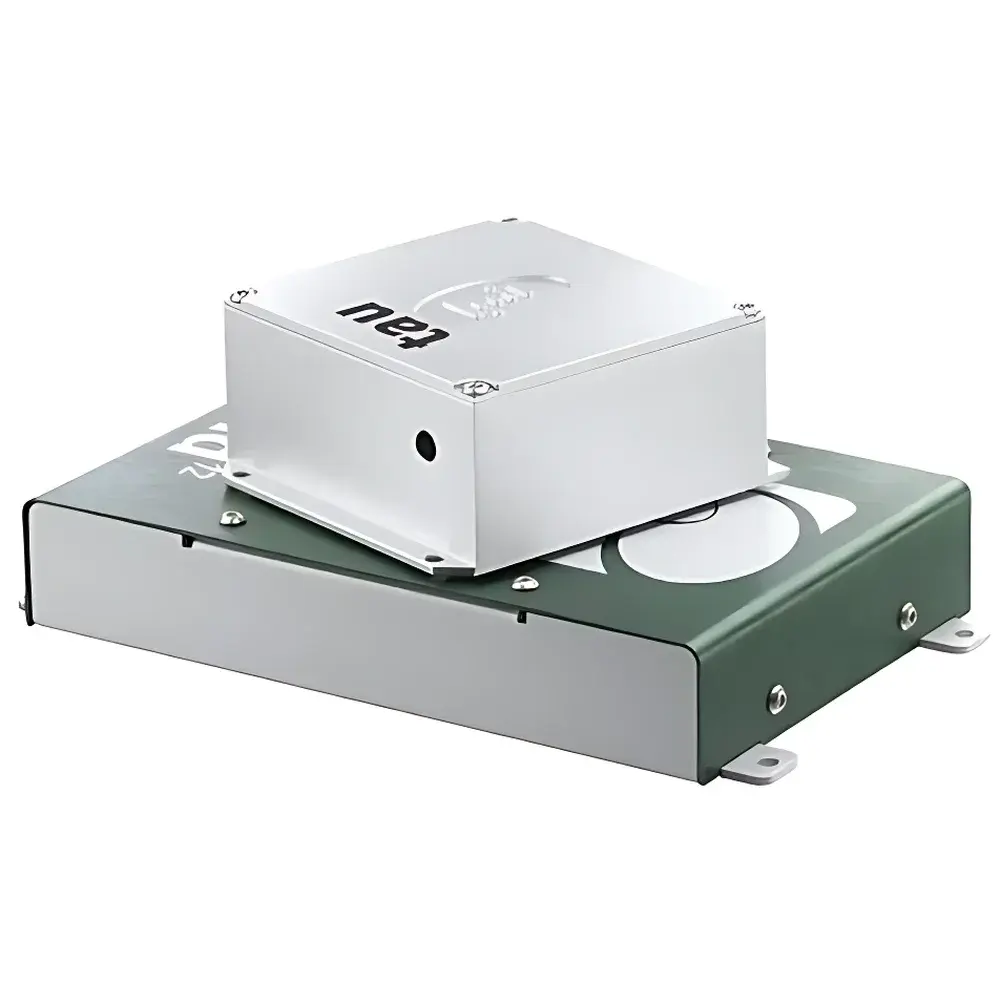
Laser Quantum Tau Series Ultra-Compact OEM Continuous-Wave Laser Systems
| Brand | Laser Quantum |
|---|---|
| Origin | United Kingdom |
| Manufacturer Type | Authorized Distributor |
| Product Category | Imported |
| Model | Tau Series |
| Core Technology | Monolithic Solid-State CW Laser |
| Wavelength Options | 532 nm / 671 nm |
| Output Power | 30–150 mW (532 nm), 30–50 mW (671 nm) |
| Beam Diameter | 1.0 ± 0.2 mm (532 nm), 1.4 ± 0.2 mm (671 nm) |
| Spatial Mode | TEM₀₀ |
| Beam Divergence | < 1.0 mrad |
| Ellipticity | < 1:1.2 |
| Spectral Bandwidth | ~100 GHz |
| Coherence Length | ~3 mm |
| Polarization Ratio | >100:1, Vertical |
| Power Stability | < 1.0% RMS |
| Beam Pointing Stability | < 10 µrad/°C |
| Intensity Noise | ≤ 0.5% (532 nm), ≤ 1.0% (671 nm), 0.1–10 kHz |
| Operating Temperature | 22–37 °C |
| Warm-up Time | < 10 min |
| Environmental Robustness | 1200 g shock-rated, hermetically sealed housing |
| Control Interface | RS232 |
| Remote Monitoring | Supported via network-enabled diagnostics and parameter optimization |
| Fiber Coupling Options | Single-mode and multimode fiber output configurations |
Overview
The Laser Quantum Tau Series represents a class of ultra-compact, monolithic solid-state continuous-wave (CW) laser systems engineered for high-reliability OEM integration in demanding optical instrumentation environments. Based on intra-cavity frequency-doubled Nd:YVO₄ technology, the Tau platform delivers stable, diffraction-limited TEM₀₀ output at two strategically selected wavelengths—532 nm (green) and 671 nm (red)—optimized for photonic applications requiring high spatial coherence, low amplitude noise, and exceptional pointing stability. Unlike modular or air-cooled alternatives, the Tau architecture integrates the laser crystal, nonlinear crystal, and cavity optics into a single thermally stabilized monoblock, eliminating alignment sensitivity and enabling robust performance under mechanical stress and thermal transients. Its hermetically sealed, maintenance-free enclosure meets stringent requirements for deployment in field-deployable instruments, embedded medical devices, and aerospace-grade subsystems.
Key Features
- Monolithic cavity design ensures long-term alignment stability and immunity to vibration-induced mode degradation.
- Diffraction-limited beam quality (M² < 1.2) with ellipticity < 1:1.2 supports efficient coupling into single-mode fibers and high-resolution optical setups.
- Low-intensity noise performance (≤ 0.5% RMS, 0.1–10 kHz bandwidth at 532 nm) minimizes signal-to-noise degradation in photon-starved detection schemes such as Raman spectroscopy and fluorescence lifetime imaging.
- Beam pointing stability < 10 µrad/°C enables stable operation across ambient temperature fluctuations typical in unregulated laboratory or industrial enclosures.
- RS232 serial interface allows full remote control of output power, modulation, and diagnostic status; optional Ethernet gateway support enables integration into centralized instrument management networks.
- Qualified to survive 1200 g mechanical shock per MIL-STD-883 Method 2002.3, validating suitability for mobile platforms including UAV-mounted LIDAR, handheld spectroscopic analyzers, and vehicle-integrated PIV systems.
- No user-serviceable optics—fully sealed construction eliminates periodic cleaning, recalibration, or realignment, reducing total cost of ownership over multi-year deployments.
Sample Compatibility & Compliance
The Tau Series is compatible with standard SMF-28, HI1060, and MMF-50/125 optical fibers via factory-optimized collimator/fiber coupling assemblies. All units comply with IEC 60825-1:2014 Class 3B laser safety requirements and are CE-marked for EMC (EN 55011, EN 61000-6-3/4) and low-voltage directive (2014/35/EU) conformity. For regulated environments—including clinical diagnostics, pharmaceutical process analytical technology (PAT), and defense contracting—the system supports audit-ready logging of operational parameters and firmware version history. While not inherently 21 CFR Part 11 compliant, its RS232/Ethernet interface architecture permits integration with validated data acquisition software meeting GLP/GMP traceability requirements.
Software & Data Management
Laser Quantum provides the Tau Control Suite—a cross-platform (Windows/macOS/Linux) application enabling real-time monitoring of output power, temperature, diode current, and internal photodiode feedback signals. The suite logs timestamped operational data at configurable intervals (1 Hz to 1 kHz), exports CSV-formatted datasets for post-processing in MATLAB, Python (NumPy/Pandas), or LabVIEW, and supports SCPI command scripting for automated test sequences. Diagnostic logs include thermal gradient maps, power ramp profiles, and fault event timestamps—critical for root-cause analysis during system qualification or failure investigations. Firmware updates are delivered via signed binary packages with SHA-256 verification to ensure integrity in secure deployment workflows.
Applications
- Raman spectroscopy: High spectral brightness and narrow linewidth enable efficient excitation of molecular vibrational modes with minimal fluorescence background—particularly advantageous for 532 nm excitation of carbon nanotubes and graphene.
- Fluorescence correlation spectroscopy (FCS) and confocal microscopy: Low-noise, Gaussian beam profile ensures precise spot formation and quantitative intensity calibration across biological samples.
- Particle image velocimetry (PIV): Stable pointing and rapid warm-up (<10 min) allow seamless synchronization with high-speed camera triggers in wind tunnel or combustion chamber diagnostics.
- DNA sequencing and flow cytometry: 671 nm output matches common far-red fluorophore absorption peaks (e.g., Cy5, Alexa Fluor 647), supporting multiplexed detection without spectral crosstalk.
- Defense and sensing: Qualified for use in ruggedized heads-up displays (HUD), eye-safe LIDAR rangefinders (at 671 nm), and non-lethal dazzler systems where compactness, shock resistance, and polarization purity are mission-critical.
FAQ
Is the Tau Series suitable for integration into FDA-regulated medical devices?
Yes—its sealed monolithic design, traceable manufacturing pedigree (UK-based ISO 9001-certified production), and deterministic thermal/mechanical behavior support inclusion in Class II diagnostic instruments. Full design history files (DHF) and risk analysis documentation are available under NDA.
Can the Tau laser be modulated externally via TTL or analog input?
No—modulation is software-controlled only via RS232 commands. Analog or TTL modulation capability is not implemented to preserve beam quality and noise performance.
What fiber coupling options are supported out-of-the-box?
Standard offerings include FC/PC-terminated single-mode (SMF-28) and multimode (50 µm core) pigtails with AR-coated collimators. Custom NA and working distance configurations are available upon request.
Does the Tau require water cooling or forced-air convection?
No—it operates passively cooled within its specified ambient range (22–37 °C); no external heat sink or fan interface is required.
Is there a version with wavelength stabilization for interferometric applications?
The base Tau Series is free-running with ~100 GHz bandwidth. For sub-GHz linewidth applications, Laser Quantum offers the Ventus series with active wavelength locking—consult technical sales for co-design support.



