
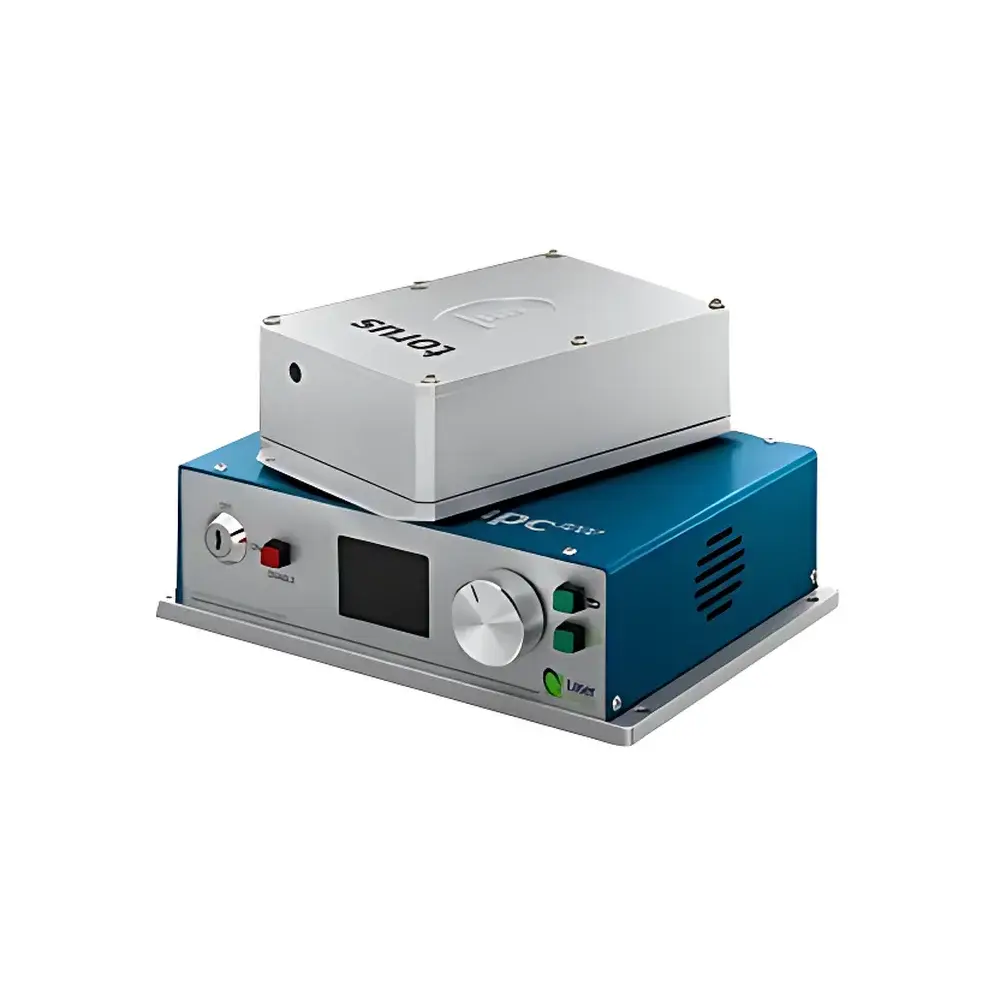
Laser Quantum Torus Series Single-Longitudinal-Mode Solid-State Laser
| Brand | Laser Quantum |
|---|---|
| Origin | United Kingdom |
| Model | Torus532 / Torus660 |
| Wavelength | 532 nm / 660 nm |
| Output Power | 50–750 mW (Torus532) / 50–200 mW (Torus660) |
| Beam Diameter | 1.7 mm ± 0.2 mm |
| Spatial Mode | TEM₀₀ |
| Beam Ellipticity | <1_1.1 |
| Spectral Linewidth | <1 MHz |
| Beam Divergence | ≤0.4 mrad |
| M² Factor | <1.1 |
| Power Stability | <1.0% RMS |
| Intensity Noise | <0.25% RMS (Torus532) / <0.5% RMS (Torus660), measured over 10 Hz–100 MHz |
| Polarization Ratio | >100:1 |
| Polarization Orientation | Vertical |
| Coherence Length | >100 m |
| Beam Pointing Stability | 1 mrad |
| Operating Temperature | 15–35 °C |
| Warm-up Time | 30 minutes |
Overview
The Laser Quantum Torus Series represents a class-leading implementation of actively stabilized single-longitudinal-mode (SLM) solid-state lasers, engineered for applications demanding ultra-narrow linewidth, exceptional amplitude and frequency stability, and long coherence length. Unlike passively stabilized or free-running SLM lasers, the Torus employs a proprietary active longitudinal mode locking mechanism that continuously monitors the cavity resonance position in real time and dynamically adjusts the optical path length via precision piezoelectric transduction. This closed-loop control maintains the lasing wavelength within ±5 pm across its full operating temperature range (15–35 °C), effectively eliminating mode hops — a critical failure mode in high-sensitivity interferometric and spectroscopic systems. The Torus532 and Torus660 variants operate at 532 nm and 660 nm respectively, both delivering diffraction-limited TEM₀₀ output with M² 100 m coherence length make it suitable for demanding coherent optical metrology where phase integrity over extended optical paths is non-negotiable.
Key Features
- Actively stabilized single-longitudinal-mode operation with real-time cavity-length correction to suppress mode hopping
- Spectral linewidth <1 MHz (FWHM), enabling high-resolution spectroscopy and low-phase-noise interferometry
- Amplitude noise <0.25% RMS (Torus532) and <0.5% RMS (Torus660) over 10 Hz–100 MHz bandwidth
- Power stability <1.0% RMS over 8-hour continuous operation under controlled ambient conditions
- Vertical linear polarization with extinction ratio >100:1, compatible with standard polarization-sensitive optics
- TEM₀₀ spatial profile with M² < 1.1 and beam ellipticity <1:1.1, ensuring optimal coupling into single-mode fibers and high-NA objectives
- Integrated thermal management and low-vibration mechanical architecture for laboratory-grade reproducibility
Sample Compatibility & Compliance
The Torus Series is designed for integration into regulated and research-grade optical platforms requiring traceable performance and operational reliability. While not certified as medical or industrial safety devices per se, it conforms to IEC 60825-1:2014 Class 3B laser safety standards when operated within specified power limits. Its low drift characteristics and deterministic warm-up behavior (30-minute stabilization period) support compliance with GLP and ISO/IEC 17025 requirements for calibration-critical measurement chains. The laser’s passive thermal design and absence of external water cooling simplify integration into cleanroom-compatible setups and reduce risk of condensation-related failure — a key consideration for long-duration Raman or Brillouin experiments. No regulatory documentation (e.g., FDA 21 CFR Part 11) applies directly to the laser source itself; however, its deterministic digital control interface and stable analog monitoring outputs facilitate audit-ready data logging when embedded in validated analytical instruments.
Software & Data Management
The Torus operates via a dedicated USB-C interface supporting both analog monitor outputs (photodiode signal, temperature feedback, interlock status) and digital command protocol (SCPI-compliant ASCII over virtual COM port). Laser Quantum provides the Torus Control Suite — a cross-platform application (Windows/macOS/Linux) enabling remote power modulation, temperature setpoint adjustment, diagnostic logging, and real-time noise spectrum visualization (via optional FFT module). All configuration parameters and operational logs are timestamped and exportable in CSV format. For integration into automated workflows, the SDK includes C/C++, Python, and LabVIEW drivers with full error-handling and state-query functionality. The system supports hardware-triggered emission gating with <1 µs rise/fall time, allowing synchronization with pulsed detectors or lock-in amplifiers without external delay units.
Applications
- Raman spectroscopy: Enables high signal-to-noise ratio acquisition in confocal and micro-Raman systems, particularly for low-concentration analytes and weak vibrational modes requiring long integration times
- Holography: Supports stable off-axis and digital holographic interferometry with minimal fringe degradation over exposure durations exceeding several seconds
- Brillouin scattering: Provides the narrow linewidth and long coherence length essential for resolving GHz-scale acoustic phonon shifts in transparent media
- Optical coherence tomography (OCT): Serves as a swept-source seed or reference arm source in high-resolution time-domain and Fourier-domain OCT platforms
- Atom trapping and cooling: Compatible with Doppler cooling configurations requiring stable, low-noise visible-wavelength excitation at 532 nm or 660 nm
- Interferometric metrology: Used in gravitational wave detector prototype systems, displacement sensors, and nanoscale surface profiling where sub-wavelength phase stability is required
FAQ
What distinguishes the Torus from other SLM lasers on the market?
The Torus is the only commercially available SLM laser employing real-time active longitudinal mode tracking and cavity-length correction — a technology that eliminates mode hops across its entire operating temperature range.
Is the Torus compatible with fiber coupling?
Yes — its TEM₀₀ output, low M² (90% coupling efficiency into standard SMF-28 fiber using off-the-shelf collimators and focusing optics.
Does the Torus require water cooling?
No — it uses conductive and convective air cooling only, making it suitable for vibration-sensitive environments and portable instrumentation platforms.
Can output power be modulated externally?
Yes — analog modulation input (0–5 V) allows direct TTL- or function-generator-driven intensity control with bandwidth up to 100 kHz.
How is long-term wavelength stability verified?
Each unit undergoes 72-hour thermal soak testing at 25 °C ± 0.1 °C, with wavelength drift monitored via a calibrated high-finesse scanning Fabry–Pérot interferometer; typical drift is <2 pm over 24 hours post-warm-up.



