
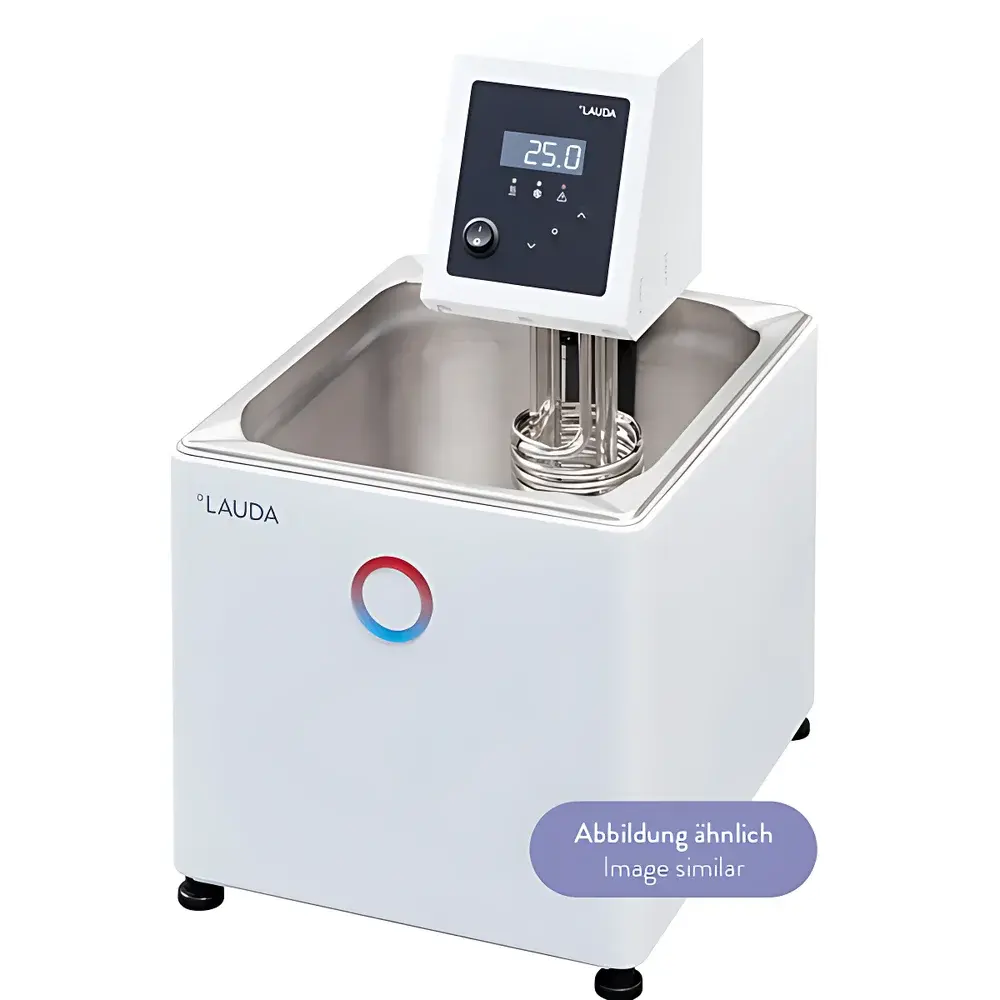
LAUDA Alpha A 6 Heated Circulating Bath (25–100 °C, ±0.05 °C Stability)
| Brand | LAUDA |
|---|---|
| Origin | Shanghai, China |
| Model | A 6 |
| Temperature Range | 25–100 °C |
| Temperature Stability | ±0.05 °C |
| Bath Volume | 5.5 L |
| Heating Power | 1.5 kW |
| Dimensions (W×D×H) | 181×332×370 mm |
| Bath Internal Dimensions | 145×161×150 mm |
| Pump Flow Rate | 15 L/min @ 0.2 bar |
| Weight | 7 kg |
| Power Supply | 220 V/60 Hz or 230 V/50 Hz |
Overview
The LAUDA Alpha A 6 is a compact, high-stability heated circulating bath engineered for precise temperature control in laboratory applications requiring thermal uniformity and operational reliability between 25 °C and 100 °C. Unlike general-purpose water baths, the Alpha A 6 employs a fully electronic PID controller with continuous regulation—ensuring minimal thermal drift and rapid recovery after load changes. Its stainless-steel pressed bath vessel provides corrosion resistance and long-term dimensional stability, while the integrated circulation pump supports both internal bath homogenization and external temperature control via recirculation loops. Designed for use exclusively with non-flammable heat transfer fluids (e.g., water, water-glycol mixtures), the system complies with IEC 61010-1 safety requirements for laboratory equipment and incorporates dual independent safety layers: low-level detection and overtemperature cutoff—both triggering audible and visual alarms. The device operates without refrigeration, making it suitable for ambient-limited environments where cooling capacity is unnecessary.
Key Features
- Fully electronic PID temperature controller with three-button intuitive navigation and large-format LED display—showing either setpoint or actual bath temperature in real time
- Stainless-steel pressed bath (145 × 161 × 150 mm internal) with optimized thermal mass and uniform wall thickness for consistent heat distribution
- Integrated circulation pump delivering up to 15 L/min at 0.2 bar pressure, equipped with flow-reduction logic to maintain stable head under variable backpressure
- Mechanically robust threaded mounting clamp compatible with bath walls up to 30 mm thick—enabling flexible integration into custom or third-party vessels
- Dual safety architecture: independent low-fluid-level sensor and redundant overtemperature cutoff, both activating simultaneous acoustic and optical alerts
- Programmable timer function allowing automatic shutdown after user-defined duration—supporting unattended operation in routine QC workflows
- Universal power input (220 V/60 Hz or 230 V/50 Hz) with CEE7/7 plug; no external voltage conversion required
Sample Compatibility & Compliance
The LAUDA Alpha A 6 is validated for use with aqueous and glycol-based heat transfer media only—strictly excluding flammable or volatile solvents per its safety certification scope. It meets EN 61010-1:2010 (IEC 61010-1) for electrical safety in laboratory environments and conforms to RoHS 2011/65/EU directives. While not inherently GLP/GMP-certified, its deterministic control logic, alarm logging capability (via optional external data acquisition), and traceable thermal performance make it suitable for regulated environments when deployed within documented SOPs. The ±0.05 °C temperature stability specification is verified under ISO 17025-accredited conditions using NIST-traceable Pt100 reference probes and is repeatable across the full 25–100 °C operating range at ambient conditions of 5–40 °C.
Software & Data Management
The Alpha A 6 operates as a standalone analog-digital hybrid instrument with no embedded firmware update capability or USB/Ethernet interface. Temperature setpoints, timer values, and alarm thresholds are configured directly via front-panel controls. For integration into centralized lab data systems, analog output (0–10 V or 4–20 mA) is available via optional signal adapter modules (sold separately). When paired with third-party DAQ hardware and compliant software (e.g., LabVIEW, MATLAB, or ELN platforms), users can record time-stamped temperature traces, alarm events, and pump status—enabling audit-ready documentation aligned with FDA 21 CFR Part 11 requirements if combined with appropriate electronic signature and audit trail configurations.
Applications
- Temperature conditioning of samples prior to HPLC, GC, or spectrophotometric analysis
- Controlled incubation of enzyme assays, immunoassays, and serological reagents in clinical and pharmaceutical QC labs
- Thermal equilibration of viscometers, density meters, and refractometers requiring stable thermal environments
- Material testing setups—including polymer melt indexers, thermal expansion fixtures, and adhesion test rigs
- Calibration baths for contact thermometers (e.g., RTDs, thermistors) in metrology laboratories
- Supporting external jacketed reactors or condensers via recirculation mode in synthetic chemistry workflows
FAQ
Is the LAUDA Alpha A 6 suitable for use with organic solvents such as ethanol or acetone?
No. The unit is certified exclusively for non-flammable heat transfer media—including deionized water, water-glycol mixtures, and silicone oils rated for >100 °C. Flammable liquids invalidate safety certifications and void warranty.
Can the bath be operated in external circulation mode only—without filling the internal tank?
No. The internal bath must always be filled to the minimum level mark (2.5 L) to ensure proper pump priming, thermal sensor immersion, and overtemperature protection functionality.
Does the device support RS232 or Ethernet communication for remote monitoring?
Not natively. Communication requires optional analog signal adapters and external DAQ hardware. No built-in digital protocol stack is included.
What is the maximum allowable ambient temperature for continuous operation?
40 °C, as specified in IEC 60068-2-1 and verified during type testing. Operation above this threshold may compromise thermal stability and shorten heater service life.
Is calibration certificate included with shipment?
A factory verification report (not ISO/IEC 17025 calibration certificate) is provided. Third-party accredited calibration must be arranged separately by the end user.



