
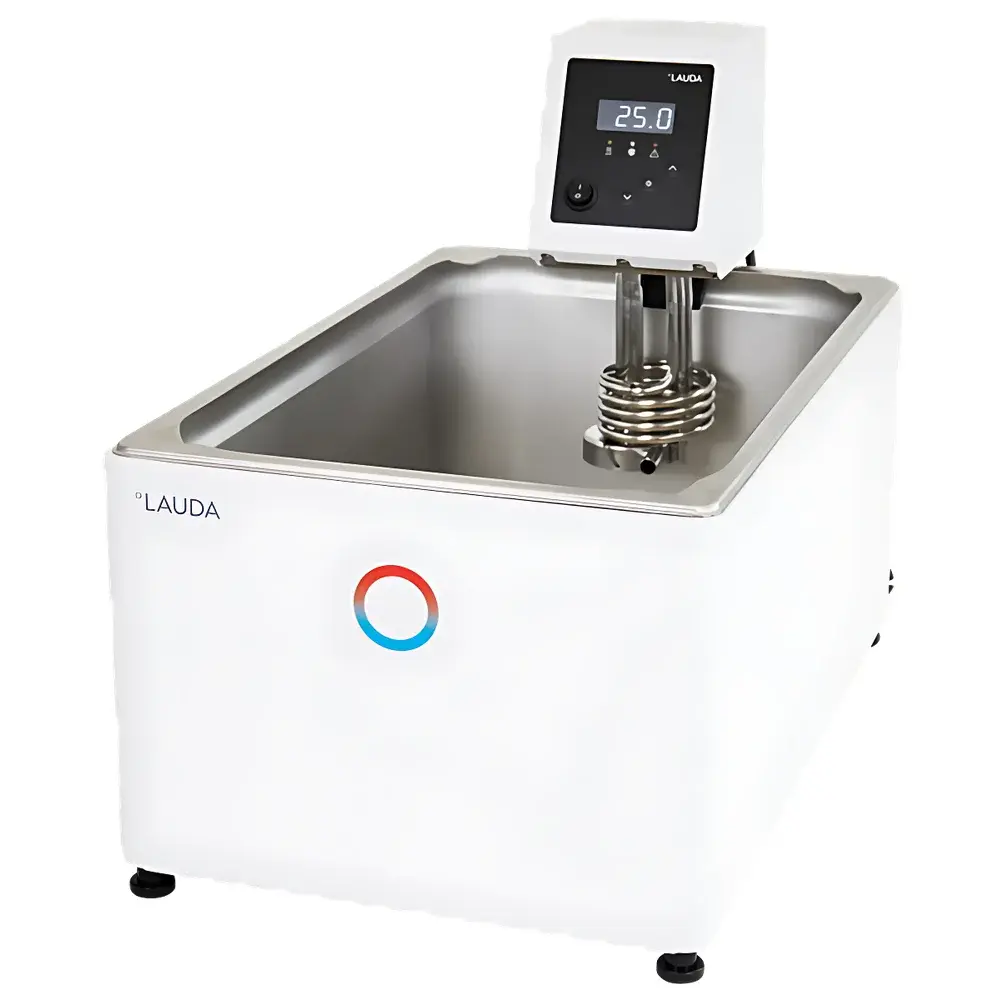
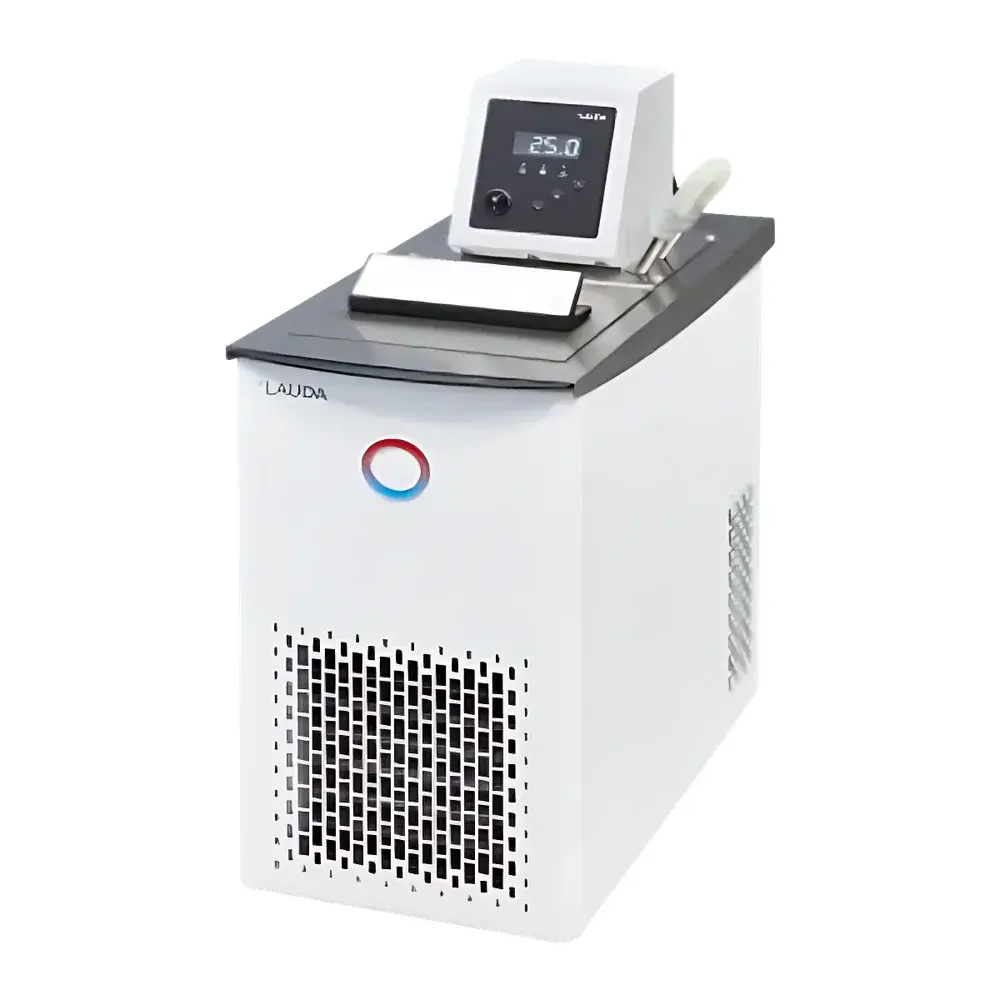
LAUDA Alpha Series Heating & Cooling Circulating Bath
| Brand | LAUDA |
|---|---|
| Origin | Germany |
| Model Variants | A6, A12, A24, RA8, RA12, RA24 |
| Temperature Range | −25 °C to +100 °C |
| Temperature Stability | ±0.05 K |
| Bath Volume | 22 L (RA-series) / 14.5–25 L (A-series) |
| Heating Power | 1.5 kW |
| Refrigeration Type | Compressor-based |
| Circulation | Internal & External |
| Fluid Compatibility | Water, Water/Glycol Mixtures (Non-Flammable Only) |
| Pump Max Flow | 5.5–25 L/min |
| Pump Max Pressure | 0.215 bar |
| Bath Opening Dimensions | 145×161 mm to 350×277 mm |
| Bath Depth | 150–200 mm |
| Construction | Stainless Steel Bath Vessel with Rear Drain Valve |
| Standard Accessories (RA models) | Insulated Bath Lid, Integrated Pump Coupling Kit |
| Control Logic | Adaptive Compressor Cycling for Extended Service Life and Energy Efficiency |
Overview
The LAUDA Alpha Series Heating & Cooling Circulating Baths are precision-engineered temperature control systems designed for demanding laboratory applications requiring stable, reproducible thermal environments across a wide operational range. Based on closed-loop liquid circulation thermoregulation, the Alpha series employs a dual-mode refrigeration-heating architecture—integrating a high-efficiency scroll compressor with an electric heating element—to achieve seamless temperature transitions from −25 °C to +100 °C. Unlike passive water baths or single-function heaters, these units maintain setpoint accuracy via PID-controlled feedback loops monitoring both bath fluid temperature and external loop return conditions. The system’s thermal stability of ±0.05 K (measured at sensor location under steady-state conditions per DIN 12876-1) ensures suitability for calorimetric measurements, viscometry calibration, spectrophotometer cell temperature control, and reaction kinetics studies where thermal drift directly impacts data fidelity.
Key Features
- Stainless steel bath vessel with rear-mounted drain valve for safe, residue-free fluid exchange and maintenance compliance.
- Adaptive compressor modulation logic minimizes on/off cycling, extending service life and reducing energy consumption by up to 22% versus fixed-speed alternatives (based on IEC 60034-30-1 efficiency benchmarks).
- Integrated dual-circulation capability: internal recirculation for bath homogeneity; external loop support (via optional pump coupling kit) for jacketed reactors, condensers, or analytical instrumentation.
- RA-series models include factory-installed insulated bath lids and pre-configured pump interface hardware—reducing setup time and minimizing evaporative loss during low-temperature operation.
- Front-panel digital interface with real-time display of setpoint, actual bath temperature, external loop inlet/outlet temperatures (when equipped), and system status codes compliant with EN 61000-6-2 EMC standards.
- Overtemperature and dry-run protection circuits meet IEC 61010-1 safety requirements for laboratory equipment.
Sample Compatibility & Compliance
The Alpha series is validated for use with non-flammable heat transfer media only—including deionized water, aqueous glycol solutions (up to 50% v/v), and specialized silicone oils rated for the full −25 °C to +100 °C range. It complies with ISO/IEC 17025:2017 clause 6.4.3 regarding environmental condition control in accredited testing laboratories. All RA models conform to DIN 12876-1 Class III specifications for refrigerated circulating baths used in analytical chemistry workflows. Units bear CE marking under the EU Machinery Directive 2006/42/EC and Low Voltage Directive 2014/35/EU. Optional traceable calibration certificates (NIST-traceable Pt100 sensor) are available for GLP/GMP-regulated environments requiring documented metrological traceability.
Software & Data Management
While the Alpha series operates as a standalone instrument, optional RS232/RS485 interfaces enable integration into centralized lab management systems. Communication protocols adhere to Modbus RTU standard (slave ID configurable), supporting remote setpoint adjustment, real-time temperature logging, and alarm event reporting. When connected to LAUDA’s optional LabView-compatible drivers or third-party SCADA platforms (e.g., Ignition, WinCC), the device supports 21 CFR Part 11-compliant audit trails—including user login timestamps, parameter change history, and system fault logs—when deployed within FDA-regulated quality control laboratories. Data export formats include CSV and XML for downstream statistical process control (SPC) analysis.
Applications
- Calibration of temperature-sensitive analytical instruments (e.g., HPLC column ovens, FTIR sample compartments, DSC reference cells).
- Thermal conditioning of reaction mixtures in glass-jacketed reactors (compatible with DIEHM and ChemGlass vessels via external loop connection).
- Stabilization of optical benches and laser diode mounts requiring sub-0.1 K thermal uniformity.
- Controlled-rate cooling/heating for polymer crystallization studies and phase transition characterization (aligned with ASTM D3418 and ISO 11357 methodologies).
- Support of accelerated stability testing per ICH Q1A(R3) guidelines when integrated into environmental chambers with auxiliary humidity control.
FAQ
What heat transfer fluids are approved for use with the Alpha series?
Only non-flammable liquids meeting DIN 51502 classification HLP or ISO 6743-4 HVLP specifications are permitted—primarily water, water/propylene glycol (≤50%), or certified silicone oils rated for continuous operation between −25 °C and +100 °C.
Can the Alpha bath be used for external cooling of an HPLC column oven?
Yes—when configured with the external circulation kit (part no. 900-001-000), it delivers stable flow rates of 9.5–22 L/min at ≤0.215 bar pressure, sufficient for maintaining ±0.1 °C column temperature control across typical analytical flow paths.
Is the temperature stability specification valid for both internal and external loop operation?
The ±0.05 K stability applies to the bath fluid under internal circulation. With external load, stability depends on loop volume, insulation, and thermal mass; typical deviation remains within ±0.15 K for well-designed jacketed systems up to 5 L total loop volume.
Does LAUDA provide IQ/OQ documentation for GMP installations?
Yes—validated installation qualification (IQ) and operational qualification (OQ) protocols are available upon request, aligned with Annex 15 of the EU GMP Guide and ASTM E2500-07 principles for laboratory equipment qualification.
How often does the compressor oil require replacement?
Under normal laboratory usage (≤8 hrs/day, ambient ≤25 °C), LAUDA recommends compressor oil inspection every 24 months; replacement is required only if moisture ingress or viscosity degradation is confirmed via onsite oil analysis (ASTM D92/D97).



