
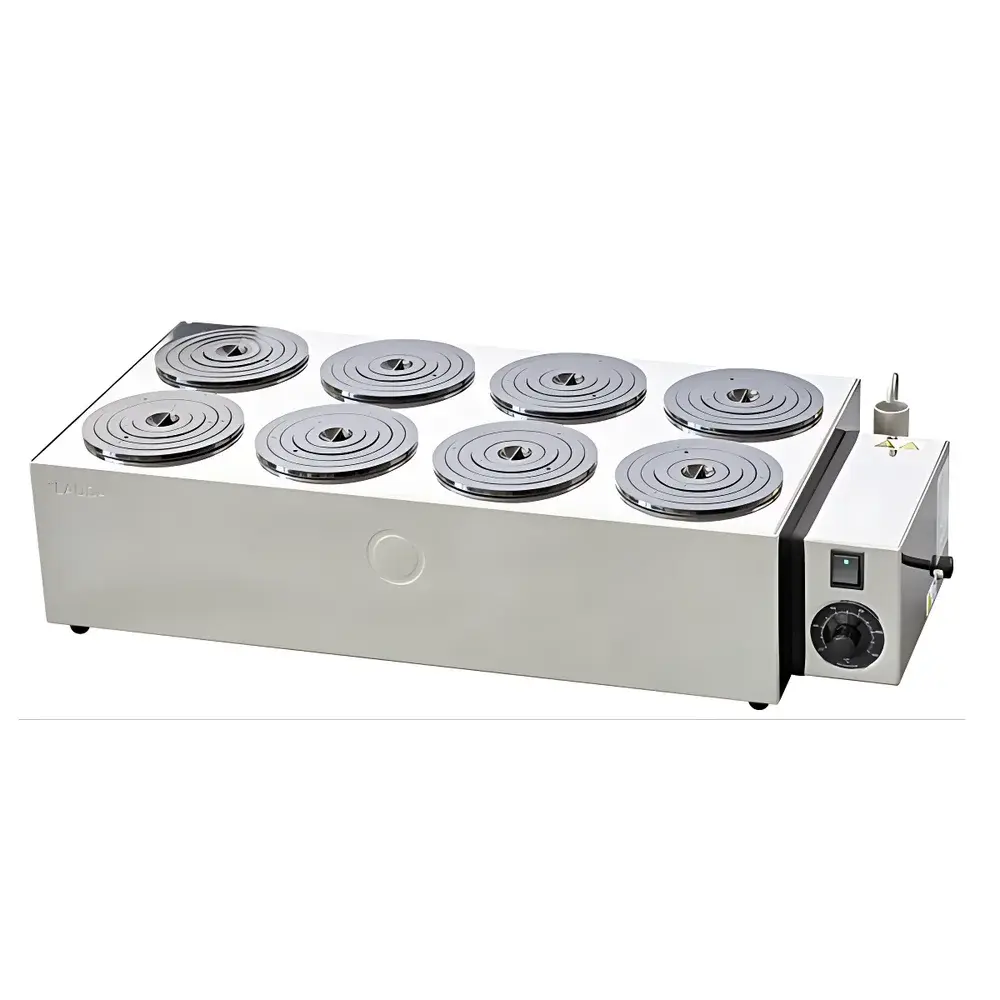
LAUDA Hydro H 19 V Stainless Steel Evaporation Water Bath
| Brand | LAUDA |
|---|---|
| Origin | Germany |
| Model | H 19 V |
| Temperature Range | 25–100 °C |
| Temperature Stability | ±3 °C |
| Bath Volume | 18.4 L |
| Heating Power | 1.5 kW |
| Dimensions (W×D×H) | 690×300×155 mm |
| Bath Opening Diameter | 111 mm |
| Bath Usable Depth | 100 mm |
| Number of Bath Openings | 8 |
| Weight | 8 kg |
| Power Supply | 230 V, 50/60 Hz |
| Material | Full Stainless Steel Construction |
| Safety Features | Low-Level Liquid Protection, Removable Heat-Resistant Plastic Ring Covers, Perforated Stainless Steel Bottom Screen |
Overview
The LAUDA Hydro H 19 V Stainless Steel Evaporation Water Bath is an engineered solution for controlled, low-temperature solvent removal in analytical, pharmaceutical, and synthetic chemistry laboratories. Designed around the principle of conductive heat transfer via a thermostatically regulated water medium, it enables gentle evaporation of heat-sensitive compounds—such as APIs, natural product extracts, or organometallic intermediates—without thermal degradation. Unlike open-flame or dry-block methods, the water bath maintains uniform temperature distribution across all sample positions, minimizing localized overheating and ensuring reproducible concentration kinetics. Its full stainless steel construction—including bath chamber, bottom screen, lid inserts, and heating element housing—ensures long-term resistance to corrosion from aggressive solvents including acetone, dichloromethane, ethyl acetate, and diluted mineral acids. The unit is specifically configured for integration into fume hood environments, with compact vertical profile (155 mm height) and rear-mounted electrical connections to preserve workspace integrity.
Key Features
- Eight precisely machined, 111 mm-diameter circular bath openings—optimized for standard Erlenmeyer flasks (50–1000 mL) and beakers, with adjustable depth compatibility up to 100 mm
- Single-point analog temperature controller with calibrated dial scale (25–100 °C range), offering intuitive setpoint adjustment without software dependency
- Integrated liquid level sensor and automatic cut-off circuitry that deactivates heating when water volume falls below operational threshold—enabling unattended overnight operation
- Modular ring cover system composed of multiple interlocking polyphenylsulfone (PPSU) rings; each ring is autoclavable and rated for continuous exposure up to 130 °C
- Perforated stainless steel bottom screen (AISI 316) prevents direct contact between vessels and heating elements while facilitating even thermal convection and easy debris removal
- Front-accessible drain valve and calibrated fill-level indicator support rapid bath fluid exchange and maintenance compliance
Sample Compatibility & Compliance
The H 19 V accommodates standard laboratory glassware without adapter kits, supporting volumetric ranges from 50 mL round-bottom flasks to 1 L boiling flasks. Its corrosion-resistant architecture complies with ISO 15190:2020 (laboratory safety requirements) and meets structural criteria for Class II biological safety cabinet integration per NSF/ANSI 49. While not intrinsically rated for explosion-proof environments, its sealed heater assembly and absence of exposed ignition sources render it suitable for use with flammable solvents under appropriate ventilation (e.g., ≥150 fpm face velocity in certified fume hoods). The device does not incorporate digital data logging or audit trail functionality; therefore, it is deployed in non-GxP workflows or as a secondary concentration tool within GLP-compliant processes where manual temperature verification and logbook entry are performed.
Software & Data Management
This model operates exclusively via analog control—no embedded firmware, touchscreen interface, or connectivity options (USB, Ethernet, Bluetooth) are present. Temperature setpoints are recorded manually, and process validation relies on external calibrated thermometers (e.g., NIST-traceable Pt100 probes) placed adjacent to sample vessels. For laboratories requiring electronic recordkeeping, integration with third-party environmental monitoring systems is feasible via optional 4–20 mA analog output modules (sold separately), enabling real-time temperature trending in SCADA or LIMS platforms. No FDA 21 CFR Part 11 compliance features are included; users must implement procedural controls for data integrity if used in regulated environments.
Applications
- Routine solvent removal during flash chromatography fraction workup
- Concentration of aqueous or organic extracts prior to HPLC or GC analysis
- Gentle drying of hygroscopic salts and coordination complexes
- Preparative-scale rotary evaporation pre-concentration (used upstream of rotovaps to reduce load)
- Controlled dehydration of biopolymer solutions (e.g., chitosan, alginate) where precise thermal history affects gelation behavior
- Standardization of reference material preparation in metrology labs adhering to ISO/IEC 17025 calibration traceability protocols
FAQ
Is the H 19 V compatible with vacuum-assisted evaporation?
No—this unit lacks vacuum sealing capability or pressure-rated bath covers. It is intended for ambient-pressure evaporation only.
Can I replace the PPSU ring covers with custom-machined stainless steel inserts?
Not recommended: stainless steel inserts would significantly increase thermal mass at the opening perimeter, causing uneven surface temperatures and potential condensation issues. The supplied PPSU rings provide optimal thermal insulation and dimensional stability.
What maintenance intervals are specified for the heating element and level sensor?
LAUDA recommends visual inspection of the immersion heater sheath and level probe every 6 months; descaling with 5% citric acid solution is advised if operating with tap water above 15°dH hardness.
Does the unit include a certificate of conformance or factory calibration report?
Yes—a DIN EN ISO 9001-certified CoC is provided with each unit; however, no NIST-traceable calibration certificate is included by default. Optional calibration services with uncertainty budgets are available upon request.
Is the 3 °C temperature stability specification measured at setpoint or across the bath surface?
It reflects spatial uniformity: maximum deviation between any two points within the active bath volume at steady state, verified per ASTM E145-22 Annex A3 methodology.



