
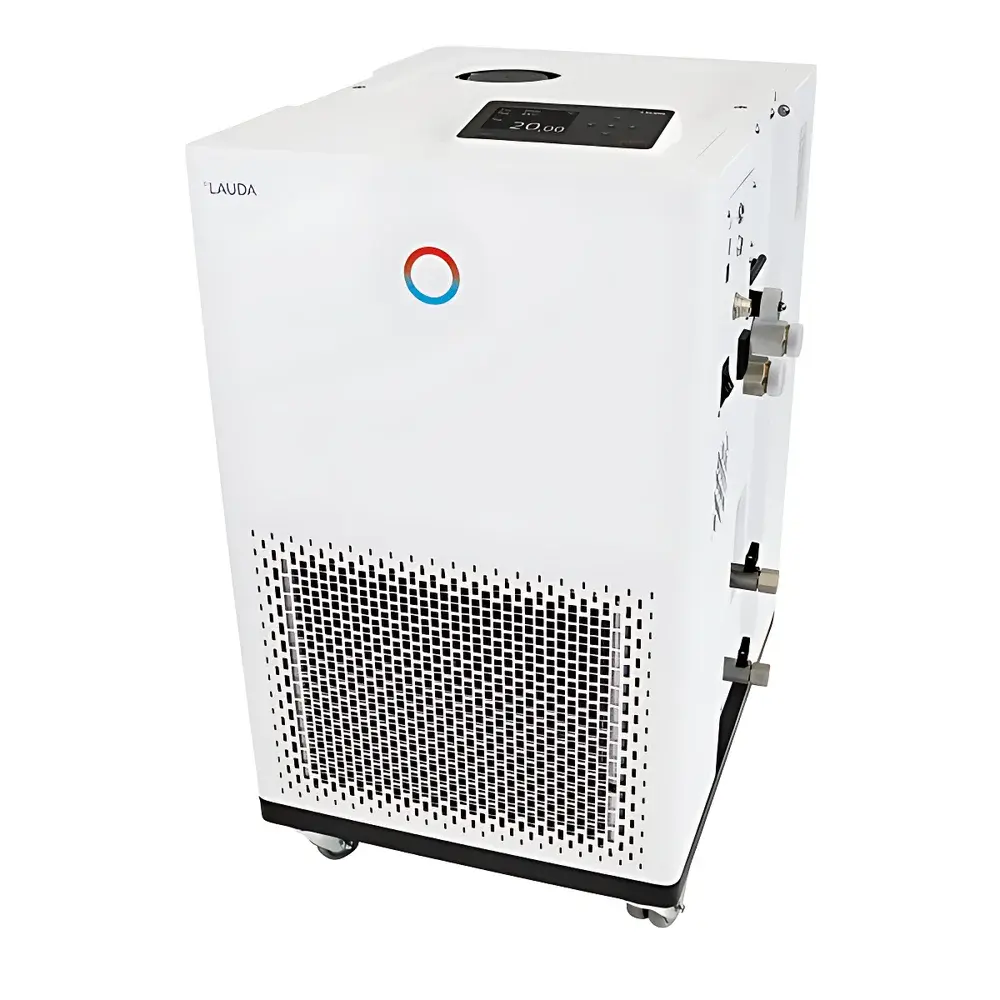
LAUDA Integral XT IN 150 XT High-Low Temperature Circulating Chiller
| Brand | LAUDA |
|---|---|
| Origin | Germany |
| Model | IN 150 XT |
| Cooling Method | Air-Cooled |
| Temperature Range | -45 to 220 °C |
| Cooling Capacity | 1.5 kW (at 20 °C, Pump Level 8) |
| Temperature Stability | ±0.05 °C |
| Pump Pressure | 3.1 bar |
| Pump Flow Rate | 65 L/min |
| Reservoir Volume | 2.5–8.7 L |
| Operating Mode | Continuous |
| Heater Power | 3.5 kW |
| Max. Power Consumption | 3.7 kW |
| Noise Level | 60 dB(A) |
| Net Weight | 103 kg |
| Dimensions (W×D×H) | 430 × 550 × 760 mm |
Overview
The LAUDA Integral XT IN 150 XT is a high-performance, air-cooled circulating chiller engineered for dynamic external temperature control across extreme thermal ranges—from cryogenic −45 °C to high-temperature 220 °C. Unlike conventional chillers limited by single-fluid operational constraints, the Integral XT employs LAUDA’s proprietary cold-oil layer flow sealing technology, enabling stable and reproducible thermal transfer using heat-transfer fluids (e.g., silicone oils, glycol/water mixtures) over its full operating span. Its architecture integrates a high-efficiency compressor system, precision PID-controlled electric heating, and an 8-stage magnetically coupled variopump—designed to maintain consistent flow and pressure even under elevated hydraulic resistance encountered in jacketed reactors, calorimeters, or custom process loops. The unit operates continuously with minimal internal fluid volume and optimized thermal mass distribution, ensuring rapid ramp rates and tight thermal stability essential for reaction calorimetry, material testing, and pharmaceutical process validation.
Key Features
- Air-cooled design with integrated refrigeration circuit—no external cooling water required
- Full-color TFT display showing real-time temperature curve, setpoint/actual values, and pump status
- Intuitive text-based menu navigation supporting six languages: English, German, French, Spanish, Italian, Russian
- SmartCool digital cooling management—intelligently cycles compressor based on thermal load to reduce energy consumption
- PowerAdapt technology dynamically adjusts heating output to match available grid capacity without compromising control fidelity
- LAUDA Variopump with eight selectable pressure/flow levels; digital pressure readout and automatic flow optimization
- Adjustable integrated bypass valve—enables independent control of internal vs. external flow paths for pressure-sensitive applications (e.g., glass reactors)
- 150-segment programmable timer (up to five independent programs), supporting complex thermal profiles for ASTM E2020 or ISO 11357 compliance
- Tmax safety override with audible alarm and automatic shutdown to prevent overheating of connected equipment
- Self-diagnostic assistant with remote fault indication—supports predictive maintenance and GLP-compliant log review
- Full electronic PID controller with auto-tuning capability for optimal response across wide temperature gradients
- Standard USB and Ethernet interfaces; optional expansion modules include RS-232/485, Profibus, analog I/O, dry contacts, or EtherCAT
Sample Compatibility & Compliance
The Integral XT IN 150 XT is compatible with a broad range of external systems requiring precise thermal regulation—including jacketed lab reactors (e.g., Chemglass, Büchi), rotary evaporators, spectroscopic cells, DSC and TGA sample stages, and pilot-scale synthesis units. Its closed-loop architecture supports both low-viscosity aqueous solutions and high-boiling-point silicone oils (e.g., DC200 series), with fluid compatibility verified per DIN 51519 and ISO 6743-12. The device meets CE marking requirements under the EU Machinery Directive 2006/42/EC and Low Voltage Directive 2014/35/EU. For regulated environments, its firmware supports audit-trail-enabled operation compliant with FDA 21 CFR Part 11 when used with validated LAUDA LabSoft software and appropriate network authentication protocols. Temperature stability of ±0.05 °C meets ISO/IEC 17025 calibration traceability requirements for accredited laboratories.
Software & Data Management
Remote monitoring and control are enabled via LAUDA’s secure web interface accessible from PCs, tablets, or smartphones within the local network. All communication uses TLS 1.2 encryption and role-based user authentication (administrator/operator/guest). The embedded web server logs timestamped temperature, pressure, flow, and alarm events with configurable retention periods. Optional integration with LAUDA LabSoft v4.x provides full data acquisition, export to CSV/PDF, trend analysis, and automated report generation aligned with GLP/GMP documentation standards. External Pt100 inputs allow for dual-sensor feedback control, while optional analog outputs support integration into PLC-based plant control systems (e.g., Siemens S7, Rockwell ControlLogix).
Applications
- Dynamic temperature control in exothermic/endothermic reaction studies (RC1e, EasyMax)
- Calibration and verification of temperature sensors and thermocouples per ISO/IEC 17025
- Thermal cycling tests for polymer characterization (DMA, DMTA)
- Stabilization of laser sources, CCD detectors, and interferometric optics
- Process development in API synthesis where strict thermal ramping profiles are mandated (ICH Q5C)
- Material testing under controlled thermal stress (ASTM D696, ISO 11359)
- Environmental simulation chambers requiring auxiliary fluid circulation
FAQ
What heat-transfer fluids are recommended for operation at −45 °C?
Low-viscosity silicone oils (e.g., LAUDA Therminol LT, Dow Corning DC-200 Fluid 0.65 cSt) or specialized low-temperature glycol blends meeting ASTM D1384 specifications are suitable. Fluid selection must account for pour point, vapor pressure, and thermal stability at target temperatures.
Can the Integral XT be integrated into a SCADA system?
Yes—via optional RS-485 Modbus RTU or EtherCAT modules, enabling bidirectional communication with industrial automation platforms under IEC 61131-3 standards.
Is the device suitable for use in explosion-hazard areas?
No—the IN 150 XT is not ATEX- or IECEx-certified. For Zone 1/2 environments, consult LAUDA’s Ex-series chillers with intrinsically safe components.
How is temperature uniformity maintained during rapid ramping?
The combination of low internal volume, cold-oil layer sealing, and adaptive PID tuning minimizes thermal lag and overshoot. Internal flow redistribution via the bypass valve further enhances transient response without compromising system pressure integrity.
Does the unit support 21 CFR Part 11 compliance out-of-the-box?
Hardware-level security features (user roles, encrypted logs, electronic signatures) are built-in; full Part 11 compliance requires validated LabSoft configuration, documented SOPs, and periodic system audits per ALCOA+ principles.



