
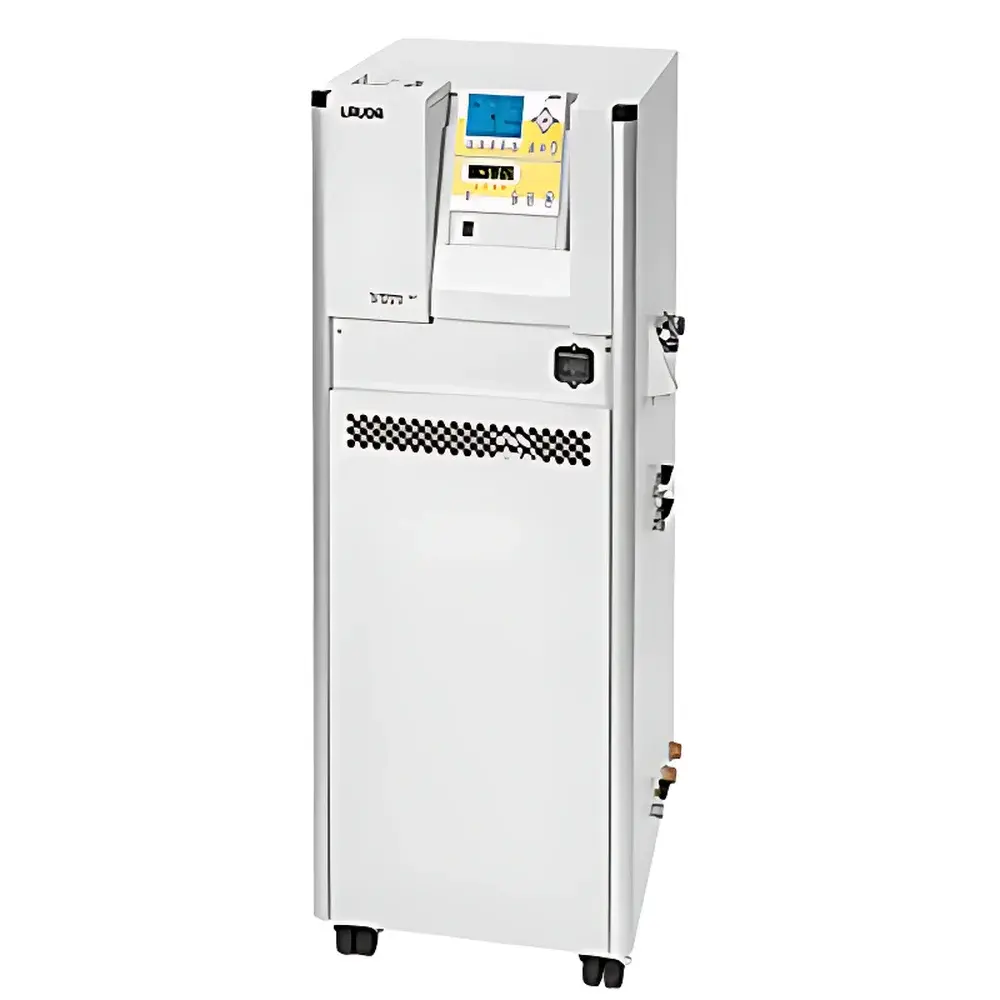
LAUDA Integral XT Process Temperature Control System
| Brand | LAUDA |
|---|---|
| Origin | Germany |
| Model | Integral XT |
| Type | Circulating Bath Chiller/Heater |
| Temperature Range | −50 °C to +300 °C |
| Temperature Stability | ±0.05 °C (typical) |
| Heating Power | up to 10.4 kW |
| Cooling Capacity at 20 °C | up to 18.5 kW |
| Pump Flow Rate | up to 90 L/min |
| Max. Pump Pressure | 5.8 bar |
| Reservoir Volume | 5.5–17.4 L |
| Cooling Method | Air-cooled or Water-cooled |
| Control Interface | Graphical LCD with detachable remote controller |
| Communication | RS-232/RS-485 standard, optional Ethernet/Modbus/Profibus modules |
| Compliance | CE, UL, ATEX optional |
Overview
The LAUDA Integral XT Process Temperature Control System is a high-performance, closed-loop circulating bath chiller/heater engineered for precise, dynamic thermal management in demanding laboratory and pilot-scale process applications. Based on LAUDA’s 50+ years of expertise in industrial liquid temperature control, the Integral XT series employs advanced thermodynamic architecture—integrating high-efficiency scroll compressors, digitally regulated magnetic-coupled circulation pumps, and adaptive PID-plus feedforward control algorithms—to deliver rapid thermal response, exceptional stability, and wide operational flexibility. Unlike conventional open-bath systems, the Integral XT operates as a fully sealed, pressurized loop capable of maintaining setpoints across an industry-leading temperature span of −50 °C to +300 °C without fluid evaporation or oxidation. Its design prioritizes reproducibility under load variation—critical for jacketed reactor control, material testing rigs, calorimetry platforms, and qualification studies requiring GLP/GMP traceability.
Key Features
- Fully sealed, pressurized circulation system with inert gas compatibility and optional ATEX-certified configurations for hazardous environments
- Digitally controlled magnetic-coupled pump with 8-step adjustable flow rate (up to 90 L/min) and infinitely variable pressure regulation (max. 5.8 bar)
- Intelligent cooling management: compressor staging, hot-gas bypass, and real-time load-adaptive refrigerant control for energy-efficient operation
- Graphical LCD interface with foldable remote controller (LGD), supporting multilingual menus and intuitive programming of up to 150 temperature/time segments across five independent programs
- Integrated self-diagnostic suite (SelfCheck) providing real-time status reporting—including refrigerant pressure, pump performance, sensor integrity, and fluid level—directly on the display
- Automated fill-and-purge sequence with vacuum-assisted deaeration to eliminate air pockets and ensure consistent heat transfer
- Top-mounted recessed fill port and side-mounted drain valve for safe, spill-free maintenance; software-guided fluid handling protocols
- Two expansion slots for communication modules (e.g., Ethernet/IP, Modbus TCP, Profibus DP) and configurable I/O for integration into SCADA or LIMS environments
Sample Compatibility & Compliance
The Integral XT accommodates a broad range of heat transfer fluids—including water/glycol mixtures, silicone oils, and synthetic heat-transfer media—enabling application-specific optimization of viscosity, flash point, and thermal conductivity. All models comply with EU Machinery Directive 2006/42/EC, Low Voltage Directive 2014/35/EU, and Electromagnetic Compatibility Directive 2014/30/EU (CE-marked). Optional ATEX Zone 1/21 certification (II 2G Ex db ib IIB T4 Gb / II 2D Ex tb IIIB T135°C Db) is available for use in explosive atmospheres. For regulated industries, the system supports 21 CFR Part 11-compliant audit trails when paired with LAUDA’s optional LabSoft software, fulfilling FDA requirements for electronic records and signatures in pharmaceutical development and QC labs.
Software & Data Management
Standard RS-232 and RS-485 interfaces enable direct connection to PCs or PLCs. Optional communication modules allow seamless integration with LabSoft, DeltaV, or Siemens PCS7 environments. LabSoft v5.x provides full remote monitoring, automated calibration logging, deviation alerting, and PDF report generation compliant with ISO/IEC 17025 and ASTM E2911. All temperature profiles, alarm histories, and maintenance logs are time-stamped and user-authenticated. The system stores ≥10,000 data points internally and supports scheduled export via USB or network share—ensuring full data integrity for internal audits and regulatory submissions.
Applications
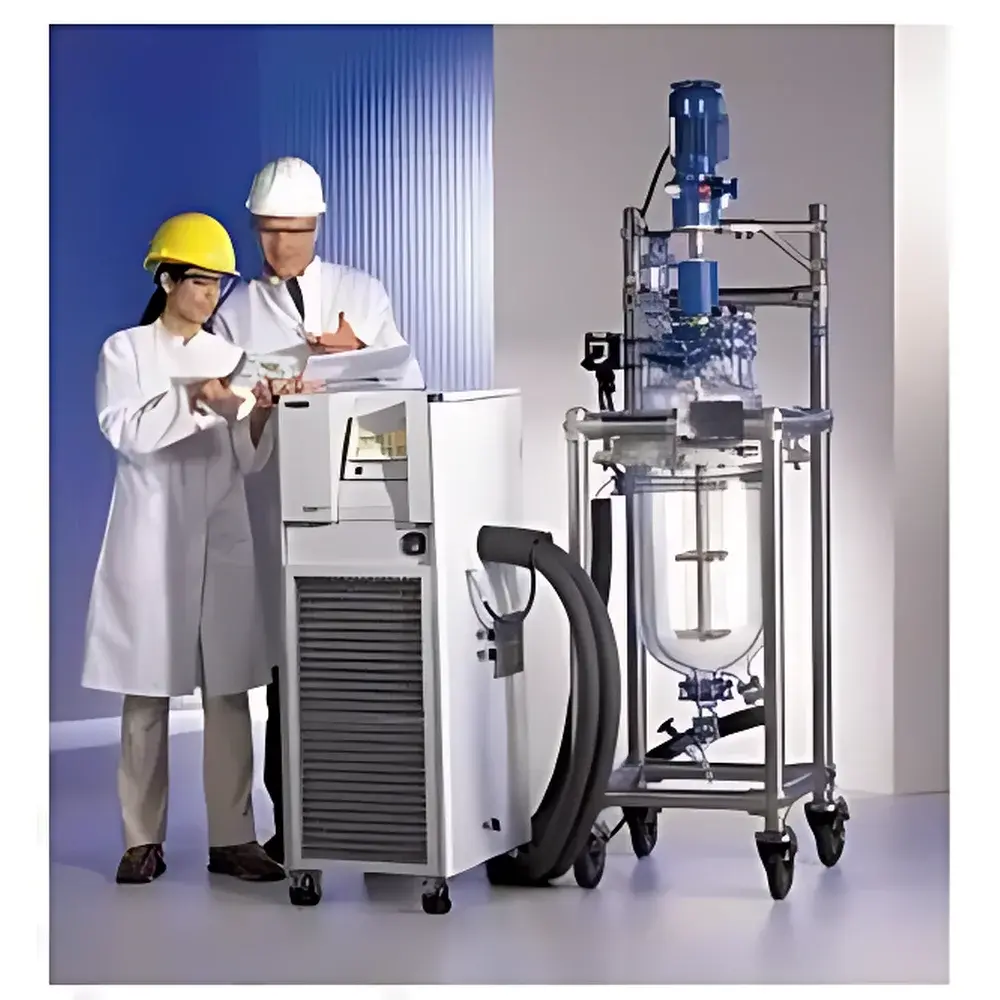
- Precise jacket temperature control for glass-lined or stainless-steel reactors in API synthesis, polymerization, and bioreactor validation
- Thermal conditioning of test specimens in mechanical testing (e.g., tensile, impact, creep) per ASTM D638, ISO 527, or EN 10002
- Stabilization of optical benches, laser sources, and interferometric setups requiring sub-0.1 °C drift over 24 h
- Calibration of temperature sensors (RTDs, thermocouples) and secondary standards in metrology labs per ISO/IEC 17025
- Accelerated aging studies of battery electrolytes, adhesives, and composite resins under controlled thermal cycling
- Support of HPLC column ovens, viscometers, and differential scanning calorimeters (DSC) requiring stable external fluid loops
FAQ
What temperature accuracy can be expected during dynamic load changes?
Under typical process loads (e.g., 5 kW thermal step), Integral XT systems maintain ±0.05 °C stability within 60 seconds—verified per DIN 12876-1 using calibrated Pt100 reference probes.
Is remote firmware update supported?
Yes—via secure HTTPS upload through the integrated web server (optional Ethernet module); updates preserve all user configurations and audit trail history.
Can the system operate with silicone oil at 280 °C continuously?
XT 350 HW and XT 750 H models are rated for continuous operation up to 300 °C with high-thermal-stability silicone oils meeting DIN 51524 Part 2 specifications.
How is pump cavitation prevented during low-temperature operation?
The system monitors inlet pressure and fluid viscosity in real time; flow rate is automatically reduced below −30 °C to maintain NPSH margin, and pre-heating sequences are enforced before startup.
Are validation documents (IQ/OQ/PQ protocols) available?
LAUDA provides customizable GxP-compliant validation templates, including traceable calibration certificates for all embedded sensors and factory test reports per VDI/VDE 2655.



