
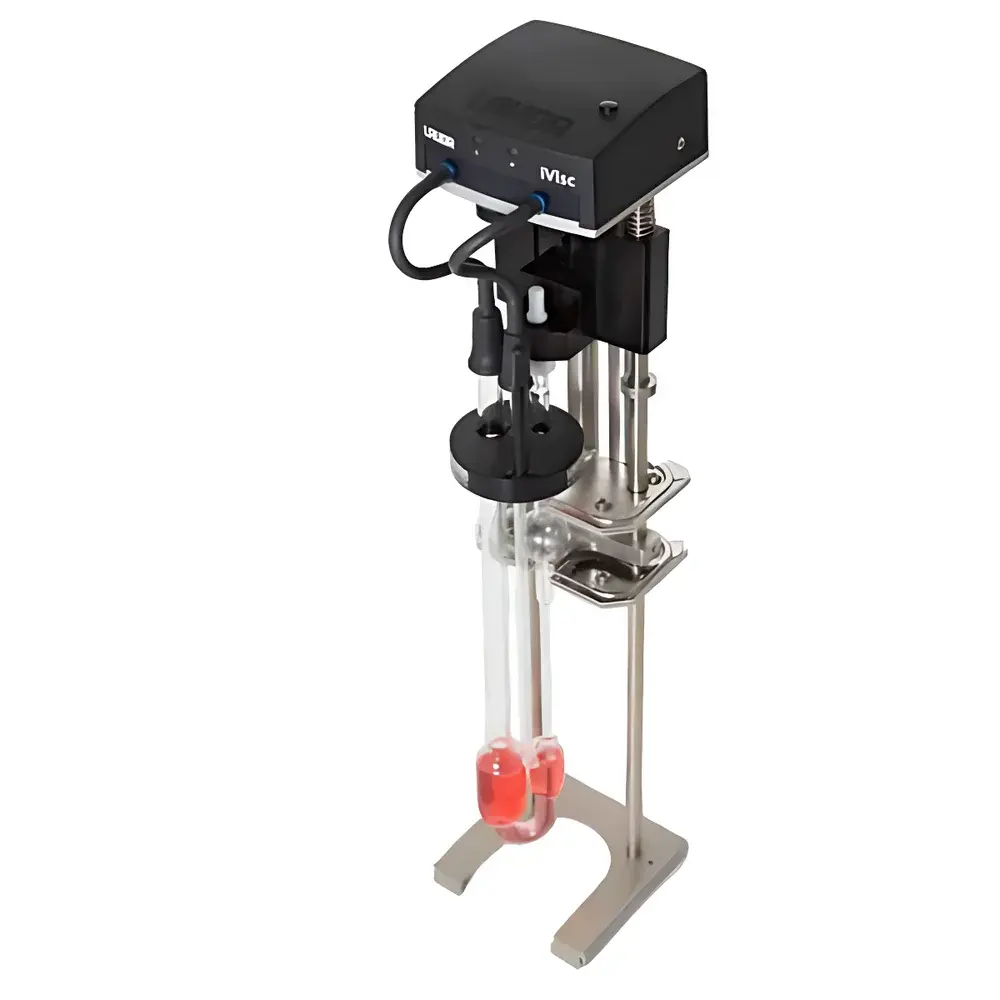
LAUDA iVisc (LMV 830) Smart Capillary Viscometer Stand
| Brand | LAUDA |
|---|---|
| Origin | Germany |
| Model | iVisc (LMV 830) |
| Temperature Range | −20 to 150 °C |
| Viscosity Range | 0.3 to 30,000 mm²/s |
| Timing Resolution | 10 ms |
| Detection Method | Optical (Near-Infrared) |
| Power Consumption | 1 W (USB-powered) |
| Dimensions (W × D × H) | 95 × 96 × 425 mm |
| Net Weight | 1.4 kg |
| Operating System Compatibility | Windows 7–11 |
| Max. Simultaneous Units per PC | 2 |
| Recommended Flow Time | 30–1000 s |
| Sample Temperature Accuracy | ±0.01 °C (when used with LAUDA thermostats) |
Overview
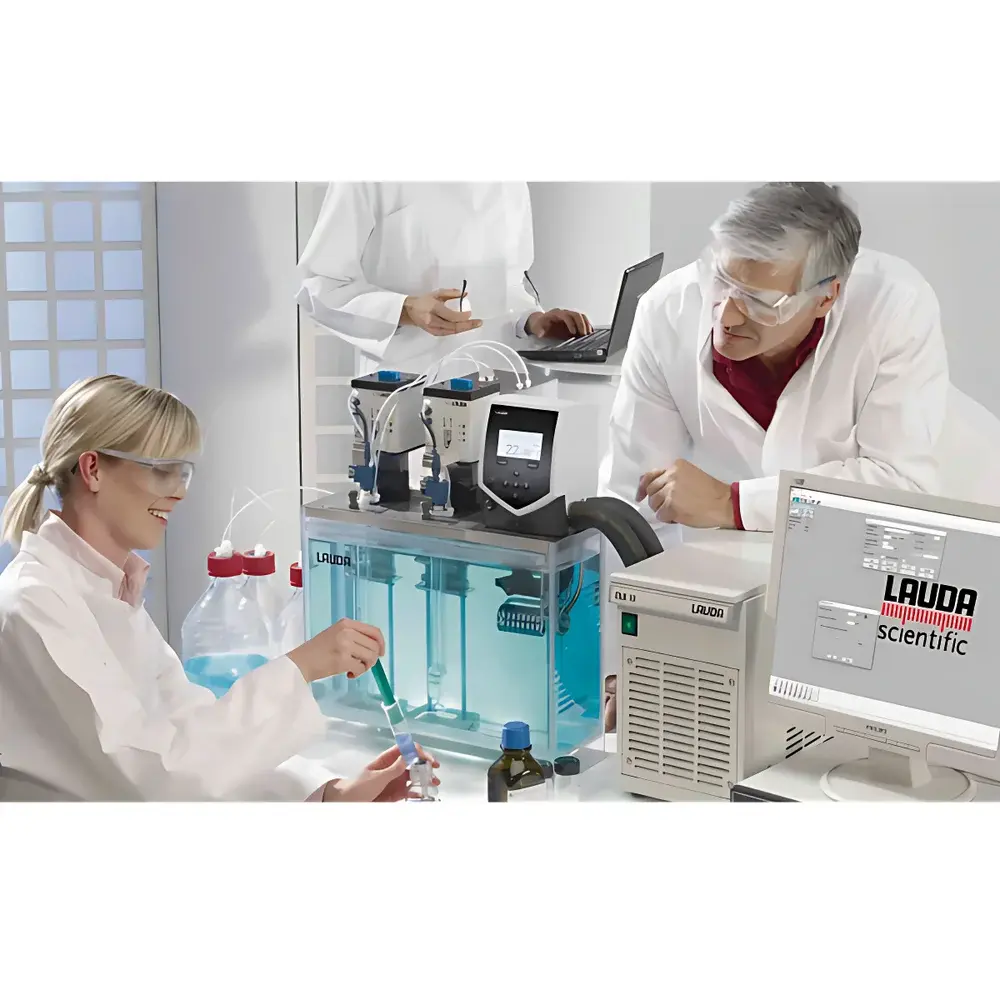
The LAUDA iVisc (LMV 830) Smart Capillary Viscometer Stand is an engineered precision platform designed for automated kinematic viscosity measurements in accordance with ASTM D445, ISO 3104, ISO 12185, and IP 71 standards. It functions as a fully integrated mechanical and optical interface between standard glass capillary viscometers—such as Ubbelohde, Cannon-Fenske, Micro-Ostwald, and Ostwald types—and LAUDA precision temperature-controlled bath systems (e.g., ET 15 S, Viscocool 6, Viscotemp 18). Unlike manual setups requiring stopwatch timing and visual detection, the iVisc employs near-infrared optical sensors to detect meniscus passage with 10 ms temporal resolution, eliminating observer bias and ensuring high reproducibility across repeated determinations. Its USB-powered architecture (1 W nominal draw) enables plug-and-play operation without external power supplies or signal conditioners, making it suitable for benchtop deployment in QC laboratories, R&D facilities, and regulatory-compliant environments operating under GLP or GMP frameworks.
Key Features
- Optical meniscus detection via near-infrared photodiodes—no physical contact with sample or capillary, minimizing contamination risk and enabling precise start/stop timing at defined calibration marks
- Compact footprint (95 × 96 × 425 mm) with vertical orientation optimized for space-constrained labs; includes integrated LED status indicators for real-time operational feedback
- USB 2.0 interface supporting up to two iVisc units per host PC; compatible with Windows 7 through Windows 11 (64-bit)
- Automated sequence control: software initiates aspiration, thermal equilibration, flow timing, and post-measurement cleaning cycles without manual intervention
- Thermal stability support: operates reliably within ambient conditions of 10–45 °C while maintaining compatibility with LAUDA baths spanning −20 to 150 °C
- Modular accessory ecosystem—including UG 003 (Ubbelohde frame), UG 094 (Micro-Ostwald frame), EZ 054 (dual-leg stand), HKB 532 (Micro-Ubbelohde adapter), and EGVZ001 Visco.Fix rotary station—for standardized handling of diverse capillary geometries
Sample Compatibility & Compliance
The iVisc supports all standard gravity-driven glass capillary viscometers conforming to ASTM D445 Annex A1–A5 and ISO 3104 Table 1 specifications. It accommodates viscosities from 0.3 mm²/s (low-viscosity hydrocarbons, solvents) to 30,000 mm²/s (heavy fuel oils, bitumens, polymer solutions), provided flow times remain within the validated 30–1000 s range. Each measurement is traceable to NIST-traceable reference oils when calibrated using certified standards. The system’s firmware and software architecture are designed to meet audit requirements under FDA 21 CFR Part 11 for electronic records and signatures, including secure user authentication, immutable audit trails, and version-controlled method storage. All hardware components comply with CE, RoHS, and IEC 61000-6-3 electromagnetic compatibility directives.
Software & Data Management
The included iVisc Measurement Software provides a validated, intuitive interface for method configuration, real-time monitoring, and automated calculation. It implements industry-standard kinematic viscosity formulas—including the Cannon–Fenske correction for efflux time, temperature-dependent density compensation, and shear-rate-independent reporting per ISO 3104 Annex B. The software maintains an embedded database of over 200 preloaded capillary viscometer geometries (including calibration constants, capillary dimensions, and immersion depth requirements), enabling automatic parameter selection upon instrument ID recognition. Raw timing data, sensor signals, thermostat setpoints, and environmental logs are stored in structured .csv and .xml formats. Export options include direct Excel integration, PDF report generation with digital signature fields, and LIMS-compatible HL7 or ASTM E1384 output schemas. Audit trail functionality records every user action, parameter change, and calibration event with timestamp, operator ID, and reason-for-change metadata.
Applications
The iVisc is routinely deployed in petroleum refining (crude assay, lubricant base stock qualification), chemical manufacturing (monomer purity verification, polymer solution characterization), pharmaceutical excipient testing (USP viscosity of injectables), and academic rheology research (Newtonian fluid benchmarking, temperature-dependent viscosity modeling). Its ability to operate across −20 to 150 °C enables low-temperature pour point correlation studies and high-temperature thermal stability assessments. In regulated settings, its deterministic optical detection and software-enforced procedural compliance reduce variability in batch release testing for fuels, transformer oils, and biopharmaceutical formulations.
FAQ
Does the iVisc include a glass capillary viscometer?
No. Capillary viscometers must be purchased separately and selected based on the target viscosity range and applicable standard (e.g., ASTM D445 Type I–IV).
Is external power required?
No. The unit draws 1 W exclusively from the host PC’s USB port.
Can the iVisc be used with non-LAUDA thermostats?
Yes—provided the bath achieves stable temperature control within ±0.01 °C and allows secure mechanical mounting of the iVisc stand.
What level of validation support is provided?
LAUDA supplies IQ/OQ documentation templates, firmware version certificates, and software validation protocols aligned with ISO/IEC 17025 and ASTM E2500.
How is capillary cleaning managed?
The system supports automated solvent rinsing via optional vacuum-assisted purge modules; physical cleaning accessories (e.g., EGVZ001 rotary station with dual-height waste cups) are available for manual post-run drying and residue removal.



