
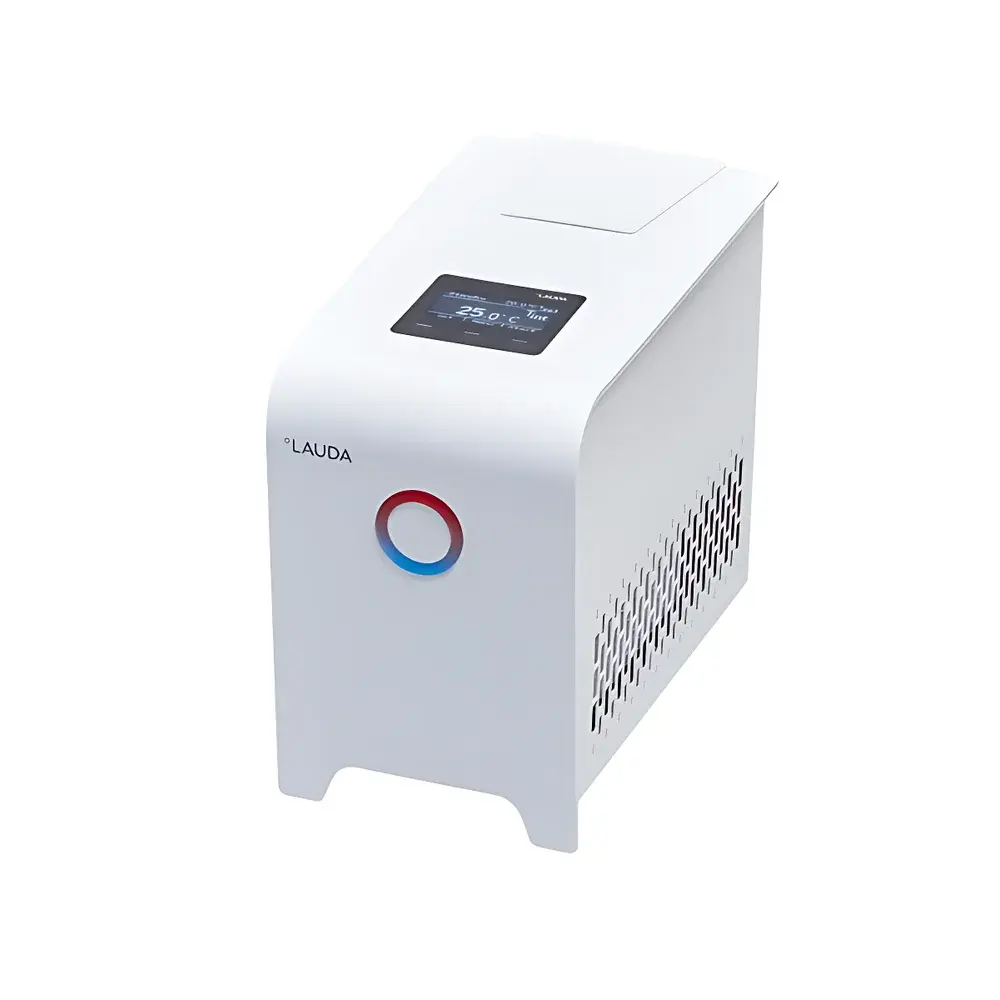
LAUDA LOOP 100 Peltier-Based External Circulating Thermostat (4–80 °C)
| Brand | LAUDA |
|---|---|
| Origin | Germany |
| Model | LOOP 100 |
| Instrument Type | Integrated Circulating Chiller |
| Cooling Method | Air-Cooled |
| Temperature Range | 4–80 °C |
| Refrigeration Capacity | 60 W (at 10 °C output) |
| Temperature Stability | ±0.1 °C |
| Circulation Pump Pressure | 0.8 bar |
| Circulation Flow Rate | 2.6 L/min |
| Bath Volume | 0.28 L |
| Operating Mode | Continuous |
| Display | High-Contrast OLED Graphic Screen |
| Interface | RS232 |
| Power Supply | 100–240 V, 50/60 Hz |
| Max. Power Consumption | 0.24 kW |
| Dimensions (W×D×H) | 175 × 301 × 266 mm |
| Net Weight | 6.5 kg |
| Noise Level | 57 dB(A) |
| Fluid Compatibility | Water, Water/Ethylene Glycol Mixtures (Non-Flammable Only) |
Overview
The LAUDA LOOP 100 is a compact, integrated external circulating thermostat engineered for precise, stable temperature control across laboratory applications requiring thermal regulation from 4 °C to 80 °C. Unlike compressor-based chillers, the LOOP 100 employs solid-state Peltier thermoelectric technology—eliminating refrigerant gases, mechanical compressors, and associated vibration or oil contamination risks. This architecture delivers inherently quiet operation (≤57 dB[A]), zero maintenance cooling cycles, and exceptional thermal stability of ±0.1 °C under steady-state conditions. Its air-cooled design ensures reliable performance without external water supply or drainage infrastructure, making it ideal for benchtop deployment in analytical labs, QC environments, and research settings where footprint, noise, and long-term operational integrity are critical constraints.
Key Features
- Peltier-based thermoelectric cooling and heating—no refrigerants, no moving parts in the cooling circuit, minimal acoustic emission and mechanical vibration
- Integrated circulation pump with adjustable flow (up to 2.6 L/min at 0.8 bar) and quick-release 1/4″ push-fit connectors for rapid system integration and fluid changeover
- High-contrast monochrome OLED graphic display with intuitive three-button navigation and context-sensitive menu structure—designed for glove-compatible operation and low-glare visibility under varied lighting
- RS232 serial interface for remote parameter setting, real-time temperature logging, and integration into automated workflows compliant with GLP/GMP data integrity requirements
- Compact footprint (175 × 301 × 266 mm) and lightweight construction (6.5 kg net) optimized for space-constrained fume hoods, instrument racks, or mobile lab configurations
- Fluid compatibility certified for aqueous and water/ethylene glycol mixtures only—ensuring chemical safety and long-term seal integrity without solvent exposure risk
- Energy-efficient operation with maximum power draw of 0.24 kW and heater capacity limited to 0.2 kW—reducing thermal load on HVAC systems and supporting sustainability goals
Sample Compatibility & Compliance
The LOOP 100 is validated for use with non-flammable heat transfer fluids only, including deionized water and aqueous ethylene glycol solutions (up to 50% v/v). It is not rated for organic solvents, oils, or flammable media. The unit complies with IEC 61010-1:2010 for electrical safety in laboratory equipment and meets EMC directive 2014/30/EU. Its sealed electronics housing carries IP20 ingress protection rating. While not intrinsically safe, its design aligns with ISO/IEC 17025:2017 recommendations for temperature-controlled ancillary devices used in accredited testing laboratories. For regulated environments, the RS232 interface supports audit-trail-capable software integration consistent with FDA 21 CFR Part 11 principles when paired with validated third-party data acquisition platforms.
Software & Data Management
The LOOP 100 operates autonomously via its embedded controller but provides full bidirectional communication over RS232. Standard ASCII command protocol enables scripting in Python, LabVIEW, or MATLAB for scheduled ramp/soak profiles, multi-step temperature sequences, and synchronized triggering with spectrophotometers, refractometers, or electrophoresis units. Logged temperature data (timestamped at 1-second intervals) can be streamed directly to CSV or exported via terminal emulation. No proprietary software is required; configuration files and firmware updates are delivered as plain-text scripts compatible with common serial terminal emulators (e.g., Tera Term, PuTTY). All parameters—including setpoint, actual bath temperature, pump status, and error codes—are accessible programmatically, facilitating traceability in ISO 17025-compliant calibration records.
Applications
- UV-Vis spectrophotometry: Precise thermal conditioning of multicell holders during DNA/RNA melting curve analysis (10–80 °C), minimizing baseline drift and improving Tm reproducibility
- Refractometry and polarimetry: Stabilization of optical path temperature at 20–25 °C to eliminate density and optical rotation artifacts caused by ambient fluctuations
- Small-scale bioreactors (≤2 L working volume): Maintaining culture temperature between 15–70 °C for microbial or mammalian cell growth studies without introducing compressor-induced vibration
- Western blotting workflows: Cold-stage incubation of SDS-PAGE gels or transfer membranes at 4–7 °C to suppress protease activity and preserve epitope integrity
- Capillary electrophoresis and X-ray source cooling: Providing consistent 20–30 °C coolant supply to minimize thermal lensing effects and detector noise
- LED light source thermal management: Active stabilization of high-intensity illumination modules to prevent wavelength shift and output degradation over extended duty cycles
FAQ
Does the LOOP 100 require regular refrigerant servicing or oil changes?
No. As a Peltier-based system, it contains no refrigerant circuit, compressor, or lubricated components—resulting in zero scheduled maintenance for cooling functionality.
Can the LOOP 100 be used with ethanol or acetone-based baths?
No. Only water and water/ethylene glycol mixtures are approved. Organic solvents may degrade seals, compromise electrical insulation, and void warranty coverage.
What is the minimum ambient temperature for continuous operation?
The unit is rated for ambient conditions between 5 °C and 40 °C. Operation below 5 °C may impair condensation management and reduce thermal efficiency.
Is the RS232 interface optically isolated?
No. The RS232 port uses standard voltage-level signaling (±3 to ±15 V) and requires proper grounding in shared instrumentation racks to avoid ground-loop interference.
How does the LOOP 100 achieve ±0.1 °C stability without a recirculating chiller’s larger thermal mass?
Through high-gain digital PID control of both Peltier elements and pump flow, coupled with low-thermal-mass bath geometry and real-time feedback from a calibrated Pt100 sensor immersed directly in the circulation path.



