
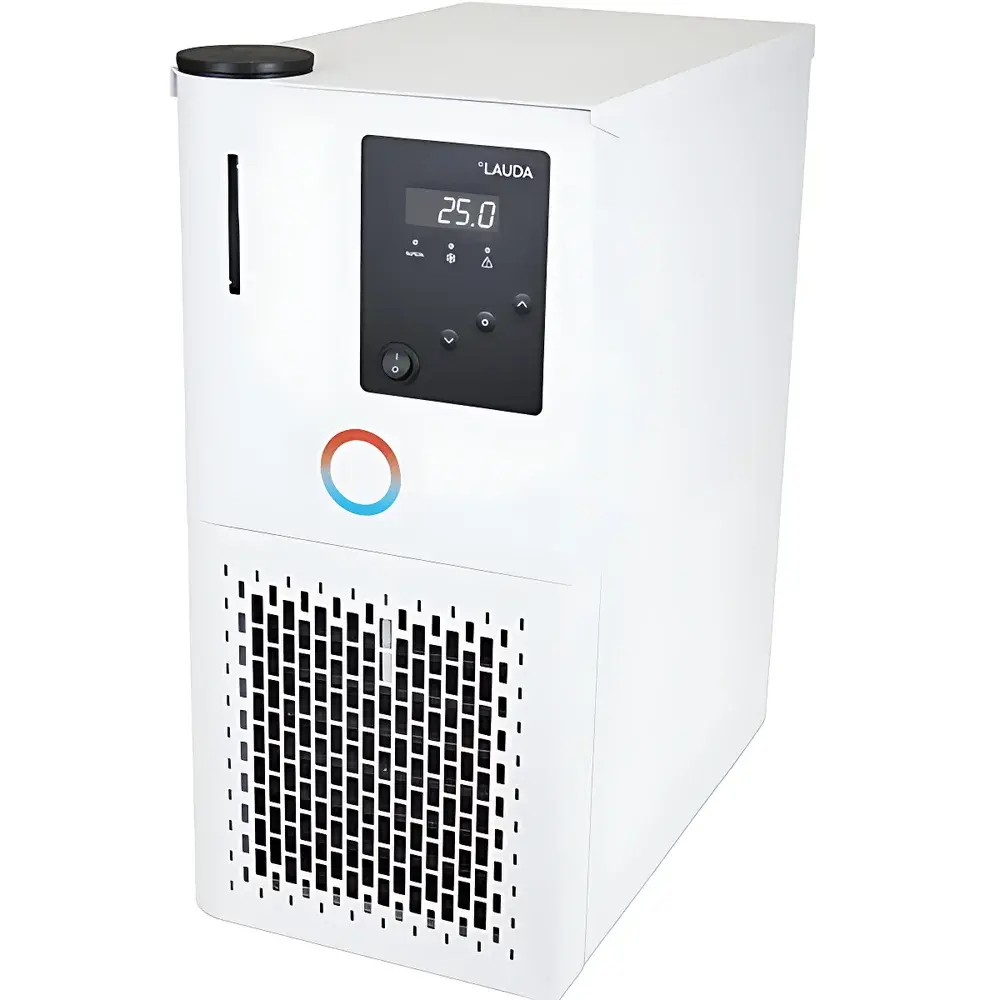
LAUDA Microcool MC 350 Circulating Chiller
| Brand | LAUDA |
|---|---|
| Origin | Germany |
| Model | MC 350 |
| Cooling Method | Air-Cooled |
| Temperature Range | −10 to 40 °C |
| Cooling Capacity | 0.35 kW (at 20 °C with ethanol) |
| Temperature Stability | ±0.5 K |
| Pump Pressure | up to 0.35 bar |
| Pump Flow Rate | 16 L/min |
| Reservoir Volume | 4.0–7.0 L |
| Power Supply | 230 V, 50 Hz |
| Refrigerant | R-134a (0.095 kg) |
| Noise Level | 60 dB(A) |
| Dimensions (W×D×H) | 240 × 400 × 500 mm |
| Weight | 34 kg |
Overview
The LAUDA Microcool MC 350 is a compact, air-cooled circulating chiller engineered for precise temperature control in laboratory environments where space, reliability, and thermal stability are critical. Designed around a closed-loop refrigeration cycle using R-134a refrigerant, the MC 350 delivers consistent cooling performance across a wide operational range of −10 °C to +40 °C. Its thermodynamic architecture integrates a hermetically sealed, magnetically coupled centrifugal pump—eliminating mechanical shaft seals and preventing fluid leakage—a key requirement for long-term unattended operation in analytical and synthesis applications. The unit operates continuously under ambient conditions from 5 °C to 40 °C, making it suitable for integration into temperature-sensitive workflows including rotary evaporation, distillation, HPLC column cooling, laser source stabilization, and calorimetric instrumentation. With a maximum cooling capacity of 0.35 kW at 20 °C (using ethanol/water mixtures), the MC 350 maintains thermal setpoints within ±0.5 K, supporting reproducible experimental outcomes compliant with GLP and ISO/IEC 17025 frameworks.
Key Features
- Magnetically coupled centrifugal pump with electronic motor drive—no dynamic seals, zero risk of coolant leakage
- Compact footprint (240 × 400 × 500 mm) optimized for benchtop placement beside rotovaps, spectrometers, or reaction blocks
- Illuminated transparent level window with integrated LED backlight for real-time reservoir monitoring
- Full electronic controller with three-button navigation, backlit LCD display showing both setpoint and actual temperature
- Comprehensive safety system: low-level alarm, pump overtemperature protection, automatic shutdown on fault detection
- RS-232 serial interface for remote monitoring and integration into lab automation systems (e.g., SCADA, LIMS)
- Proportional electromagnetic valve control of refrigerant flow and compressor staging for fine-grained cooling power modulation
- Top-fill port and rear-mounted inlet/outlet connections (M10 external thread) enabling rapid system integration without reconfiguration
Sample Compatibility & Compliance
The MC 350 is validated for use with non-flammable heat transfer fluids—including deionized water, aqueous glycol solutions (up to 50 vol%), and ethanol-based coolants—ensuring compatibility with standard laboratory safety protocols. Its design conforms to IEC 61000-6-3 (EMC emissions) and IEC 61000-6-2 (immunity), and meets CE marking requirements under the EU Machinery Directive 2006/42/EC and Low Voltage Directive 2014/35/EU. While not intrinsically rated for hazardous locations, its sealed pump and absence of ignition sources permit safe deployment in general-purpose chemical laboratories. All firmware logic supports audit-ready event logging (via RS-232), aligning with FDA 21 CFR Part 11 expectations for electronic records when paired with compliant data acquisition software.
Software & Data Management
Equipped with a native RS-232 interface, the MC 350 supports ASCII command protocol for bidirectional communication—enabling remote setpoint adjustment, real-time temperature readback, status interrogation (e.g., pump state, alarm flags), and error code retrieval. When integrated with LAUDA’s optional LabView-compatible drivers or third-party SCADA platforms (e.g., Ignition, WinCC), the chiller contributes timestamped thermal metadata to centralized experiment logs. Though no proprietary GUI is bundled, the device’s ASCII protocol is fully documented in the user manual (Part No. L003640), facilitating custom script development in Python, MATLAB, or LabWindows/CVI. All operational events—including start/stop cycles, temperature deviations exceeding ±1.0 K, and low-fluid alerts—are stored in volatile memory and accessible via serial query, supporting retrospective root-cause analysis during method validation.
Applications
- Temperature regulation of rotary evaporators (e.g., Büchi R-300, IKA RV 10) to maintain condenser efficiency across solvent boiling point ranges
- Cooling of HPLC and UHPLC column ovens and detector cells to minimize baseline drift and retention time variability
- Stabilization of Nd:YAG and diode lasers in spectroscopy setups requiring sub-degree thermal control
- Heat extraction from exothermic batch reactors and jacketed glass vessels during controlled synthesis
- Support of differential scanning calorimeters (DSC) and thermogravimetric analyzers (TGA) requiring stable bath temperatures
- Environmental chamber auxiliary cooling for accelerated stability testing per ICH Q1A(R2)
FAQ
What heat transfer fluids are approved for use with the MC 350?
Deionized water, 20–50% aqueous ethylene or propylene glycol solutions, and ethanol/water mixtures are permitted. Avoid chlorinated solvents, oils, or fluids with pH 9.0.
Can the MC 350 operate unattended overnight?
Yes—its continuous-duty rating, automatic low-level shutoff, and electronic fault detection enable safe 24/7 operation when installed in ventilated, non-humid environments.
Is the RS-232 interface compatible with modern USB-to-serial adapters?
Yes, provided the adapter uses FTDI or Silicon Labs chipsets and is configured for 9600 baud, 8N1, no flow control.
Does the MC 350 support external temperature feedback control?
No—it operates in internal sensor mode only; external PID loops require integration via the RS-232 interface and host-side control logic.
What maintenance intervals are recommended?
Annual visual inspection of condenser fins and reservoir cleanliness; biannual verification of refrigerant charge integrity by authorized service technicians per EN 378-2.



