
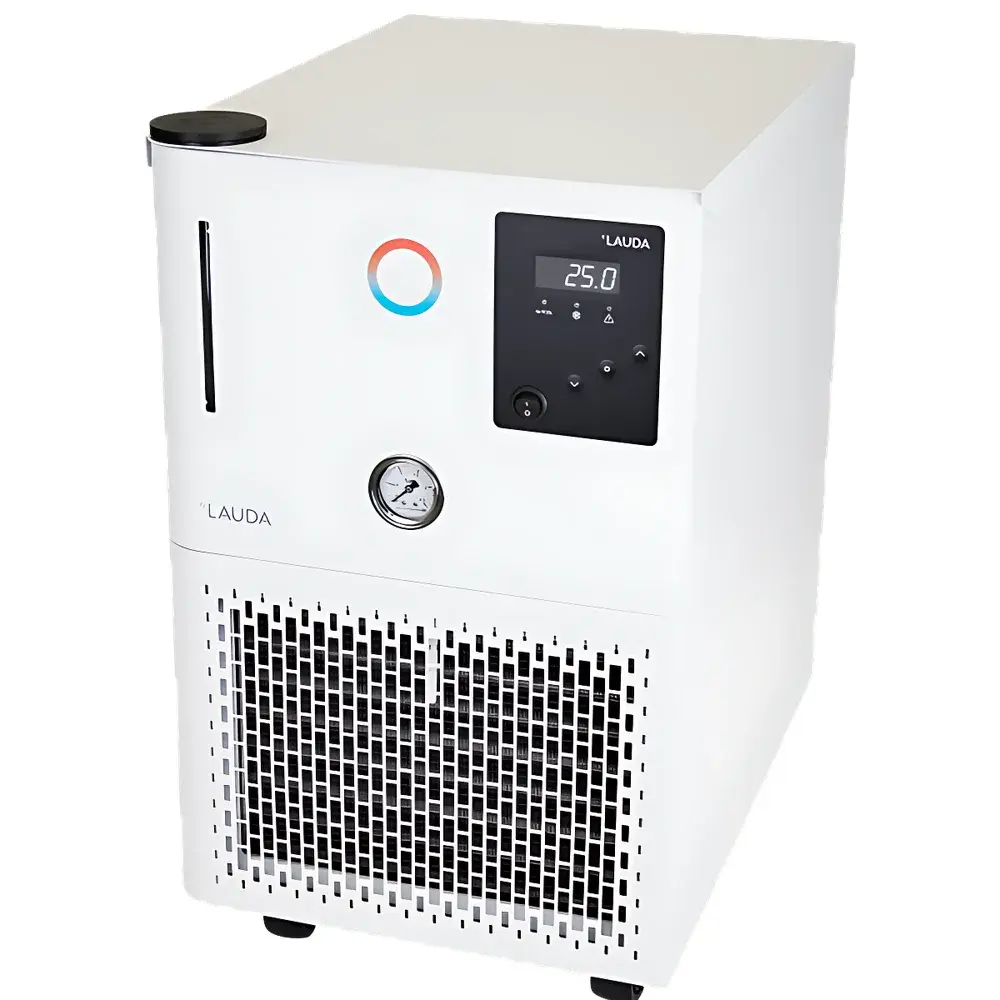
LAUDA Microcool MC 600 Circulating Chiller
| Brand | LAUDA |
|---|---|
| Origin | Germany |
| Model | MC 600 |
| Cooling Method | Air-Cooled |
| Temperature Range | −10 to 40 °C |
| Refrigeration Capacity | 0.60 kW at 20 °C (Ethanol) |
| Temperature Stability | ±0.5 °C |
| Pump Pressure | up to 1.3 bar |
| Pump Flow Rate | 35 L/min |
| Reservoir Volume | 4.0–8.0 L |
| Power Supply | 230 V, 50 Hz |
| Refrigerant | R-134a (0.295 kg) |
| Dimensions (W×D×H) | 240 × 400 × 500 mm |
| Weight | 50 kg |
| Noise Level | 57 dB(A) |
| Max. Power Consumption | 0.7 kW |
Overview
The LAUDA Microcool MC 600 is a compact, air-cooled circulating chiller engineered for precise thermal management of laboratory instruments requiring stable, continuous cooling within the range of −10 °C to +40 °C. Designed and manufactured in Germany, it employs a hermetically sealed magnetic-coupled centrifugal pump—eliminating mechanical shaft seals and preventing fluid leakage—a critical reliability feature for uninterrupted operation in analytical, spectroscopic, and materials testing environments. Its thermodynamic architecture integrates an R-134a refrigeration circuit with electronic expansion valve control, enabling dynamic modulation of refrigeration output based on real-time thermal load demands. The unit operates continuously under ambient conditions of 5–40 °C and is certified for use with non-flammable heat transfer fluids, including deionized water and aqueous ethylene glycol mixtures (up to 50 % v/v), ensuring compatibility with sensitive instrumentation such as HPLC column ovens, laser sources, ICP-MS nebulizers, and rheometers.
Key Features
- Magnetic-coupled centrifugal pump with brushless DC motor: zero maintenance, no seal wear, and full leak-tightness for long-term operational integrity
- Integrated electronic controller with three-button navigation and backlit LED display showing setpoint, actual temperature, pump status, and alarm codes
- Translucent, illuminated reservoir window with level indicator and low-level optical sensor triggering audible/visual alarms and automatic pump shutdown
- RS-232 serial interface (standard) for remote monitoring, parameter configuration, and integration into lab-wide SCADA or LIMS platforms
- Programmable timer functions: scheduled start-up and auto-shutdown to align with experimental protocols or facility energy policies
- Electronically actuated solenoid valve for stepless refrigeration capacity control, minimizing compressor cycling and extending service life
- Compact footprint (240 × 400 × 500 mm) optimized for under-bench installation or freestanding deployment—no external ventilation ducting required
Sample Compatibility & Compliance
The MC 600 is validated for use with water-based and glycol-water heat transfer fluids meeting ASTM D1122 and ISO 2160 specifications. It complies with EU Directive 2014/30/EU (EMC), 2014/35/EU (LVD), and RoHS 2011/65/EU. Its refrigerant charge (R-134a, GWP = 1430) adheres to F-Gas Regulation (EU) No. 517/2014 reporting thresholds. The unit supports GLP/GMP workflows through traceable temperature logging (via RS-232), configurable alarm history retention, and hardware-enforced safety interlocks—including overtemperature cut-off, dry-run protection, and pressure-limit shutdown. All electrical components meet IP20 ingress protection standards; the chassis is grounded per IEC 61000-6-2/6-4 for electromagnetic immunity in shared lab infrastructure.
Software & Data Management
While the MC 600 operates autonomously via its embedded firmware, its RS-232 port enables bidirectional communication using ASCII-based command protocols (e.g., “TSET?” for setpoint query, “ALM?” for active alarm status). Third-party software—including LabVIEW drivers, Python pySerial scripts, and custom MATLAB interfaces—can log temperature stability data at user-defined intervals (1–60 s resolution). Audit trails generated by connected systems may satisfy FDA 21 CFR Part 11 requirements when paired with appropriate electronic signature and data integrity controls. Firmware updates are performed offline via PC connection; no cloud dependency or internet connectivity is required.
Applications
- Stabilization of HPLC autosamplers, detectors, and column compartments across method development and QC release testing
- Cooling of high-power diode lasers and solid-state UV-Vis light sources in spectroscopy and photometry systems
- Thermal regulation of sample stages in XRD, DSC, and TGA instruments during extended thermal ramping sequences
- Heat extraction from vacuum pumps, rotary evaporators, and ultrasonic homogenizers in synthetic chemistry labs
- Support of controlled-temperature electrophoresis and PCR thermal cycler validation protocols
FAQ
What heat transfer fluids are approved for use with the MC 600?
Deionized water, 10–50 % (v/v) ethylene glycol/water solutions, and other non-flammable, non-corrosive fluids compatible with stainless steel (AISI 304) and EPDM wetted materials. Ethanol and methanol are not recommended due to material compatibility and flammability concerns.
Can the MC 600 maintain ±0.1 °C stability?
No—the specified temperature stability is ±0.5 °C under steady-state conditions with constant load and optimal fluid flow. Higher precision requires external PID controllers or recirculating chillers with dual-stage refrigeration.
Is the RS-232 interface opto-isolated?
Yes—galvanic isolation is implemented to prevent ground-loop interference in multi-instrument setups common in analytical laboratories.
Does the unit support 60 Hz power input?
No—the MC 600 is rated exclusively for 230 V, 50 Hz operation. A dedicated voltage/frequency converter is required for use in North American or Japanese facilities.
What is the minimum allowable fill volume for safe operation?
4.0 liters. Operation below this threshold triggers immediate low-level alarm and disables pump activation to prevent dry-running damage.



